
Three Writers on 2 + 2
by
Chris Harrison
*
As an interested but non-expert reader of George Orwell, I’ve always been struck by how often his work connects with other writers who wrestled with matters of freedom and truth. To me, one of the strangest links is in arithmetic. It is well known that Fyodor Dostoevsky and Orwell both refer to the equation “two plus two equals four,” but appear to draw entirely different conclusions from it. In We (1924), Yevgeny Zamyatin makes a slightly different point by presenting a utopian world-view built on arithmetic. What lessons do the similarities and differences between these perspectives have for life in 2025?
In Notes from Underground (1864), Dostoevsky’s Underground Man complains: “Twice two makes four without my will. As if free will meant that!” For him, 2+2=4 is a kind of prison, the unfeeling inevitability of rational necessity. He wants the freedom to be irrational, even self-destructive, just to prove he’s not a cog in a machine or, as he puts it, “a stop in an organ”.
In Nineteen Eighty-Four (1949), Winston holds to a different belief: “Freedom is the freedom to say that two plus two make four.” For Orwell, the equation is not a prison but the ultimate demonstration of truth. When the Party insists that 2+2=5, Winston’s resistance is simply to affirm that reality exists, even if power demands otherwise.
It’s striking that the same equation can appear to signify oppression and constraint in one book and liberation and choice in another. Somewhere between the two is Zamyatin’s We, which constructs a whole dystopia around mathematics. Citizens of Zamyatin’s OneState are identified by numbers, their lives are scheduled precisely, and their freedom is sacrificed for the “beauty” of mathematical certainty. In We, rational order based on mathematics is treated not just as fact but as belief.
So, we have three writers with a similar point of departure, but seemingly very different destinations: Dostoevsky fears the tyranny of logic, Orwell fears the tyranny of lies, and Zamyatin fears the tyranny of utopia.
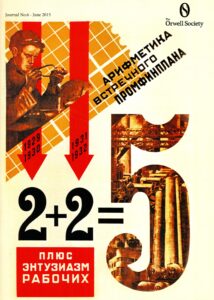
This isn’t new; scholars have been making these connections for years. For example, Adrian Wanner has argued that Dostoevsky’s suspicion of rational determinism anticipates later anti-utopian thought. Mihajlo Mihajlov demonstrates how, through OneState’s obsession with mathematics, Zamyatin connects Dostoevsky and Orwell. And I.H. Soudek contends that the different contexts explain why the same equation can symbolise either oppression or liberation.
It may not be a new observation, but it feels freshly relevant and certainly made me think again. In the modern world, algorithms predict our choices, which is Dostoevsky’s nightmare of necessity, and disinformation campaigns attempt to rewrite reality, which is Orwell’s nightmare of falsehood. We see this when our choices are predicted before we’ve even made them, and every time someone insists that facts don’t matter.
Perhaps that’s the point. Whether freedom signifies the right to be irrational, the right to defend objective truth, or the right to resist utopian arithmetic, the debate over “2+2=” remains relevant today. The paradox is that the same simple equation can mean opposite things depending on context: for Dostoevsky, it is a prison, whilst for Orwell it is a symbol of truth. We continue to argue about our own versions of 2+2 across medicine, politics, technology, and culture, sometimes fearing the tyranny of logic, sometimes fearing the tyranny of lies. That’s the paradox. And it continues to matter.
References:
Fyodor Dostoevsky, Notes from Underground, 1864
Yevgeny Zamyatin, We, 1924
George Orwell, Nineteen Eighty-Four, 1949
Adrian Wanner, ‘The Underground Man as Big Brother: Dostoevsky’s and Orwell’s Anti‑Utopia’, Comparative Literature Studies
Mihajlo Mihajlov, ‘Life = Freedom: The Symbolism of 2×2=4 in Dostoevsky, Zamyatin & Orwell’, Crisis Magazine
I. H. Soudek, ‘2+2=5: Symbol of Tyranny or Freedom’ in the Technological Society, Bulletin of Science, Technology & Society, 1989
*
Chris Harrison is a board member of three NHS Foundation Trusts and an Honorary (MAHSC) Professor in the Department of Cancer Studies at the University of Manchester. Chris is a self-taught scholar of Orwell, and former Secretary of the Orwell Society.
Indeed it does matter, Chris
Thanks
Quentin