
Victor Serge
New Light On His Letters To George Orwell
*
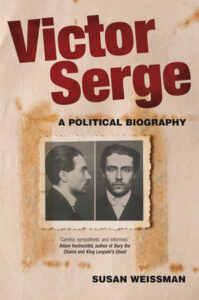
Susan Weissman’s biography of Victor Serge refers to George Orwell’s attempts to place Serge’s memoirs with a British publisher, though giving little more detail than one can gather from Orwell’s letters first published in 1968. Given the size of her biography (originally published in 2001 as Victor Serge: The Course Is Set On Hope, and then in a revised edition in 2013 as Victor Serge: A Political Biography), the elusive nature of her references to a tangential figure in Serge’s life is understandable. Much more detail has become available, though, now that Dr Anna Vaninskaya has published ‘Might-have-beens: George Orwell and Victor Serge’ in Orwell Society Journal number 17).
Dr Vaninskaya points out that while Serge and Orwell had little first-hand acquaintance, the two men had been orbiting each other since the early thirties. Serge was cited by the ILP as a proponent of their party line, while Orwell took the French newspaper La Flèche which regularly quoted Serge in defence of the POUM. Orwell, though, would have heard most about Serge from Dwight Macdonald and the magazine Politics, published in New York.
By 1945 Serge was in contact with Orwell, and Orwell in turn had passed his address on to the Secker and Warburg publishing house. Serge was in political exile in Mexico, and living on the edge of poverty. This had consequences which he indicated only indirectly: he could not afford to type a second copy of his book, and was loath to mail it at the cheapest rate lest it be lost. Equally, he was being chivvied by communists in Mexico, and feared a KGB murder squad, as had happened to Trotsky. To preserve his lines of communication he could ask his correspondents to send mail registered, and to use one of a number of a surnames (his mother’s maiden name, his birth name, his political sobriquet) on the address. Finally in May 1946 Orwell received the manuscript at his flat in London in the last days before he packed his goods and transferred his home to Jura. Rather than take the manuscript with him he passed it immediately to Fredric Warburg.
Victor Serge died in November 1947, his memoirs unpublished then, and his great novel The Case of Comrade Tulyaev also unpublished. He had alluded to its existence in one of his letters to Orwell in 1946; Orwell received the French edition in 1949, after Nineteen Eighty-Four was complete. How different would Orwell’s novel have been, wonders Dr Vaninskaya, had he read Tulyaev in 1946 as she concludes her article.
*
‘Would the Modern Quarterly, for instance, print a full history of the arrest and execution of Ehrlich and Alter, the Polish Socialist leaders? Would it reprint any extract from the Communist Party’s “stop the war” pamphlets of 1940? Would it publish articles by Anton Ciliga or Victor Serge?’
Dr Vaninskaya quotes George Orwell’s Editorial from Polemic May 1946 showing the closeness of thought of Orwell and Serge. It is now clear (though only since Professor Peter Davison’s annotations in the Complete Works) that the trials of Jones, Aaron and Rutherford in Nineteen Eighty-Four were based not just on the Moscow trials of the Old Bolsheviks but on later abuses of process under Stalin, specifically the mis-treatment in Moscow of Polish exiles Ehrlich and Alter. Fortunately for English-language readers we can see the same thoughts expressed by Victor Serge, as his Notebooks 1936-1947 were published in 2019.
Serge’s Notebook entry for March 9th, 1943, records the ‘Stalinized’ host of a social gathering saying of Ehrlich and Alter,
‘”But they were Trotskyists!” in a tone that signified it went without saying saying and that one can, on must, kill Trotskyists’.
Or take another example, Orwell said ‘One favourite way of falsifying history nowadays is to alter dates.’ He gave as an example, the French communist Maurice Thorez, who had deserted the French army during the Molotov-Ribbentrop Pact Period, and not before as his newspaper claimed, and asked,
But why the alteration of date? In order to make it appear that Thorez deserted, if he did desert, a year before the war and not after the fighting had started. This is merely one act in the general effort to whitewash the behaviour of the French and other Communists during the period of the Russo-German pact.
Serge, it seems, was even more alive to this than Orwell. For while Orwell was writing in November 1944, in May 1942 Victor Serge wrote in his notebook:-
The Nazis are in the process of destroying the cadres of the French C[ommunist] P[arty] … Stalin is keeping in reserve Thorez, Duclos … and is allowing the Nazis to rid him of the rest.
Orwell was frequently prescient in his analysis, but it seems that sometimes he was not as prescient as a figure such as Victor Serge.
Notebooks 1936-1947 is a thick book of nearly six hundred pages, with an additional fifty pages of short biographies of individuals named. Not every one mentioned, though, has an entry – Maurice Thorez, for one, and George Orwell for another. As the book does not have an index, though, one would have to read at least the last one hundred and fifty pages to see if Orwell’s name appears at all. It is clear, though, that Serge like Orwell was a man of wide interests, not just Marxist politics, and one can find discussions of subjects as wide-ranging as surrealism, Viktor Frankl and the quest for freedom and happiness, and no-holds barred wrestling.
Dr Vaninskaya has given us more reasons for reading both George Orwell and Victor Serge.
*
Bibliography: All references are hyperlinked.
Very interesting. I have been looking for Serge’s work since reading this.