
When language can no longer revolt
By
Liam McPartland
*
When George Orwell finished Nineteen Eighty-Four he gave totalitarianism its own language — Big Brother, doublethink, thoughtcrime. He was not the first to write about a closed society: Zamyatin’s We (1924) imagined a glass surveillance state that abolishes names and replaces them with numbers. Huxley’s Brave New World (1932) showed control by pleasure, conditioning and distraction. Koestler’s Darkness at Noon (1940) crafted a revolution devouring its founders, and a prisoner coerced into a false confession. Orwell read Huxley, knew Koestler, and reviewed We in 1946. Nineteen Eighty-Four became most famous not because he invented the closed society, but because he showed, more fully than the others, how a state can make thought and language corrupt each other.
Language is not static; words rot and blossom from the lexicon every year. Newspeak only subtracts, and by deleting words, it removes the ability to think clearly and even to feel honestly. Language is an instrument for conveying emotion and reason. By removing the word that describes an emotion and blurring the rationale for its existence, it suppresses honest expression. This results in words, thoughts and feelings being manufactured by central control.
Orwell was not the first to spot how thought and language shape each other. Confucius said wrong names lead to disorder. Herder and Humboldt said each language trains people to notice some things and miss others. The key insight Orwell brought as a journalist and novelist was the vicious circle of this process and its political and tyrannical use over a population.
To understand the genesis of Nineteen Eighty-Four, we can look to Homage to Catalonia and “Politics and the English Language”. In “Politics and the English Language” (1946), Orwell says:
“But if thought corrupts language, language can also corrupt thought.”
“It becomes ugly and inaccurate because our thoughts are foolish, but the slovenliness of our language makes it easier for us to have foolish thoughts. The point is that the process is reversible.”
Homage to Catalonia is a first-hand account of fighting during the Spanish Civil War in 1936. Orwell travelled to Barcelona and joined the POUM militia. Months on the Aragon front, then a bullet through the throat. Why did an Englishman fight in a Spanish civil war? His reason:
“If you had asked me why I had joined the militia, I should have answered, ‘To fight against Fascism,’ and if you had asked me what I was fighting for, I should have answered, ‘Common decency.'”
Fighting against one form of tyranny, he discovered an equal or worse form of totalitarianism. In Spain he saw a functioning workers’ state, the “working class… in the saddle”. He did not necessarily like it but understood its social significance and reasoned with himself it was worth enough to fight and even die for, as he almost did. The Communists also recognised this working-class revolt. However, it was not their version of one, so they destroyed it.
In “Looking Back on the Spanish War”, Orwell wrote, “I remember saying once to Arthur Koestler, ‘History stopped in 1936’, at which he nodded in immediate understanding. We were both thinking of totalitarianism in general, but more particularly of the Spanish Civil War.” If the Party rewrites history, did the past really happen? In Spain, he read reports of battles that never happened, and he witnessed and fought in battles that never made it into print.
In Nineteen Eighty-Four, the Ministry of Truth drives political deception and historical fabrication. If the Party controls archives of the past, who can say that an event happened at all? The clearest example is when Oceania switches enemies from Eurasia to Eastasia during Hate Week; posters are changed mid-speech, newspapers and textbooks are rewritten, and the official line becomes “Oceania has always been at war with Eastasia.” The only remnant of accurate history lies in Winston Smith’s memory, which the Party soon compromises.
Winston’s job, in fact, reinforces this deception. Working in the Records Department of the Ministry of Truth, he rewrites old newspapers, so they match the Party’s demands. The irony, of course, is that he secretly objects to the power of the state, yet helps destroy its history, thereby strengthening it.
The common view of a totalitarian state is that its leadership enforces what people think. Orwell argues this is inefficient, and he projects this view through Syme, who tells Winston about the Eleventh Edition of the Newspeak dictionary as they lunch in the Ministry canteen: orthodoxy means not thinking—not needing to think. By reducing the stock of words, it affects citizens’ ability to think, reason, and argue, rendering their thoughts fragmented and dull. Why tell people what to think when the means of rebellion can no longer be articulated? Let alone acted upon.
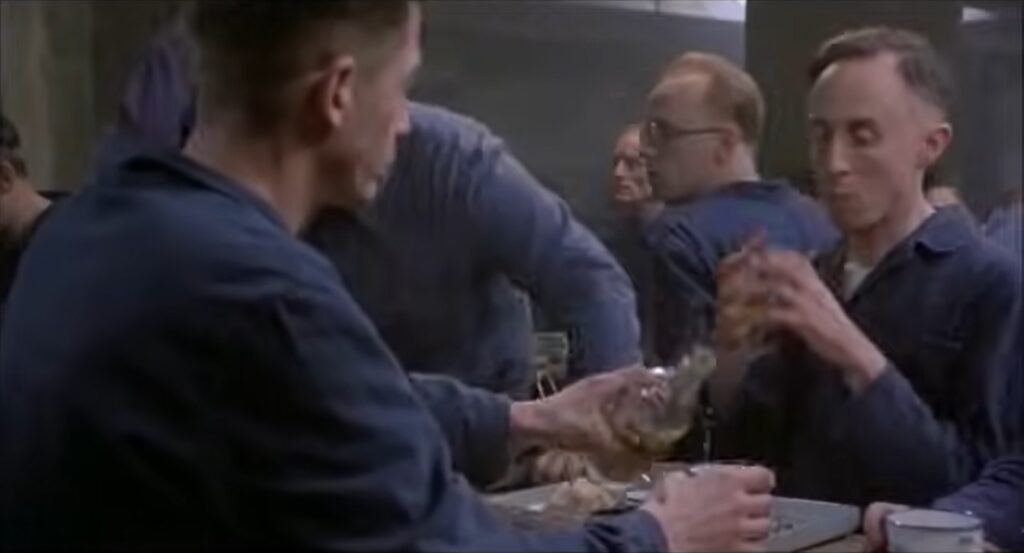
Winston and Syme at lunch in Michael Radford’s 1984 film adaptation of Nineteen Eighty-Four
Newspeak is Oceania’s official language, designed to make heresy unthinkable and then unsayable. In Newspeak, bad becomes ungood. Excellent becomes plusgood or doubleplusgood. It does this by destroying the word bad and replacing it with ungood. By removing the language of an opposing view, the ability to expose contradictions becomes harder, which in turn helps doublethink — the power to hold two contradictory beliefs in one’s mind simultaneously and accept both.
The logical conclusion to draw year by year as Newspeak removes more and more words: even the prefix inserted to mark the distinction will be removed, leaving only one word, making doublethink inescapable. Thoughtcrime is the crime of thinking something the Party forbids. If the word bad doesn’t exist, how can a citizen think forbidden thoughts, let alone object to the wrongdoings of the Party?
The Party slogan is “Who controls the past controls the future: who controls the present controls the past.” That is what he meant when he told Koestler that history stopped in 1936. If history survives through language, archives, and memories, and the Party controls all three, then where does the past exist? O’Brien makes Winston face this riddle in the Ministry of Love. All Winston has left is what he remembers. Room 101 is there to break that. When he is forced to deny what he knows, history does stop. As long as the novel remains in print and individual thought is alive, Nineteen Eighty-Four will remain a political warning, and the novel’s survival a bulwark against its content materialising.
A breathtaking and erudite observation of of a monumental problem facing society today.
Absolutely wonderful article. I learnt something new, and was completely engaged from start to finish. Nice work.
A timely article given what we are besieged by from Meta et al