
Winifred Holtby
*
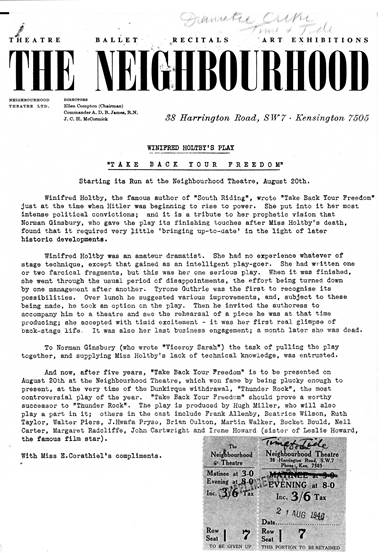
Introduction. Among the names of many once famous but now largely forgotten writers mentioned by George Orwell is that of Winifred Holtby. He reviewed her play Take Back Your Freedom in the 24 August 1940 Time and Tide. She had died in 1935, Norman Ginsbury had revised and completed the drama, the premier opening at the Neighbourhood Theatre in South Kensington. It was (Orwell wrote):
a study not so much of the way in which a successful tyranny might be established as of the way in which a thinking and sensitive man can become reconciled to tyranny.
That review was put on this website on 14 February 2021. There is no point in reproducing it in full here. In this article I look at Winifred Holtby’s short but eventful life.
Hugh Lorimer Miller, an actor, directed Take Back Your Freedom and acted a minor role in it. He was born in Berwick on Tweed in 1889; acted and directed plays and films in Britain and the USA; helped found the London Stage Society; married Olga Katzin a satirical poet alias Sagittarius in 1921; had three children; and died in 1976 aged eighty seven.
Orwell’s review concluded that:
We may hope that this play, so remarkable in its insight and potentially so valuable as propaganda, will follow its predecessor “Thunder Rock” to the West End.
Norman Ginsbury was born in Whitechapel in the East End in 1902; and was a playwright working for the stage, films and television. His 1935 play Viceroy Sarah about Queen Anne’s favourite Sarah Duchess of Marlborough ran for 157 West End performances. He translated several of Henrik Johan Ibsen’s Norwegian plays into English before he died in 1991 aged eighty eight.
Jonathan Cape had published Winifred Holtby’s Take Back your Freedom in book form in 1939, with a preface by Vera Brittain; and an introduction by (William) Tyrone Guthrie, the director of the Shakespeare Repertory Company in Stratford on Avon.
A 3rd August 1940 Swindon Advertiser review of the play Take Back Your Freedom noted that it was written five years earlier but had not found a publisher because in 1935 “Ostrichism” was in fashion and no one would put it on. By 1940 nightmares were reality and reality was a nightmare. This is still true in many countries today.
The other play mentioned by Orwell, Thunder Rock by Robert Ardrey, was a 1939 play set at Thunder Rock Lighthouse in Lake Michigan, about the folly of running away from trouble. Instead one should fight for what one believes in. It premiered at the Mansfield Theatre in New York in 1939; and in Britain at the Neighbourhood Theatre in June 1940 two days after France capitulated.
This play captured the British 1940 spirit. It transferred to the West End Globe Theatre until September 1940 when the neighbouring Queen’s Theatre was bombed; was broadcast live on BBC Radio on 15 July 1940; after the West End theatres closed due to air raids toured the provinces September-November 1940; was revived at the West End St Martin’s Theatre February-April 1941; was made into a film starring Michael Redgrave in 1942; and after the war was shown in many countries.
Family Background. Winifred Holtby was born on 23 June 1898 at Rudston, an East Riding of Yorkshire village, the younger of two daughters of David Holtby, a prosperous farmer, and Alice Holtby née Winn. David Holtby was born in 1860; married Alice Winn in 1893; had two daughters; and died in 1933 leaving £56,095 18s 5d.
Alice Holtby née Winn was born in 1859; sat on the East Riding County Council, on many committees including the East Riding War Pensions Committee; was elected the first East Riding woman Alderman in 1934; retired from public life in 1936 after her husband and their daughters had died; died at Harrogate in 1939 aged eighty; and was interred in Bridlington Priory graveyard after a well-attended funeral.
David and Alice Holtby’s older daughter Grace was born in 1896. She married a surgeon Peter Morrison Tolmie in 1923; and died in childbirth died in 1928 aged thirty two.
Early Life. Winifred Holtby was educated by a governess and at Queen Margaret’s School in Scarborough (which had been founded in 1901; evacuated to the Atholl Hotel in Pitlochry during the First World War; was later based near York; and closed in 2025).
In 1911 Alice Holtby had a volume of her thirteen year old daughter Winifred’s poems titled My Garden published. It was meant as a surprise present but Winifred saw a copy on sale in a shop which spoilt the surprise.
Winifred left school in 1916. After a year as a probationer nurse in a London Nursing Home she went to Somerville College, Oxford. In July 1918 she joined the Women’s Auxiliary Army Corps and was a hostel forewoman in France until August 1919.
In October 1919 Winifred returned to Somerville College, where she studied modern history and met Vera Mary Brittain. Winifred Holtby was tall, fair haired, confident, gregarious and even tempered. Vera Brittain was short, a brunette, pretty, shy and volatile. They became firm friends. They graduated in 1921 with second class history honours and shared a London flat.
Winifred, a lively, stylist and witty writer contributed articles and reviews to the feminist journal Time and Tide and many other journals including the then Manchester Guardian. She wrote a weekly column for the Trade Union journal The Schoolmistress.
Margaret Haig Mackworth née Thomas founded Time and Tide in 1920. Its first editor was Helen Alexander Archdale née Russell. Margaret Mackworth took over as editor in 1926 and Winifred Holtby joined its Board. It published many notable writers, finally closing in 1979. A 1984-1986 attempt to resurrect it failed.
Winifred Holtby and Vera Brittain were active in the League of Nations Union. In 1922 they toured Europe to report on conditions. They joined the Labour Party and Margaret Haig Mackworth’s Six Points Group founded in 1921.
The Six Points Group called for stricter laws on child assault; more support for widowed mothers; support for unmarried mothers and their children; equal rights of guardianship of children when marriages broke up; equal pay for teachers; and equal opportunities in the Civil Service. It later called for political, economic, occupational, moral, social and legal equality for women. Many suffragettes joined it. Many women’s and other organisations supported it. It was dissolved in 1983 due to a lack of younger supporters.
In 1923 Bodley Head published Winifred’s first novel Anderby Wold. It cost seven and six, about £40 in our terms. It was to quote the 24 April 1923 Hull Daily Mail an imaginary story of imaginary events on an imaginary farm but was based on Yorkshire farming life.
In 1924 Bodley Head published Holtby’s novel The Crowded Street. It opens with a poignant scene set around an eleven year old girl who struggles with her feelings and identity at a party. She wants to make something of herself but her Victorian mother has more conventional ideas. In 1924 most parents of eleven year olds were brought up in Victorian times.
On 27 June 1925 Vera Brittain married George Edward Gordon Catlin aged twenty nine, a First World War veteran, New College Oxford history graduate, socialist and a Professor at Cornell University in the USA. She disliked academic life and they agreed he would live at Cornell most of the year and in England in summer with her.
South Africa. Winifred toured South Africa for five months in 1926 to report for the League of Nations Union. She was appalled by conditions there, began campaigning against them and financially supported the black Trade Union movement.
Back in London. On returning to Britain Winifred lived with Vera Catlin née Brittain in London and Professor Caitlin when he was in London. Vera and John Catlin had two children – John Edward Brittain Catlin born in 1927 who died in 1987; and Shirley Vivien Teresa Brittain Catlin born in 1930. They called Winifred ‘auntie’. Professor Catlin was jealous of her.
Shirley Catlin is best known by her married name Shirley Williams. She became a Labour MP and cabinet minister, left the Labour Party for the Social Democrats, was raised to the House of Lords as Baroness Williams of Crosby, and died in 2021.
Later Writings. Jonathan Cape published Winifred’s novel The Land of Green Ginger in 1927. It was named after a Hull street but opens on a Yorkshire farm where the heroine cares for her TB-stricken husband and their two children. It ends with the heroine on a ship going to South Africa. In view of Winifred Holtby’s views on South Africa she may have intended to write a sequel.
Jonathan Cape published Poor Caroline in 1931. Its central character is a strong but over-enthusiastic woman, and it focuses on the board of directors of the fictional Christian Cinema Company. It was probably modelled on Winifred’s experiences on the board of Time and Tide.
Mandoa Mandoa! was published by Collins in 1933. It is a satirical view of a fictional African country which is visited in turn by a Hollywood film crew, a travel agency, a humanitarian group, representatives of the European great powers, and finally tourists. It focuses on the Africans struggle to understand the visitors, and how the visitors behave. Also in 1933, Lovat Dickson published her novel The Astonishing Island which satirises British life including parliament, Christmas, cricket, Bank Holidays and progressive persons. It received mixed reviews. Lovat Dickson, a publishing house founded by (Horatio Henry) Lovat Dickson in 1932, merged with Macmillan, of which he became a director, in 1938. He died in 1987 aged eighty four.
Collins published a collection of Winifred’s short stories, Truth is not Sober, in 1934, and a year later it published her poetry collection The Frozen Earth.
Non Fiction. Kegan Paul and Co. published Holtby’s A New Voter’s Guide to Party Programmes in 1929. Although many women got the vote in 1918, in 1928, the then Conservative government gave women on equal terms to men. A General Election was due in 1929 and was to lead to the Second Labour Government.
Wishart and Co. published Winifred Holtby’s Virginia Woolf: A Critical Memoir in 1932. Virginia Woolf was then alive and active and a Guardian reviewer called it a critical work of marked discernment.
Bodley Head published Holtby’s Women; and a Changing Civilisation in 1934. In it she linked the 1930’s reaction against feminism to a broader revolt against reason caused by war and depression. This brought the Nazis to power in Germany and a swing to the right in Europe. Also high unemployment made unemployed men jealous of women workers; and the man shortage after the First World War eased as children too young to fight in it came of age. Interestingly, she used the word ‘civilisation’ in her title a year before Sidney and Beatrice Webb’s controversial Soviet Communism: A New Civilisation? (1935).
The End. Winifred began suffering high blood pressure, recurrent headaches and bouts of lassitude. In 1931 she was diagnosed with nephritis, then known as Bright’s Disease i.e. Kidney disease. She died of what her death certificate called chronic interstitial nephritis on 29 September 1935, aged thirty seven, in a London nursing home. Her mother informed the authorities of her daughter’s death. A memorial service was held for her on 1 October 1935 at St Martin in the Fields in Trafalgar Square; she was buried the next day in the graveyard of Rudston’s medieval parish church, very near her birthplace.
Winifred Holtby left £24,730 17s 5d. Probate went to her mother Alice Holtby; and to Vera Catlin née Brittain. One legacy funded the first public library in the Soweto Black Township in Johannesburg in South Africa. It opened in December 1940 and was named the Winifred Holtby Memorial Library. The royalties to her books were left to Somerville College which funded a scholarship with them.
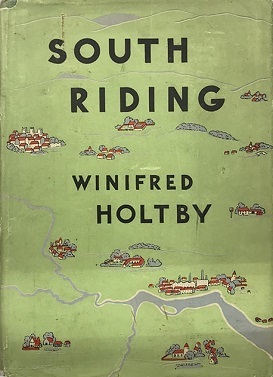
After Life. Collins published Winifred Holtby’s last novel South Riding in 1936. It looks at Yorkshire local politics. Inspired by the East Riding of Yorkshire (not the Metropolitan County of South Yorkshire which was set up in 1974) the characters include a woman alderman Mrs Beddows often thought to have been inspired by Alice Holtby, her mother. It won the 1936 James Tait Black Literary Prize. In 1938 a film version, South Riding, directed by Victor Saville appeared.
Collins published Winifred Holtby’s Letters to a Friend, a collection of her letters in 1937. The friend was Jean Fergusson McWilliam, the Commandant of the Women’s Auxiliary Army Corps Camp in France where Winifred Holtby was a hostel forewoman. Jean died in Edinburgh in 1963 aged eighty one. The letters, edited by Alice Holtby, dated between 1920 and 1935, show that Winifred Holtby loved books, music, the theatre and clothes; but that her life became dominated by an: ever accumulating series of conferences, committee meetings, councils, assemblies, lectures, interviews and social functions.
South Riding is still in print. It was adapted for Yorkshire TV in 1974 by the Yorkshire born novelist, playwright and scriptwriter Stanley Barstow who died in 2011 aged eighty three. In 1999 BBC Radio Four broadcast a version. In 2011 BBC TV broadcast a three part adaptation by Andrew Davies.
All Winifred Holtby’s novels were republished as Virago Modern Classics. In 1999 Virago published a collection of her short stories edited by Paul Berry and Marion Shaw titled Remember, Remember. To quote the 4 September 1999 Daily Telegraph:
This selection illustrates both the range and vigour of her writing and, if some of the stories with their too obvious morals now seem dated, others bristle with invention.
In 1967 the Royal Society of Literature instituted the Winifred Holtby Prize for Regional Literature. In 2003 it was incorporated into the Ondaatje Prize. Much has been published about her, including by her friend Vera Brittain who died in 1970, aged seventy six.
Conclusion. Winifred Holtby lived a short but active life in a complex time. We too live in complex times.
Leave a Reply