
The Club Men: Part II
*
Introduction. Part one of this article was about the Right Book Club. Here I look at its rival on the right, the National Book Association. In Part Three I will look at the Liberal and Peace Book Clubs.
The National Book Association was founded by Arthur Wynne Morgan Bryant in 1937, who became its Editor. The Club President was the Conservative Prime Minister Stanley Baldwin, a steel manufacturer’s son. The club’s publisher, Walter Victor Hutchinson, owned and ran the Hutchinson Publishing Company. His father Sir George Hutchinson had founded it in 1887 which by 1937 was a conglomerate with many imprints.
Arthur Bryant was born on 18 February 1899 on the royal Sandringham estate in Norfolk. His father Sir Francis Morgan Bryant was the Chief Clerk to the Prince of Wales (Edward VII). Arthur Bryant studied at Harrow and in 1916 won a History Exhibition to Pembroke College, Cambridge. In 1917 he became a Royal Flying Corps pilot. He was in the first squadron to bomb the Rhineland in 1917.
In January 1919 Bryant entered Queen’s College, Oxford, and in 1920 he graduated with a distinction in the shortened veteran’s Modern History Course. He briefly taught at a London council school. He was then called to the bar but in 1923 he was appointed Principal of the Cambridge School of Arts, Crafts and Technology. In 1924 he married Sylvia Mary Shakerley the daughter of Sir Walter Shakerley, a baronet, of Somerford Park, Cheshire. The marriage was childless.
Arthur Bryant was appointed a lecturer in the Oxford University Extra Mural Studies Department in 1925. In 1929 he was appointed Educational Adviser to the Conservative Ashridge Training College in Hertfordshire. That year his first book the traditionalist Spirit of Conservatism was published. He helped organised the Greenwich historical pageants.
In 1931 Bryant’s biography King Charles II was published. It was well researched, very readable and sold well. A three volume life of Samuel Pepys, the diarist and Navy Board official, followed (in 1933, 1935 and 1938). In 1936 Bryant replaced G. K. Chesterton as writer of the Our Notebook column in the Illustrated London News.
Arthur Bryant admired Hitler. In an essay collection published in 1934 he described Hitler as a mystic who had enabled Germany to find its soul. He refused to believe reports of Nazi atrocities. This was a mirror image of left wingers who refused to believe the truth about Stalin.
The National Book Assocation (or Club) was so called to distance itself from the overtly politically named Right Book Club. In fact both were closely entwined with the Conservatives and Ashridge College. The National Book club claimed to publish national minded and independent writers. It was actually and intentionally more right wing than the Right Book Club, which published some books by Liberals such as Sir Philip Gibbs.
A 10 February 1939 News Chronicle advertisement lists National Book Club publications as follows:
Arthur Bryant: Stanley Baldwin – a Tribute; and Humanity in Politics.
G A W (George Albert William) Tomlinson: Coalminer. He was a Worksop, Nottinghamshire, coal miner. The Nottinghamshire miners scabbed in 1926 and 1985. Coalminer had an Introduction by Bryant, in which he attacked George Orwell’s Road to Wigan Pier, and promoted the work of Ashridge College.
Admiral Sir Barry Edward Domvile: Look to your Moat. An open pro-Nazi and anti-semite he was gaoled in Britain under the Defence of the Realm Acts from July 1940 to July 1943. In later life he joined the National Front. He died in 1971 aged ninety two.
C J M (Cuthbert James McCall) Alport: Kingdoms in Partnership (a study of political change in the British Commonwealth). He was Conservative MP for Colchester from 1950 to 1961 when he was made the 1st Baron Alport. He died in 1998 aged eighty six.
Arnold (Henry Moore) Lunn: Spanish Rehearsal. He was a Catholic convert. Like many such he was obsessed with religion. He detested Nazism and communism and admired Franco. He saw the Spanish Civil War as a communist dress rehearsal for a world-wide attack on Christian civilisation.
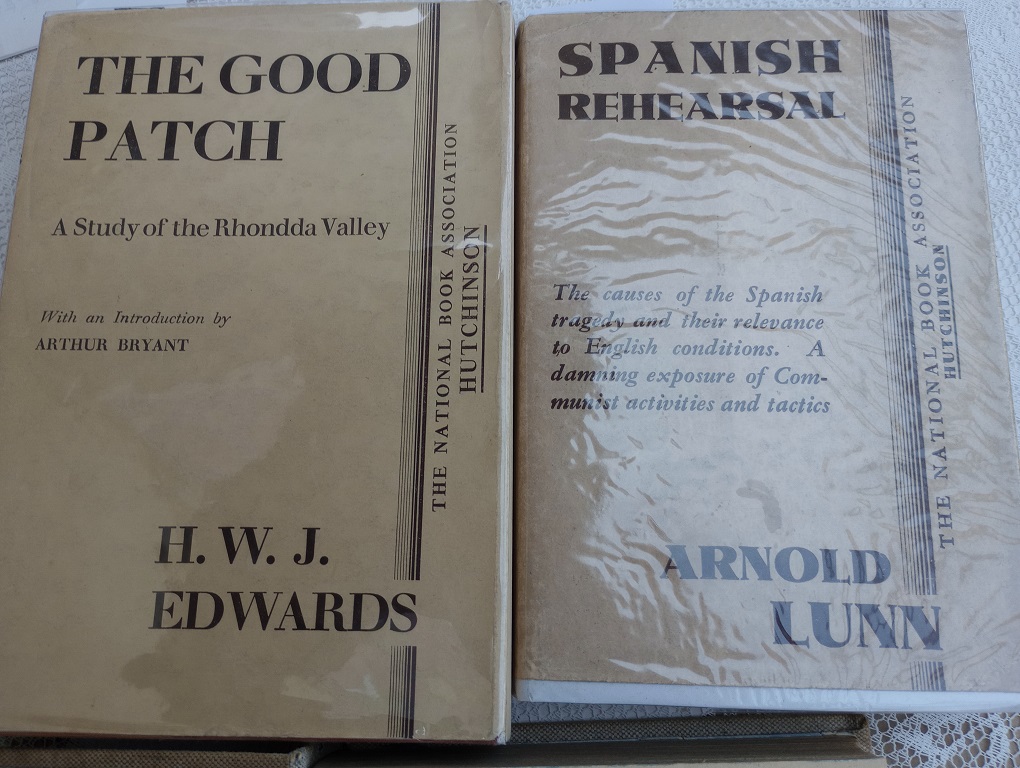
N.B.A. books were issued in distinctive white dust-jackets, in both hardback and softcover editions.
(Professor) Hugh (Gilbert Rene) Sellon: Europe at the Crossroads. Professor Sellon was an Oxford and Ashridge College lecturer. He died in 1974 aged seventy three.
Victor Serge: Destiny of a Revolution (A Russian Communist describes the horrors of communism). He was born Victor Lvovich Kibalchich and was an anarchist, turned Bolshevik, turned opponent of Stalin. He died in 1947 aged fifty six.
Lawrence (Henry) Sutton: The Nation Keeps House: an Introductory Study of Economics.
H W J (Henry William John) Edwards: The Good Patch (the story of the Rhondda Valley); and Young England. He was a Catholic convert and supported Plaid Cymru.
John Scanlon: Cast of all Fooling (A ruthless criticism of the policies and priorities of the Labour Party). He had also written The Decline and Fall of the Labour Party. He criticised Labour and the communists allegedly from the left.
Professor (William) Macneile Dixon: The Human Situation (the story of man’s achievement down the ages). He was a former Regius Professor of English Language and Literature at Glasgow University. He died in 1946 aged seventy nine.
Leslie Blackwell KC: African Question. He was an Australian born South African lawyer, MP, and judge who later lived in Rhodesia/Zimbabwe. He died in 1976 aged ninety one.
W. J. (William Joseph) Blyton: Arrows of Desire (a brilliant study of England and the English political genius). He was Catholic convert. By the outbreak of the Second World War the N.B.A. had also published Blyton’s Anglo-German Future.
Frederic (William) Lee: Manufacturer (the autobiography of a businessman). He was an industrialist and a strong supporter of Ashridge College.
Captain Edward Tupper: Seaman’s Torch. He was a merchant seaman and trade unionist.
(Luke) William (Burke) Teeling: Gods of Temperance. He was an Irish cradle Catholic and was a Conservative MP for Brighton from 1944 to 1969. He was on the Conservative right and was a Monday Clubber.
The Right Honourable Neville Chamberlain’s (the by this time Prime Minister): Book of speeches: In Search of Peace.
Earl Baldwin (the by this time retired Prime Minister Stanley Baldwin): The Last Speeches as Prime Minister of Earl Baldwin.
The Fall of the National Book Club. The 10th February 1939 News Chronicle advert for the National Book Association’s Book of the Month and its earlier publications was topped with a picture of Hitler. Below it read:
Hitler’s world famous book Mein Kampf has been selected as the January Book of the Month of the National Book Association. Here is your chance to obtain the authorised English Edition of this important book – “the blue-print to German Imperialism” – at only half the usual published price, specially bound in fine quality crush cloth with frontispiece and coloured top. Only available to old and new members of THE NATIONAL BOOK ASSOCIATION for half a crown. [Half a crown was worth about £10 in modern terms.]
THE NATIONAL Book Association (President; Earl Baldwin: Editor; Arthur Bryant: Chairman of Publishing Committee: Walter Hutchinson) was founded in 1937 to give its members important new books that have a sound aspect of great matters of the day affecting their daily lives and welfare. It is non-party: its authors have been Conservative, Liberal or Labour.
It has more famous men and women as members than any other book club in the Country, and all the thousands of members buy one book a month, published from 25/- downward including the above. [Actually it had about five thousand members compared to the fifty thousand Left Book members, and the twenty thousand Right Book Club members.]
for only 2/6 each
There then followed the list of books I briefly described above and a membership form for anyone who wanted to join the National Book Association. The address given to send it to was that of the publisher Hutchinson’s.
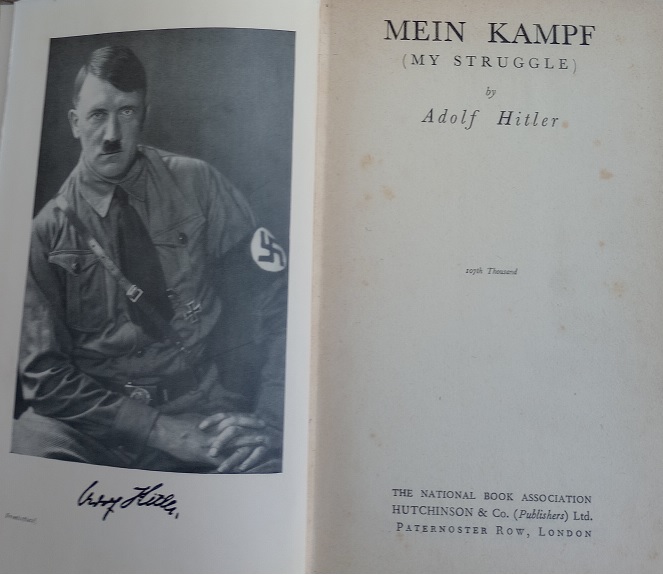
The N.B.A. edition of Mein Kampf, was an abridged, edited work in which Hitler’s intentions for war were omitted. When George Orwell wrote in 1940 that ‘simply on the internal evidence of “Mein Kampf,” it is difficult to believe that any real change has taken place in Hitler’s aims and opinions’ his evidence was the newly published ‘unabridged edition’, not the N.B.A. version.
The timing was bad. In February 1939 the Nazis broke the Munich agreement and Nazi tanks rolled into Prague. Hitler mocked Neville Chamberlain for having trusted him. Neville Chamberlain began to seriously rearm; and made a pact with Poland. Stalin continued to try and get an alliance with the west, released about a third of the military victims of his purges, and privately began probing the possibility of a pact with Hitler.
Earl Baldwin denounced the National Book Association and it ceased to operate. Arthur Bryant and his first wife were divorced in 1939. He continued his pro-Nazi activities even after the Second World War began.
In January 1940 Bryant’s book Unfinished Victory looked at German history from 1918 to 1933. It was pro-Nazi and anti-semitic although it criticised some Nazi outrages. Kenneth Rose said that Goebbels himself could not have composed a more ingratiating apologia for the Nazis. Arthur Bryant was involved in high level British government probes for a possible peace with Germany.
Bryant reinvents himself. After Churchill replaced Chamberlain as Prime Minister there came Dunkirk and the Battle of Britain. Arthur Bryant became an ardent supporter of the British war effort. He bought up as many copies of his book Unfinished Victory as he could and had them pulped.
In 1941 Bryant married Annie Elaine Primula Brooke, an artillery officer’s daughter. She belonged to the Brooke family of the White Rajahs of Sarawak fame. This marriage was also childless.
Arthur Bryant’s books The Years of Endurance, 1792-1802 and The Years of Victory 1802-1812 were published in 1942 and 1944 respectively. They looked at Britain’s wars with revolutionary France and then with Napoleon. Arthur Bryant compared Napoleon to Hitler and was welcomed back into the literary world.
George Orwell mentioned Bryant in 11 and 17 July 1944 letters to Rayner Heppenstall, writing that it was unfair to drag up the Catholic convert (Ignatius) Roy(ston Dunnachie) Campbell’s pro Franco past. Roy Campbell had changed his views having seen the orgy of executions Franco ordered after the Spanish Civil War ended. Roy Campbell had joined the British Army in 1942 despite being forty one. Orwell argued that if Bryant had been forgiven so could Roy Campbell.
After the Second World War ended Bryant became a much loved establishment historian. He had more than twenty books, many shorter works and much journalism published. In 1949 a Labour government made him a CBE; in 1954 a Conservative government had him knighted; and in 1967 a Labour government made him a Companion of Honour.
Many of Bryant’s post Second World War works were based on secondary sources. Some involved detailed research including his two volume edition of the diaries of Alan Francis Brooke the 1st Viscount Alanbrooke, the Chief of the Imperial General Staff from 1941 to 1946. The Turn of the Tide was published in 1957 and Triumph in the West in 1959. They contained criticisms of Churchill and exposed Anglo-American rivalry in the 1944-1945 Northwest European campaign.
According to a 22 May 2021 Spectator article by Adam Sisman Arthur Bryant was an inveterate womaniser well into old age. Bryant’s second marriage ended in divorce in 1976. He died in New Hall Hospital, Bodenham, Salisbury, Wiltshire, on 23 January 1985 aged eighty five.
Leave a Reply