
Animal Farm – A Czech Discovery
“I don’t think the book could be openly published in any iron curtain country until the map changes a good deal.”
George Orwell to Leonard Moore, CWGO XIX: 234
In the mid-1940s Animal Farm took the world by storm. Naturally, its most enthusiastic readers and eager translators were those who had experienced all the vicissitudes of Soviet history – refugees from Russia, Ukraine, the Caucasus and other parts of the USSR – and also those from East European countries only recently captured by Stalin who were looking at the Soviet Union with apprehension. Orwell could not have been more pleased. As he admitted in the “Preface” to the Ukrainian edition of Animal Farm (1947), he had set himself a task “of exposing the Soviet myth in a story that could be easily understood by almost anyone and which could be easily translated into other languages” (CWGO XIX: 88). The fact that Soviet and East European readers appreciated his book was the best proof that his understanding of the “Soviet myth” was right. Two weeks after the book’s publication, he wrote replying to Russian émigré Gleb Struve’s glowing letter: “If translations into Slav languages were made, I should not want any money out of them myself” (CWGO XVII: 275). And the first translations were, indeed, into Slavonic languages. But if the stories of Polish, Ukrainian and Russian translations are relatively well-known to Orwell scholars writing in English, the Czech edition was very obscure. And it was the translation into Czech that proved to be the first ever translation of Animal Farm into any language: it was published before Christmas 1946, sixteen months after the publication of the original. It was also the first illustrated edition of Animal Farm.
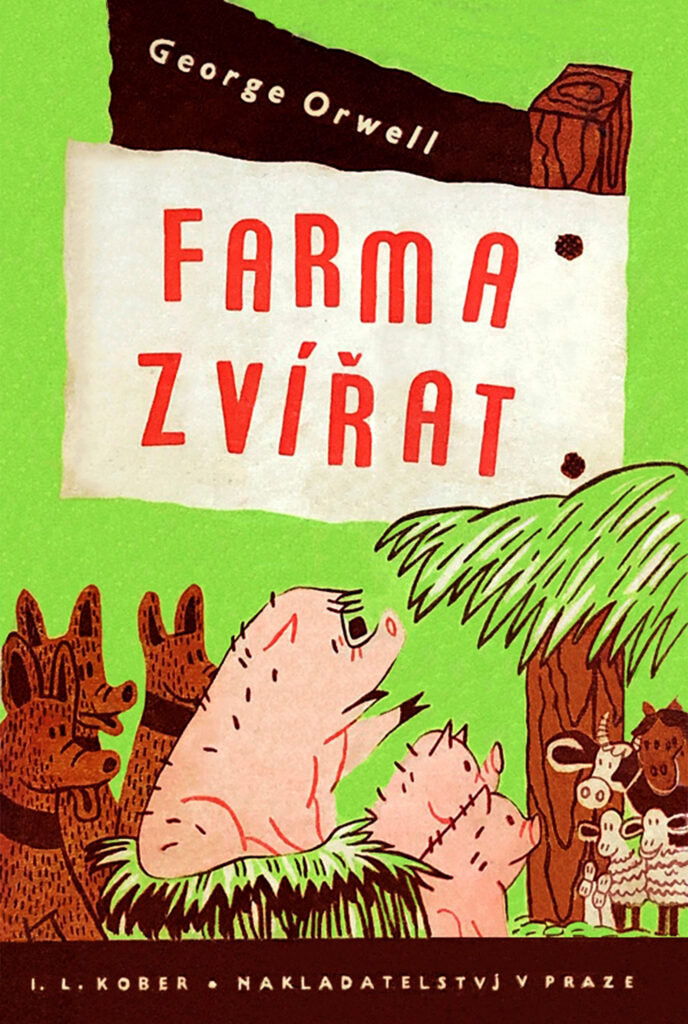
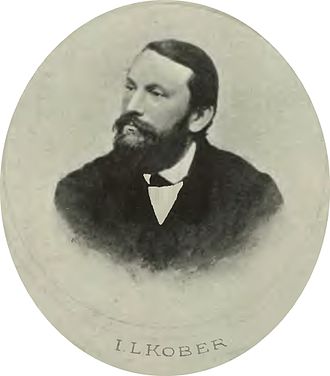
Moreover, despite Orwell’s generally correct assertion about the impossibility of publishing Animal Farm “in any iron curtain country”, the Czech edition was brought out not abroad (as were Polish, Ukrainian and Russian editions) but in Prague, the capital of Czechoslovakia. And not by some lone enthusiast but by the old and venerable publishing house named after its founder I. L. Kober.
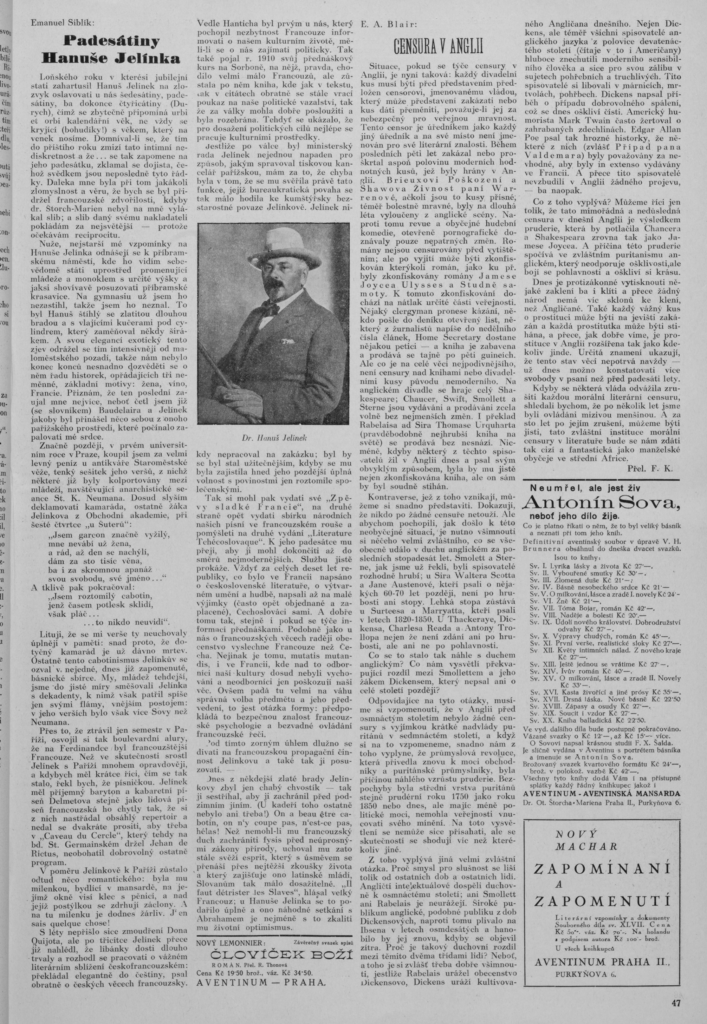
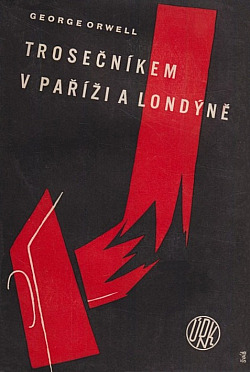
Foreign literature had always been welcome in Czechoslovakia. For example, the Czech translation of Joyce’s Ulysses published in 1930 was “the third foreign language translation of the work and preceded the first unexpurgated British edition by six years” (Čulík 2001, 625). Orwell had not been unfamiliar to Czech readers either: his first ever professionally published piece, the 1928 article on censorship in England, signed E.A. Blair, which appeared in Henri Barbusse’s Monde was immediately translated in the Czech magazine Rozpravy Aventina (The Aventine Debates). And his first book, Down and Out in Paris and London (Trosečníkem v Paříži a Londýně), was translated into Czech by Karel Kraus (1886-1942) and published in Prague in 1935, just two years after the original.
It is not known whose idea it was to publish a Czech translation of Animal Farm but the publishers obviously expected the book to be in some demand — 5000 copies of Farma zvířat were printed (at least, this is what it said on the cover). Did they reach their readers? Yes and no. The process of distribution definitely started in 1946-47 – there are at least two proofs of that. The first is an unsigned review in the Christmas issue of the regional magazine Československý východ (The Czechoslovak East). The review is short and bland, it briefly gives the content but avoids any political allusions, but it is grandly titled “Christmas Sensation of the World Literature” (Československý východ 1946:22-23). The second evidence – of 31 January 1947 – is found in a very unlikely place: the section “Zemědělské aktuality” (“(Agricultural News”) of the newspaper Národní obroda (The National Revival). The author of the item about the country’s new hunting law sarcastically compares this law to Animal Farm, because, in the same way as it is in Orwell’s fable, the whole huge effort to change the existing situation is bound yet again to make some individuals privileged and others disadvantaged (Dvorský 1947:2). Further research is needed to find any other reviews, any other references, maybe private – in diaries, in correspondence, but it seems “the sensation of the world literature” vanished in Czechoslovakia at some point in 1947. There is an unconfirmed suspicion that the printed copies of Farma zvířat (if all 5000 of them were printed) could have been simply removed or bought in bulk from the publisher or from the bookshops where they had already been delivered and that was the end of them. On the other hand, even today the 1946 edition, although rare, still can be found in some libraries and second-hand bookshops. Obviously not everything was destroyed, but the book owners, of who there could not be more than a handful, must have kept quiet about it for many years.
The mystery deepens when we consider the evidence that comes from none other than Orwell himself. On 17 December 1947, he wrote to his literary agent Leonard Moore:
I’m not surprised about the Czech version of A.F. What did surprise me was anyone accepting it in that country. If they question you again, please say that A.F. is intended as a satire on dictatorship in general, but of course the Russian Revolution is the chief target. It is humbug to pretend anything else. It doesn’t any way make much odds because I don’t think the book could be openly published in any iron curtain country until the map changes a good deal (CWGO XIX: 234).
In The Complete Works of George Orwell, the second sentence of this letter (“What did surprise me …) has a footnote: “A Czech version of Animal Farm, prepared by J. Salae & Co*, was banned by the Czech authorities (Willison)” (ibid: 235). Ian Willison, a scholar who compiled the first bibliography of Orwell’s publications, must have been sure that as the Czech edition had been planned but did not materialize it wasn’t published. Obviously, Leonard Moore and Orwell thought so too.
Orwell’s remarkable insight into what was going on in Eastern Europe did not let him down, but the situation on the ground was more complicated and with the Iron Curtain separating one part of Europe from the other he could not know much about it.
Between Nazis and Communists – Nearly Three Years of Limited Democracy
In the first half of the 20th century, Czechoslovakia went through four distinct historical periods. The First Republic (1918-1938), which emerged after the collapse of the Austro-Hungarian Empire, was a democratic and liberal state comprising two nations, Czechs and Slovaks. The Second Republic (1938-39) followed the Munich agreement and left the country as a rump state: after ceding its border regions to Germany and Hungary. Czechoslovakia ceased to exist. Germany occupied the Czech part renaming it the Protectorate of Bohemia and Moravia while the Slovak part became a nominally independent Slovak Republic, allied with Hitler. So in 1939-45, the country was ruled by the Nazis, who imposed their ideology: hundreds of authors were banned, books prohibited and confiscated, bookshops and publishing houses closed. The Third Republic was born in April 1945, when after the liberation from the Nazis an attempt to reinstate a democratic Czechoslovakia was made – it lasted until the Communist coup in February 1948. However, in December 1947, when Orwell wrote his letter to Moore, the country still had its Third Republic – it was not yet fully an “iron curtain country”.
In 1945 the draconian Nazi laws on censorship were abandoned and the Czech Constitution of 1920 was restored. It stated expressly that “the freedom of the press as well as the right to peaceful assembly is guaranteed. This is why it is in principle impermissible to subject the press to preliminary censorship” (quoted in: Čulík 2001, 625). So Animal Farm got published!
Yet things were not that simple as the struggle between Communists and their opponents was getting more and more intense. Communists were one of the most popular parties – at the 1946 elections the Czechoslovak Communist Party received 38 per cent of all votes, but there were also other parties of different – mostly socialist – persuasions, with the People’s Party the strongest among them. There were also regional differences: although Communists won 40 per cent of the votes in the Czech part of the country, in Slovakia the anti-communist Democratic Party had 62 per cent.
This complex balance of political power in the Third Republic was reflected in the intricate system of literary regulation established in the country. Officially, at the beginning there was no censorship, but already in November 1945, the notorious communist hardliner Václav Kopecký, the head of the Czechoslovak Ministry of Information, was accusing the People’s Party of printing “fascist and reactionary material”(Čulík 2001, 626). To avoid arbitrary decisions of the Communists, journalists requested the introduction of “clearly defined rules” (ibid), while writers, especially the Czech left-wing and left-liberal literary elites, hoped that rules would help them to protect high art and national literature from the influence of the market. They wanted to be – and to a certain degree, they were – their own censors. Meanwhile, Kopecký’s Ministry of Information established a publishing department which introduced a new book approval process.
In the past – before the war and even under the Nazi occupation – Czechoslovak censors would decide whether to ban books or to allow them to be published and sold. If the permission to print and sell was granted, that was the end of the story. Under Kopecký, the process became unpredictable because his Ministry could make publishers re-apply for permission again and again.
The weekly of the People’s Party Vyvoj (Development) edited by Pavel Tigrid, one of the most prominent journalists of the time, suggested, rather sarcastically, that after Animal Farm was allowed to be published and was ready for sale, someone would remember that it was actually anti-communist and the publisher was told to apply for the permission yet again as if he had not already received it (quoted in V obecném zájmu, 2014:976).
The fact that in 1947 Leonard Moore was approached by somebody from Czechoslovakia with the question – easily reconstructed from Orwell’s reply – whether Animal Farm was directed against dictatorships in general or against the Russian revolution in particular, seems to indicate that the Ministry of Information attempted to stop Orwell’s satire after it had been published and either some officials from the Ministry or the publisher instructed by them tried to determine just how anti-communist and anti-Soviet it was.
Actually, Orwell’s letter is the only confirmation that the Ministry of Information tried to hinder the distribution of Animal Farm – there seems to be no other evidence. According to Pavel Janáček, the author of the chapter on censorship in the Third Republic in V obecném zájmu, the documentation of the entire 1945-1949 permissions issuing process has been lost or is not available to researchers.
After the Communist Takeover
Were there any repercussions for the people involved in publishing Farma zvířat in 1946? No, it seems there were no consequences for individuals: neither the book’s translator Jiří Havelka, nor its illustrator, Marcel Pokorný, had any setbacks in their quite illustrious careers. Nor was the head of I. L. Kober’s publishing house, Josef Salač (1915 – 1981), the grandson of Josef Salač Sr (1858 -1934) who in different roles had been with the firm since 1887, held responsible for this particular publication. But as far as book publishing on the whole was concerned, Communists dealt with it decisively: just 36 publishing houses were allowed to function in the whole country – certainly under the state control, while around 400 private publishers were closed down. I.L. Kober with its century-long respectable history was one of them.
Jan Čulík writes in his chapter on censorship in Czechoslovakia: “In a country that had known liberal democracy, however short-lived, party control of all outlets for fresh ideas or alternative policies was immediately necessary after the 1948 coup. … Like the Nazis before them, the new government issued several lists of banned titles… From 1952 all public libraries were cleansed of “Trotskyite and anti-Soviet literature”, right-wing social democratic literature and works by [the former presidents] T. G. Mazaryk and Edvard Beneš. An estimated 27.5 million books were destroyed in Czechoslovakia at this period” (ibid).
Naturally, Orwell’s name was among the banned. It was 20 years later, in the 1970s, that Farma zvířat – 1946 edition typed on the typewriter – reappeared in Samizdat. It did not remain the only translation for long. In 1976, poet and translator Miroslav Drozd translated and published (i.e. typed 8-12 copies) both Animal Farm ( Zvířecí farma in his version) and Nineteen Eighty-Four (the latter translation was done jointly with Josef Kreuter) as part of his self-publishing project called Auroboros. This was enough for him and his three friends, who supported him, to lose their jobs at the Institute of Technical and Economic Information. Since then and up to the Velvet Revolution of 1989, Drozd had to earn his living by working at a warehouse. In 1981 Jiří Komárek’s translation Zvířecí statek was brought out by an important émigré publishing house Index, in Cologne. And of course, Tamizdat (over-there publishing) soon became Samizdat (self-publishing) – typewriters helped to increase the number of copies. Samizdat activity was persecuted and punished. Even as late as 1986, a man called Eduard Vacko was sentenced to 18 months imprisonment for his involvement with Samizdat – distributing Animal Farm was one of his offences.
It is not known how many copies of Farma zvířat printed by I.L.Kober survived, but even if only a few they did play their role in the development of their readers’ minds. There is an interesting quote from a letter sent by Lubomír Dorůžka, a renowned music journalist and translator, to Josef Škvorecký, an eminent Czech writer and publisher, who spent half of his life in Canada, supporting Czech dissidents and publishing banned Czech literature. The letter is dated 21 January 1978 and Dorůžka is describing the Bulletin of the Jazz Section, a semi-legal venture done by volunteers. “Among other things, they do not hesitate to quote from Orwell’s Animal Farm, including the date when it was published.” — undoubtedly, he means the 1946 edition. In 1978, 10 years after the suppression of the Prague Spring with Soviet tanks, during the so-called “normalisation” period (1969-1989), which was in fact another clampdown on free speech, there were people, especially in Czech musical circles (see Tom Stoppard’s play Rock-n-Roll), who were not dissidents but persistently pushed the boundaries established by the state. Orwell and the memory of the short period when Animal Farm could be published in Prague helped them with that and paved the way to the return of democracy in 1989.
*
Note:
* “J.Salae & Co” stands for I.L. Kober because, since the end of the 19th century, Kober publishing house had been first managed and then owned by the Salač family. It still kept its original name although its founder, Ignác Leopold Kober, died in 1866. The difficulty of printing “č” in the English text must have caused the misprint: “J.SalaE & Co”.
*
References
Československý východ (The Czechoslovak East) (1946) Košice, Christmas issue.
CWGO (1998) The Complete Works of George Orwell, Davison Peter (ed.) London: Secker & Warburg.
Dvorský, Jaroslav (1947) Zemědělské aktuality, Národní obroda (Agricultural News in the National Revival), 31 January, No. 26.
Čulík, Jan (2001) – Czech Republic entry in: Censorship, A World Encyclopedia in 4 volumes, Jones, Derek (ed). Volume 1. London, Chicago: Fitzroy Dearborn Publishers.
V obecném zájmu (2014) Cenzura a sociální regulace literatury v moderní české kultuře 1749–2014 (In the Public Interest: Censorship and Social Regulation of Literature in Modern Czech Culture 1749-2014) Vol. II (1938-2014).
*
Masha Karp is immensely grateful to all those who helped her to explore the history of Animal Farm’s translation into Czech: Julia Sherwood, Michal Jareš, Viktor Janiš, Ivan Adamovič and The Museum of the 20th Century in Prague.
Leave a Reply