
When Orwellian becomes Kafkaesque
One Hundred Years of Franz Kafka’s The Trial
*
A century has now passed since Franz Kafka’s most renowned work The Trial was published posthumously in defiance of his dying wishes by his literary executor. The novel was originally published in the German language as Der Prozess in 1925, along with his other novels Der Schloss/The Castle (1926) and Amerika (1927). If we accept Orwell’s argument in defence of Shakespeare in ‘Lear, Tolstoy, the Fool,’ (1947) that the only true test of greatness is survivability, then Kafka’s place among the literary elite would seem assured. Furthermore, just as it is often said that the adjectivizing of Orwell’s name stands as an effective validation of his relevance today, the same is certainly true of Kafka; especially when we encounter practices and incidents in the modern age that are worthy of being considered Kafkaesque in bold print. Orwell and Kafka obviously never met, and nowhere in Orwell’s entire literary output does he even mention his name. This may seem surprising when we consider how both authors embarked on similar thought processes to imagine the evolution of political systems that were far worse than anything they had witnessed.
As a German Jew growing up in Prague within Austria-Hungary Empire, Kafka experienced the detriments applicable to being marginalised in an atmosphere of antisemitism. Had he survived into middle-age, he would almost certainly have succumbed to a similar fate to that of his three sisters who became victims of the Holocaust; Elli and Valli were murdered in Chelmno Extermination Camp in 1942 and Ottla in Auschwitz-Birkenau in 1943. Kafka managed to defy any prejudices that might have held him back, and aspired to a government position as a lawyer for a state-funded worker’s accident insurance agency – an important job that gave him considerable power over people. He may have been a small cog, but he was very good at his job, and might have advanced up the power structure had he valued his role as more than just a distraction from his writing. Like Kafka, Orwell had also been a small cog in the machinations of a failing empire as a middle-ranking official in the Burma Military Police. His first novel Burmese Days (1935) is a story interwoven with a damning condemnation of the British Empire and imperialism in general. Both of these prospective writers saw injustice all around them. Kafka’s employment saw him submerged into a world where the injured working class were powerless to defend their rights in the face of ignorant and corrupt court officials, while Orwell confessed in Burmese Days that his experience of working in the service of the British Empire made his ‘burn inside with hatred of his fellow countrymen.’
Both writers had an inescapable compulsion to write – Kafka confessed his obsession to Felice Bauer – one of several women he became engaged to, but never married. He later conceded that he was ‘bound to his literature by invisible chains,’ while all the time being submerged into a world of big bureaucracy. At home he felt constrained by the whims of his family, especially his tyrannical father who was a significant background figure in his life. His 1915 novella ‘The Metamorphosis’ in which the central character awakes one morning to discover he has been transformed into a huge Cockroach, is often viewed as being a metaphor for his being an outsider who is ultimately disowned by his family. Orwell’s ambition to be a writer can be traced back to his childhood days in the sleepy Berkshire village of Shiplake where the FAMOUS AUTHOR by the name of E.A. Blair was created – he didn’t believe that ‘Eric’ was a good name for an author to have. When he finally returned from Burma on leave in 1927, he had already resolved to resign from his job and follow his true vocation to be a writer. Thereafter, he too struggled against the suffocating restrictions of family life in Southwold and the awkward relationship with his obviously disappointed father. Eager to escape the gossiping tongues condemning the young man who’d chucked-up a well-paid job to become a writer, he fled to London in search of cheap flat and the solitude he craved.
Kafka would continue working in insurance for most of his life, while Orwell had regular opportunities to immerse himself fully in his writing. Both wrote with simplicity of style, although each was consumed with his own measure of self-doubt. Kafka rarely submitted anything for publication and reportedly burnt ninety percent of his work, before leaving instructions for the remainder to be burnt after his death. Additionally, he was never shy of painting himself in a bad light, especially in his letters to another girlfriend Milena Jesenska, (published as Letters to Milena in 1952). Orwell was also notoriously hard on himself, confessing that he once destroyed an entire novel before instantly regretting it. Most of the novels that were published seemed to centre on failures who were stuck in a rut that they were desperately trying to tear themselves out of. He would warn his publishers not to expect big sales from his books including Nineteen Eighty-Four, having confided to his friend Anthony Powell in 1947 that it was ‘a ghastly mess,’ and ‘a good idea ruined.’ He also charged his closest friend Richard Rees with burning the manuscript if he should die before it was finished. ‘Every book is a failure’ he wrote in ‘Why I Write’ (1946), and it seems he never altered his opinion throughout his entire writing career.
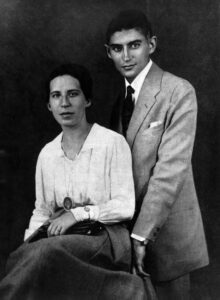
There are elements of The Trial that are drawn from Kafka’s involvements in Prague, beneath the heel of the autocratic Habsburg Empire. Daily life was punctuated by an almost permanent atmosphere of suspicion, and a feeling of being watched. When World War I broke out, many people were shocked to be arrested on charges of being unpatriotic. The press was heavily censored, and anything that looked suspiciously like a meeting was instantly broken up. The world that Kafka creates in The Trial is a both a parody and a plausible dystopian projection relative to the world he inhabited and understood. He was able to draw heavily upon his experiences as a lawyer to very effectively satirize the ignorance of the court officials. Many a time he had witnessed men being rendered virtually powerless to defend their rights in a system that always worked against them. He was able to weave his observations of the indifference of law officials to individual suffering into the terrifying world he described.
In contrast to Kafka, Orwell had never experienced life under totalitarian rule, although both he and wife Eileen had known what if felt like being caught up in an atmosphere of political terror in Barcelona. In a situation that was indeed ‘Kafkaesque,’ Orwell was effectively being hunted down, unaware that the faction with whom he was fighting on the front line in the Spanish Civil War had been outlawed on the orders of Stalin. Upon his arrival back in England, he discovered it was virtually impossible to find a publisher willing to set his own account, or anything else critical of Stalin into print. The nightmare scenario he envisaged in Nineteen Eighty-Four began to evolve when he discovered newspaper reports about the war that bore no relation to the facts. In his essay ‘Looking Back on the Spanish Civil War’ (1943) he wrote that history was now being written ‘not in terms of what happened, but of what ought to have happened according to various party lines.’ He conceded he found this frightening, for he could see how totalitarianism would eventually go beyond falsifying simple detail to destroying what he called ‘the common basis of agreement.’ By this he meant facts that were universally acknowledged by everyone, such as the laws of arithmetic.
Dystopian fiction typically focuses on a hero-victim – the central character fighting against the dehumanizing effects of the state apparatus. Both Jozef K in The Trial and Winston Smith in Nineteen Eighty-Four have this in common, and the methods by which the state controls the people in these two books are not so very different as they first seem. Both victims are striving to discover how they arrived at the situation they are now in and searching for answers. Both are also living under intense scrutiny; for Winston the apparatus of surveillance is very much in his face, but for Jozef K, the powers that torment him are invisible, and yet the watchful eyes of their agents seem to be all around him. The humour element in The Trial lies in Jozef K’s inability to make sense of his situation, suspended in ignorance by the invisible arms of the same institution that hunted him down and have since toyed with him in his desperate search for information. Through a series of encounters with agents of the court, he discovers them to be trespassers and thieves, who violate women, read pornography and resort to sadistic practices to maintain discipline; the top officials, wherever they may be, are both inaccessible and unaccountable. Faced with this situation, Jozef K feels impotent, for there is nothing he can do to either defend himself or to prove his innocence, as his crime will always remain unspecified. Even though Jozef K holds an esteemed position at the bank, the court’s regard for him never rises above that of any other worthless member of the populace. Never at any time is there any possibility of a fair trial in a political system that denies the weak and powerless access to justice.
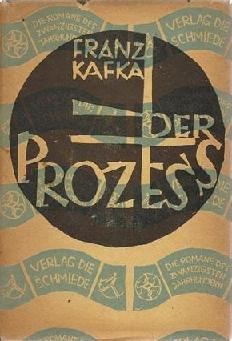
First German language edition of The Trial (Wikipedia)
In Nineteen Eighty-Four history is something that is created, rather than learned. Orwell had previously conceded that his experiences following his return from Spain had led him to believe that the concept of objective truth was fading out of the world. The society he creates has evolved much further to the point where it demands continuous alteration of the past on an industrial scale, with the result that his real-life fears about the total disappearance of objective truth have been fully realised. Further clues to how he arrived at these major themes of his novel and his motivation to write it are embedded within his 1945 essay ‘The Prevention of Literature.’ Orwell sees the monopolisation of the modern press by a handful of rich men stripping away the integrity of writers and journalists through thwarting their efforts to provide truthful accounts. The ‘press lords’, he declares, have become ‘the enemies of truthfulness and hence the freedom of thought,’
It is beneath these similarly suffocating conditions that each of the books follow their respective downtrodden hero-victims Winston Smith and Jozef K through their ordeals; Jozef K trying to make sense of a system that denies him any opportunity to prove his innocence and Winston Smith trying to make sense of a system that denies any truth. The Trial very effectively conveys Jozef K’s suffering, his tension and his anxiety as he seeks information from anyone who can help him escape from under the force of injustice that presses him down. His character is assassinated, his reputation smeared and his standing at the bank where he works is severely undermined. K knows that this is an existential problem for him, as there is nothing or nobody at any stage of the trial process that can protect him from the inevitable; his advisors (of questionable trustworthiness) cannot promise anything, beyond delaying the process. As a result, he can no longer focus on anything other than the trial – a condition that leaves him depressed and dehumanised in this inescapable, dystopian hell. Whereas Jozef K is slowly being crushed by corrupt agents who keep him in ignorance of the fact that he has already been condemned to death, in Orwell’s novel ignorance is the one strength that will keep citizens of Oceania alive – as per the party motto ‘Ignorance is Strength.’ Since the concept of objective truth has long been destroyed, Winston Smith is forever trying to make sense of the world and how things have become the way they are. He knew that actual truth existed somewhere and at some time, but he cannot get beyond the deliberate falsification of records, the interchangeability of truth and lies, nor the intricacies of deception and betrayal. When the opportunity arises to finally confront O’Brien about the truthfulness of the blueprint for rebellion in the pages of Goldstein’s manual, it soon becomes clear that the book is yet another element of deception. O’Brien admits to having been complicit in writing it, before casually dismissing the programme it sets forth as ‘nonsense,’
For Kafka, evil is simply endemic to human societies and his novel effectively illuminates the omnipotence of evil and the banality with which the absence of justice gives rise to widespread corruption. Violence and terror are brazenly used to control, disempower and dehumanise individuals. Even those employed within the expansive grip of the legal system are subject to a hierarchical system ruled by violence. However, unlike Jozef K, whose fate has already been sealed, Winston Smith must be tortured into positive obedience to the extent that he must truly love Big Brother. ‘We make the brain perfect before we blow it out’ O’Brien tells him. It is a demonstration of the raw naked power of an oligarchy that has gone far beyond totalitarianism to something a thousand times worse. Power is not a means it is an end – ‘the object of persecution is persecution, the object of torture is torture, the object of power is power.’ With this in mind, can we say that Kafka has similarly advanced towards something post-totalitarian – a system of government that goes far beyond the subjugating elements that he knew? I would say he has, for his hero-victim is put to death without ever having had the opportunity to plead his case. There was not the show-trial that one might expect of a totalitarian state, rather the trial took place all around him without him being aware of it. His sentence was effectively confirmed in a very sinister scene inside the cathedral where a priest, who was apparently expecting him and knew everything about his case, admonishes him for challenging the authority of the court by seeking outside help. This throws up another interesting parallel between the novels; in Nineteen Eighty-Four, God has effectively been replaced by the Inner-Party represented by O’Brien, who declares ‘we are the priests of power.’ In The Trial the court has absolute influence over a church that justifies the inhumane practices of the legal system, meaning that Kafka has also effectively shown us a world where there is no God.
The comparison between Orwell and Kafka typically evolves into a battle between the adjectives. When does Orwellian become Kafkaesque and vice versa. We tend to label instances of being hunted down by individual institutions as being Kafkaesque, the most notable recent example being the British Post Office Scandal when, between 1999 and 2015 around 900 sub-postmasters were wrongly convicted of theft and false accounting. There were echoes of Kafka according to those sub-postmasters battling to prove their innocence, where moving forward with the case always seemed to be an illusion. The convictions were only finally overturned in 2024. Then there are the so-called online hate crime complaints that law enforcement officers are obliged to follow up; the unexpected knock on the door often occurs many months after the social media post had long been forgotten about by the bemused offender. Among the most notorious examples was the human rights activist Oleg Orlov who was tried and convicted in February 2024 of discrediting the Russian Army in a Facebook post in November 2022. His sentence of two-and-a-half years followed a trial that was Kafkaesque on so many levels that the accused spent the court hearings deliberately engrossed in Kafka’s iconic novel.
Finally. there are those who may be driven to describe their perceived persecution as being somewhat Kafkaesque, and yet pay little heed to the school of thought that believe (and continue to believe) that Jozef K had been guilty all along, and he knew it!
With that in mind, when people complain about their ordeal having been Kafkaesque, there is always the possibility that the adjective could effectively be turned back upon the user!
Leave a Reply