
On the Crick Trail
*
Following on from pieces about Orwell at the Edinburgh Fringe 2025
and the Winston Smith Library of Victory and Truth,
Charlie Ellis reflects on his personal memories of one of Orwell’s more significant biographers.
*
The political theorist and political writer Sir Bernard Crick (1929-2008) is widely considered one of the key figures in the evolution of the academic study of politics in the UK. His In Defence of Politics (1962) has been described by Labour Peer and academic Maurice Glasman as “the most enduring and significant essay on politics to come out of England in the past 100 years.” The rise of national populism in established democracies has made the defence of politics newly urgent, a thread that was a recurrent theme in Crick’s writing.
Crick engaged well beyond academia. He was, among other things, a parliamentary reformer, theatre critic, citizenship advocate, constitutional architect, quiet diplomat in troubled places (including Northern Ireland), and an advisor to the Labour Party. A key aspect of his work was his deep and long engagement with Orwell.
Crick and the Long Journey with Orwell
Crick’s contribution to Orwell Studies is substantial, going well beyond his ‘semi-authorised’ biography, George Orwell: A Life, first published in 1980. Crick had, as outlined in his essay ‘On the Orwell Trail,’ a ‘long journey’ with Orwell’s work, starting in the early 1970s. His wider contribution includes, but is not limited to, numerous essays and articles on Orwell, the book of ‘personal reminiscences and recollections’ Orwell Remembered (co-edited with his research assistant Audrey Coppard), and his role as consultant on the BBC’s Arena series of the same name.
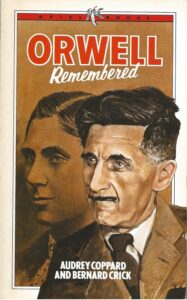
Crick’s most lasting legacies in this sphere are, of course, the Orwell Prize for political writing and the Orwell Lecture. Crick had a pivotal role in setting these up, born of a frustration with the state of public discourse. Crick’s full contribution to Orwell studies is something I will examine in a future article, as it deserves extended attention. In this piece, however, I reflect on some personal memories of Crick and how they illuminate his key themes.
From Student Essay to Academic Trail
From a personal perspective, my first engagement with Crick’s writing coincided with my first serious foray, as an undergraduate, into Orwell’s work. This would lead to an interest in Crick the man and his work, outlined in articles I’ve written on ‘the ‘meddling professor’, Crick’s (extensive) political journalism and his promotion of the political essay.
I had the good fortune to be taught, as an undergrad, by a noted Orwell scholar, Stephen Ingle. In The Social and Political Thought of George Orwell, Orwell Reconsidered, and elsewhere, Ingle’s work manifested an increasing seriousness about Orwell within British political studies and in academia more broadly.
My interest in Orwell was really ignited during a course on ‘Politics and European Literature’ taught by Ingle. During a lockdown de-cluttering session I came across an essay I had written during that course (‘Was the failure of the revolution on Animal Farm inevitable?’). On re-reading it, I noted that two of the sources I cited the most were Bernard Crick’s biography of Orwell and his Essays on Politics and Literature.
Essays on Politics and Literature Bernard Crick
This was my first interaction with Crick’s distinctive voice. Little did I then realise how different his vigorous writing style was from that of most academics. His essays on Orwell are bracing and engaging, with the liveliness you would expect of someone who bashed out thousands of short articles on top of his academic outputs. Crick’s writings on Orwell also manifest some of his eccentricities as a man and as a writer (such as his habit of adding significant asides in parenthesis). So, it was via Ingle and Crick that I first read Orwell’s brilliant short non-fiction.
Orwell’s Penguin Essays was, alongside Ian MacDonald’s Revolution in the Head, the key text in my evolution from someone with general interest in ‘current affairs’ to doing further study and research on political ideas. That ‘best of’ volume features a lengthy, engaging introduction by Crick. Though he was far from alone in this view, Crick was a prominent proponent of the view that ‘if Orwell has genius, it is as an essayist.’ What has stayed with me were those essays of Orwell which examined the everyday, drawing out the deeper story. I’ve carried this outlook into my writing on, for instance, coffee, cultural events, and explorations of overlooked urban spaces. Without Ingle and Crick, I would not have encountered Orwell’s non-fiction at that receptive time in my life.
The Influence of Sheffield
That real interest in politics stirred by Orwell’s essays led me to do postgraduate study. The connection with Crick continued, though again indirectly. My doctoral studies took me to Sheffield, to the politics department that Crick had forged there and which had become one of the leading departments in the country. Though most of the academics he worked alongside were no longer there (with exceptions, including Patrick Seyd and Anthony Arblaster), his influence remained. For instance, Andrew Gamble, now professor emeritus, was much influenced by Crick and has written extensively about him, including Crick’s ODB entry. Crick’s influence lives on today through Matthew Flinders, Founding Director of the Sir Bernard Crick Centre for the Public Understanding of Politics.
A Principled Moderate
Crick suffered from cancer for his final 20 years, though he kept writing and engaging. I met Crick on a few occasions during his final three years, including visiting his book-lined basement flat in Edinburgh (my home city). Crick spent his last decades in the city, holding an honorary professorship at the university. Themes of our discussions regularly connected to Orwell.
One major theme was the social democratic tradition. These friends included Richard Hoggart, another thinker much influenced by Orwell (see Hoggart’s introduction to the Penguin edition of The Road to Wigan Pier). Hoggart is considered the founding father of British Cultural Studies, a field to which Orwell was a key precursor with essays like ‘Boys’ Weeklies.’ I met with Crick to discuss a book chapter I was writing on Hoggart.
Crick and Hoggart were both significant social democratic voices. They rejected the idea that Orwell (despite his work being ‘bodysnatched’ by Neoconservatives) was a figure of the right. Crick argued that the idea that Orwell went off democratic Socialism was erroneous. Unsurprisingly, both Hoggart and Crick saw Orwell as part of the same “English socialists” tradition, defined by an “empirical, historical cast of mind and with moral values… drawn more from tradition than from coherent theory.”
Crick’s belief that being a moderate was a principled position was a core lesson from these meetings. This view is outlined in his essay on ‘The Character of a Moderate (Socialist),’ and in the pamphlet he co-wrote in 1988 with his star student, David Blunkett, The Labour Party’s Aims and Values. He acted as discussant for a workshop I co-organised on moderation, keen that young scholars should see the role of the moderate as significant—essential for a coherent politics. His plea was ‘let us cool the debate, not stir it.’ However, Crick was a truculent moderate, who could be combative.
David Blunkett and Bernard Crick: The Labour Party’s Aims and Values (1988)
Know Your Enemies
Among the foes were figures like the historian Max Beloff, about whom I interviewed Crick. Over broccoli soup, stilton and red wine, we discussed the “brilliant, foolish, contrarian” Beloff and the wider New Right milieu within which he was prominent.
Despite his own centre-left views, Crick did not reject right-wing thinkers in a knee-jerk manner. As he put it in an essay on bias, “personally I hold some strong views; but although a democratic Socialist, I am obsessed with the plausibility, for instance, of Conservatism.” He brought this belief in intellectual pluralism (what is described today as ‘viewpoint diversity’) into the politics department at Sheffield, where he ensured that its members held different perspectives.
In his approach to conservative ideas and thinkers, Crick followed the mantra (which he ascribed to Orwell and Koestler) to ‘know thy enemy as thyself’. Another Orwell-derived maxim that Crick manifested was his view that extremists on both sides need each other to justify their immoderate opinions. As I left, he gave me a copy of his Essays on Citizenship, containing his essay on bias; a final reminder to own our own biases and to engage fully with ideas and intellectuals we disagree with.
In Defence of the Essayist
Orwell permeated numerous aspects of Crick’s thinking, featuring prominently in his many essays on themes such as nationalism, multiculturalism, and the future of the UK.
I saw Crick deliver his Mackintosh Memorial Lecture, ‘The Four Nations – Interrelations,’ in October 2007. The lecture was a highly engaging example of Crick’s sense he was “a political theorist and political writer who has always believed in the primacy of historical explanation.” Making his way off the stage, he stumbled badly, only just staying upright. Clearly a sign of his failing health, as he noted in an email: ”my falling off the platform at the lecture could show that I am a little stiff and uncertain on my feet.” It was, however, also evidence that he was keen to keep engaging till the end.
Crick regularly emphasised that Orwell should be taken seriously as a political writer and as a ‘political thinker of genuine stature.’ This view was often met with academic resistance, a factor in Crick’s ‘falling out’ with a profession he felt had become over-specialised and dominated by opaque jargon. This desire to see political writing that engaged well beyond academia was part of his reason for setting up the Orwell Prize.
His frustrations with Orwell’s academic critics were exemplified by his theatrical performance at the 2003 Edinburgh Book Festival, where his truculence was fully on display clashing with academic Scott Lucas. Crick felt Lucas was judging Orwell by standards more appropriate for a political theorist, not for an essayist and a journalist who is “not always consistent in his conclusions” but is nonetheless ‘consistently relevant.’
Passing the Baton
D. J. Taylor has, in many ways, taken over Crick’s status as the ‘go to’ man on Orwell. Crick’s own “afterbirth” of his biography had been substantial, leading to many public speaking engagements that he genuinely enjoyed: “I can never tire of talking about Orwell.”
After his death, Crick’s papers were transferred to an archive at Birkbeck College. A bookselling acquaintance managed to get his hands on the copy of D. J. Taylor’s 2003 biography that Taylor had personally signed for Crick; symbolic of the passing of the baton from one biographer to another.
Crick’s key legacy is helping to ensure that Orwell is taken seriously as a political thinker and that the essay is a vital literary, cultural, and political form. As is, manifested in the Orwell Prize, the need for good political writing; for political writing as an art.
*
Charlie Ellis is a researcher, writer and EFL teacher based in Edinburgh. He writes on culture, politics, specialty coffee, sport, and education.
Thanks Charlie, a very interesting article.
cheers
Quentin
Thanks for writing this, Charlie, I am also fascinated by the history of the biographers and the story of how the story of Orwell has been told. I recently procured an edition of David Taylor’s biography that he inscribed to the Ian Angus in 2003. My research shows that Ian was the “go to man” for three generations of researchers. Everyone wrote to him. His own early interviews with those connected with Orwell are invaluable. A large number of fascinating books from Ian’s literary estate have come into my possession. His detailed annotations of Crick’s biography of Orwell (as well as in the Revised Edition) are very insightful. It has been slow going transcribing them but makes for interesting reading considering the story Orwell’s biographers and the various controversies. Feel welcome to send me an email, I’d love to chat further.