
Orwell and Barrie
In Inside the Whale (1940) George Orwell discussed the three literary generations that had existed in Britain in his lifetime i.e. the Housman-era Nature Poets, the Despair of Life writers, and the Stalinist pro-Russians. He wrote that at any given moment of course there is a huge tribe of Barries and Deepings and Ethel M. Dells who simply don’t notice what is happening.
My previous two articles looked at Orwell and Ethel M. Dell, and Orwell and Warwick Deeping. Here I look at Orwell and Sir James Matthew Barrie.
Orwell and Barrie. In a 1 February 1941 Time and Tide review Orwell called a performance of Barrie’s play Dear Brutus at the Globe Theatre a:
Sugary fantasy (a group of people get the chance to live their lives over again), hardly worth reviving but put across successfully owing to excellent acting by John Gielgud, Leon Quartermaine, Ursula Jeans and various others worthy of better material.
George Orwell’s essay Benefit of Clergy; Some Notes on Salvador Dali intended for publication in the number 4, 1944 Saturday Book, but suppressed, was first published in Critical Essays in 1946. Orwell notes Dali’s predilection for the Edwardian era; and writes that the design at the bottom of page 62, for instance, would nearly go into Peter Pan.
In a 20 December 1945 Manchester Evening News review of Cellar, a three act play by William Russell, Orwell wrote that:
It is a curious fact that plays, although primarily written for the stage, are often as least as readable in book form as the average novel. Bernard Shaw used to publish his plays in book form with such elaborate stage instructions, as practically to turn them into novels. Sir James Barrie, with ‘The Admirable Crichton’ did the same.
James Matthew Barrie was born in Kirriemuir in Forfarshire on 9 May 1860, the eleventh of thirteen children, and third and last son of David Barrie a handloom weaver, and Margaret Barrie nee Ogilvy a stonemason’s daughter. Two of his older sisters died in infancy before he was born. His second oldest brother David, their mother’s favourite, drowned in a skating accident aged thirteen in 1867 when James was seven.
James and David Barrie’s older brother Alexander studied at Aberdeen University, got a classics degree, taught at Glasgow Academy and became a Schools Inspector. James Barrie studied at Glasgow, Forfar and Dumfries Academies. At Dumfries Academy he joined the Drama Society and composed his first play a six scene melodrama Bandalero the Bandit.
From 1878 to 1882 James Barrie studied a wide range of subjects at Edinburgh University including literature and psychology. As a student he began writing articles for the Edinburgh Courant. In January 1883 he was appointed a Nottingham Journal police court reporter and leading article writer writing about topics ranging from Ireland to Charles Darwin and. He also wrote for London journals. The Nottingham Journal closed in October 1884 and in 1885 he moved to London and became a full time writer.
The Novelist and Playwright. From 1887 to 1936 Barrie had published more than sixty novels, plays and short story collections as well as many articles and reviews. A full account of them would require a book. Several biographies of him have been published.
James Barrie began as mainly a novelist using Kirriemuir and his early life for inspiration. His critics accused him of belonging to the Kaleyard tradition of Scottish sentimentality; but his biographical novel Margaret Ogilvy, published in 1896, a year after his mother died, described the trauma of his older brother David’s tragic death in 1867. James Barrie later became mainly a playwright.
Peter Pan. George Orwell mentioned three Barrie works. The Peter Pan series included a novel The Little White Bird or Adventures in Kensington Gardens (1902); Peter Pan or the Boy who wouldn’t Grow Up (staged 1904), Peter Pan in Kensington Gardens (1906), When Wendy Grew Up: An Afterthought (written 1908, published 1957); and the novel Peter and Wendy (1911).
Peter Pan, a free spirited and mischievous boy, can fly and never grows up so cannot love. He lives on the fictional island of Neverland, leading the Lost Boys and interacting with fairies, pirates, mermaids, and American Indians. The other characters include Tiger Lily, Tinker Bell, the pirate Captain Hook and his boatswain Mr Smee, and the Crocodile.
In self-defence Peter Pan cuts off the pirate captain’s right hand. The captain replaces it with a hook and becomes Captain Hook. Peter Pan throws the hand into the sea. A crocodile eats it, gets a taste for human flesh and pursues Hook; but it has also swallowed an alarm clock which goes off and alerts Hook to his danger. Salvador Dali would have been amused.
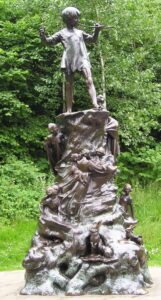
The play Peter Pan or the Boy Who Wouldn’t Grow up opened at the Duke of York Theatre in London on 27 December 1904 and on Broadway in New York in 1905. It became a staple Christmas play and inspired films, TV programmes, manga, games, comics and statues including the Peter Pan statue in Kensington Gardens.
It was Peter Pan, or its sexual implications, on which Orwell wrote most:
Modern books for children are rather horrible things, especially when you see them in the mass. Personally I would sooner give a child a copy of Petronius Arbiter than Peter Pan, but even Barrie seems manly and wholesome compared with some of his later imitators. (“Bookshop Memories“, 1936)
One result of the breakdown of religious belief has been a sloppy idealization of the physical side of life… Hence the tee-heeing brightness of Punch, hence Barrie and his bluebells, hence H. G. Wells and his Utopiæ infested by nude school-marms. (Review of Henry Miller, 1935; later subject of “Inside the Whale”)
And later still he complained,
It is queer to think that London could commemorate Wallace in Fleet Street and Barrie in Kensington Gardens, but has never yet got round to giving Blake a monument in Lambeth. (Orwell was wrong he later admitted: Blake had a monument)
The Admirable Crichton a Barrie play opened at the Duke of York Theatre in London on 4 November 1902. In it a group of aristocrats and their butler are marooned on a tropical island. Their previously subservient butler, the only practical person among them, takes charge and is about marry the young Lady Mary who is already engaged to an aristocrat in Britain. A rescue ship arrives, they all return home and normal life resumes.
This tragi-comedy was often revived. It inspired a 1918 silent movie, a 1957 film and several indirect adaptation films; a BBC TV version in 1950; an American made for TV film in 1968; and a 2011 BBC Radio 4 Play. The theme is the artificiality of the class system.
Dear Brutus a Barrie play ran at Wyndham’s Theatre in the West End from 2 October 1917 to 24 August 1918. Some dissatisfied couples who believe they have made the wrong life choices stay at a country house. On Midsummer night an enchanted wood appears and they become their alter egos.
A light fingered butler becomes a rich and fraudulent financier. A philanderer who has married his mistress discovers that he really loved his ex-wife. An alcoholic painter whose wife despises him and who is childless finds himself happily married with a much loved daughter; and the painter’s wife is alone and starving having been abandoned by the aristocrat she had wished she had married.
In Act Three life returns to normal. The butler accepts his lot; the philanderer resumes his womanising; and the artist and his wife are reconciled. The theme is that if we could live our lives over again some of us would learn from our mistakes but others would repeat them or do worse.
The Adored One is a 1914 Barrie play about a mother who resents a man annoying her baby by smoking in a railway carriage. She throws the man off the train. He dies and she is arrested but fools a male judge and an all-male jury into acquitting her. It was booed and Barrie revised it so that it transpired that the woman was dreaming. It was re-staged as The Legend of Leonora and did well.
Personal Life. James Barrie formed his own cricket club in 1887. It included writers, explorers and other dignitaries and was active until 1913. He shared a houseboat with the Liberal politician Lord Rosebery’s Private Secretary Thomas Lennox Gilmour, and the Australian writer Henry Brereton Marriott Watson.
James Barrie was less than five feet tall and the society women he mixed with looked down on him literally and figuratively. In some of his earlier novels he took revenge by having artisan writer heroes have better luck with women than he did. In 1891 his friend Jerome Klapka Jerome (of Three Men in a Boat fame) introduced Barrie to the actress Mary Ansell a Paddington publican’s daughter.
Mary Ansell and James Barrie became friends and she nursed him when he was ill. They married in Kirriemuir on 9 July 1894. He was thirty four and she thirty three. The marriage was childless and was probably never consummated.
James Barrie was an honorary uncle to, played games with and told stories to the writer William Ernest Henley’s daughter Margaret Emma Henley who died of meningitis in 1894 aged five and who inspired Peter Pan’s Wendy; and the writer Arthur Thomas Quiller Couch’s son Bevil Bryan Quiller Couch.
James Barrie later befriended the barrister Arthur Llewellyn Davies, his wife Sylvia Llewellyn Davies nee Du Maurier and their five sons. They inspired Peter Pan’s lost boys. Sylvia Llewellyn Davies’s niece was the novelist Daphne Du Maurier.
Mary Barrie became lonely and began an affair with Gilbert Cannan who was twenty years her junior. James Barrie found out and divorced her in 1909. Gilbert Cannan and Mary Barrie married in 1910 but he was unfaithful and they separated in 1917. James Barrie gave her an annual allowance; and left her a £1,000 bequest and a £600 pa annuity in his will. She died in 1950 aged eighty nine.
Arthur Llewellyn Davies was jealous of Barrie but developed throat cancer. Two botched operations left Davies unable to speak. James Barrie generously supported him financially until Davies died in 1907. Sylvia Llewellyn Davies died in 1910 and James Barrie became the guardian of the five Llewellyn Davies children.
James Barrie’s friend the explorer Captain Robert Falcon Scott died in 1913 in Antarctica. At the request Captain Scott made in his last letter to his wife written when he was dying, Barrie helped Scott’s widow, the sculptress Lady Edith Agnes Kathleen Scott née Bruce, look after her son the future naturalist Peter Markham Scott of Slimbridge fame.
The oldest Llewellyn Davies son George studied at Eton and Cambridge and was an amateur actor. In 1914 he was commissioned a Second Lieutenant in the King’s Royal Rifle Corps. He was killed aged twenty one by a German sniper near Ypres on 15 March 1915.
Bevil Bryan Quiller Couch studied at Oxford, served in the Royal Artillery in the First World War, rose to be a Major and won the Military Cross. He survived the war but died on 6 February 1919 aged twenty eight of influenza in the 1918-1919 flu pandemic, while serving in the British Army of Occupation in Germany.
Michael Llewellyn Davies studied at Eton and Oxford. He and a student friend Rupert Buxton drowned in the Thames on 19 May 1921 when Michael was twenty. There were rumours it was a homosexual suicide pact but the inquest decided that Michael died accidentally and his friend died trying to save him.
The other three Llewellyn Davies children survived their guardian. The last survivor Nicholas Llewellyn Davies died in 1980 aged seventy six. The three had married and fathered six children between them.
Money and Politics. James Barrie was rich but had high expenses and was generous. He and other writers including Conan Doyle were defrauded by their literary agent Arthur John Addison Bright who committed suicide on 29 May 1906. The legal proceedings were long and expensive.
In 1910 the House of Lords vetoed the Irish Home Rule Bill. The Liberal government considered appointing enough new peers to stop this happening again. James Barrie was among those considered for this honour. The idea was dropped but in 1913 he was made a baronet becoming Sir James Barrie.
During the War Barrie worked on boosting British morale, writing the play Der Tag in 1914. “Der Tag” was a Prussian after-dinner toast to the coming day when Germany would hold world dominion. Orwell referred to it later in one of his “As I Please” articles, as Professor Davison notes. It was this morale-boosting aspect of Barrie’s work that would have made Orwell include him in a list of that period’s innumerable comic writers, Sir James Barrie, W. W. Jacobs, Barry Pain and many others.
Final Years. After the First World War Barrie’s writing was increasingly melancholic. Perhaps it was post First World War despair of life. In 1922 he was awarded the Order of Merit. Oxford University gave him an honorary doctorate in 1926 and Cambridge gave him one in 1928. He was President of the Society of Authors in 1928.
Sir James Barrie’s last play The Boy David about the friendship between the biblical David and King Saul’s son Jonathan opened in 1936. The critics damned it with faint praise but it ran for seven weeks in London. He fell ill, cancer was suspected and bronchial pneumonia developed. He died in a London nursing home on 19 June 1937 aged seventy seven. He left £173, 467 9s 5d.
Conclusion. Sir James Barrie was a Victorian and Edwardian writer and satirist although he learnt not to go too far. He lost three young men he had known since their infancy in six years. When the Stalinist pro-Russian writers emerged he was a sick and dying old man. Orwell was harsh in his judgement of a very decent man.
Sir James Barrie’s Kirriemuir birthplace is a National Trust for Scotland property and is open to the public. Moat Brae House in Dumfries where he played with childhood friends and whose gardens inspired the fictional Neverland is today the National Centre for Children’s Literature and Storytelling and is open to the public.
The Duke of York Theatre opened as the Trafalgar Square Theatre in 1892. In 1895 it was renamed the Duke of York to honour the future King George V. It is still a theatre and is a listed building.
Leave a Reply