
A Weekend in Wigan
March 4th and 5th, 2022
*
Eighty-five years after the publication of George Orwell’s blistering and unforgettable Road to Wigan Pier, what’s Wigan got? And how does the town deal with its singular fame – or notoriety? That’s what more than 30 members of the Orwell Society set out to investigate, in George’s footsteps, one weekend in March 2022. Blinking in the light of actually meeting in person after such a long pandemic-created break, it was a revelatory outing, brilliantly organised and shepherded by Quentin Kopp and illuminated by Richard Blair. For Orwell Society newbies, it was a great treat to get to know fellow fans, while longer-standing members renewed old friendships and forged new ones.
Right from the start, though, it was clear that Wigan and its people would be the real stars. The Premier Inn, where the Orwell Society group group stayed, sits in a tangle of roads and car parks, interspersed with oddly-shaped scraps of spare ground, clearly the results of post-war slum clearance. One wall of the hotel’s lobby is taken up with a huge black and white photo of the canal, site of the famous “pier” and now of the Orwell pub. The accompanying text urges guests to check out the location and stresses the importance of the Orwell connection. That sets the tone for the town’s embracing of its literary fame, whatever about its uneasy acceptance of the book’s actual contents.
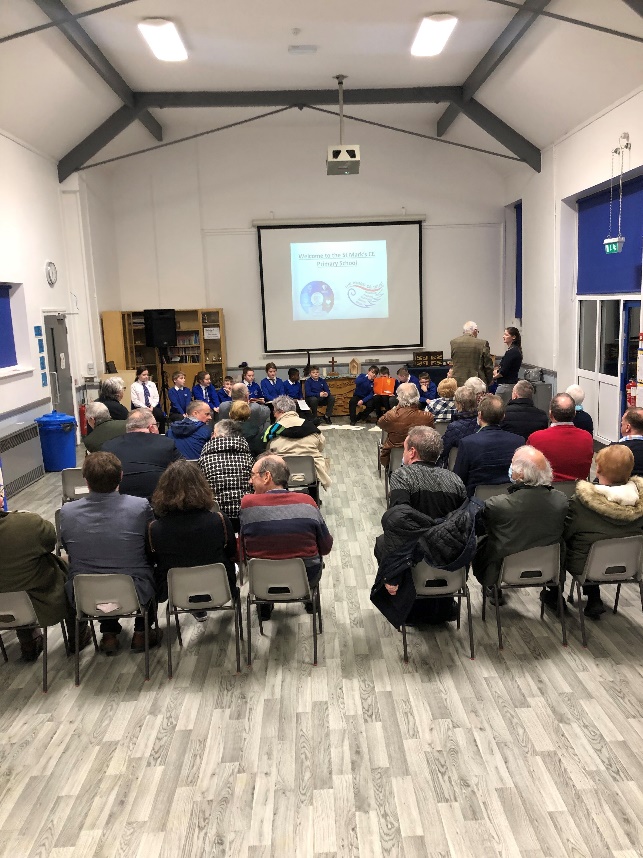
On our first evening, Year 6 in St Mark’s Primary School dealt with The Road to Wigan Pier head-on. Funded through an Orwell Society Teacher Award, the children had written vivid imaginary diaries based on the first part of the book (heavy on the black beetles and general deprivation). They had also re-interpreted the photographs which accompanied the first edition and had explored Orwell’s biography. Fifteen of them read from their impressive work and then chatted animatedly with the Orwell Society oldies.

Though the work mostly related to the tripe shop, and mining, the more abstract parts of the book were not ignored. Orwell was “the far-thinking conscience of the nation”, said one child, while another defined imperialism as being “when England took over poor countries”. The thing about Orwell, they said, was that he was posh, but he believed that people were equal. “I live in a posh house”, one boy told me, “but I’m not greedy”. He and his classmates admired Orwell, not least because and “he was extremely brave on behalf of other people, like when he fought in Spain”. Would they be as brave as him? They didn’t think so, but they intended to read his other books when they got older.
Though most people we met had not read Orwell’s more polemical writings on class, how his own “poshness” informed his attitude to Wigan and his motivations in writing about it as he did, was a theme that echoed throughout the weekend. With particular vividness it provided the premise of the impressive work-in-progress that is the musical show, Beyond the Pier. We saw excerpts of an expanded version – with narrative and dialogue, as well as new songs – of Beyond Wigan Pier, the 2017 brain-child of the irrepressible Alan Gregory, a local man who lives on his emotions and can turn anything into cultural gold.
The Orwell Society had witnessed the original version in 2017, for the 80th anniversary of the publication of The Road to Wigan Pier. This new version – ably narrated by Richard Blair and performed by professional and student actors – is an ambitious re-working that explores the unease about Orwell’s purpose in Wigan. The aim is to put on a gala premiere
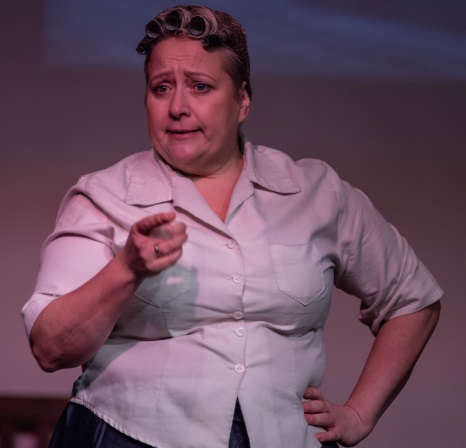
“Mrs Brooker”
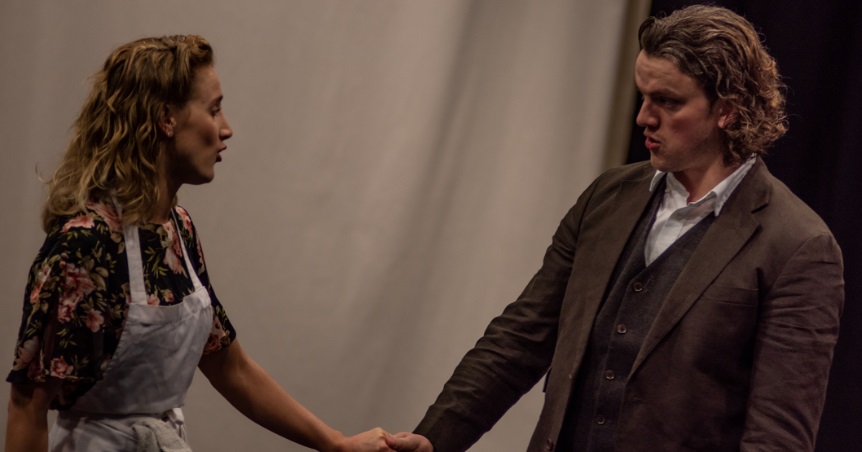
“Winnie, the Brooker’s maid, and Orwell”
in September 2023, to mark the opening of Wigan’s restored Royal Court Theatre. Put a note in your diary, as the Orwell Society will be turning out in force to cheer it on.

Orwell’s son, and ‘father’ on the right!
Like everything in Wigan – and like Orwell’s book – the show and its staging are multi-layered and gave rise to a lot of conversation in the cheery meet-and-greet with the cast and crew which followed the performance. The town’s vigour was apparent in the way in which Alan and his collaborators had harnessed every kind of local resource to literally put on the show, and how the third sector is driving innovation, local pride, and change.
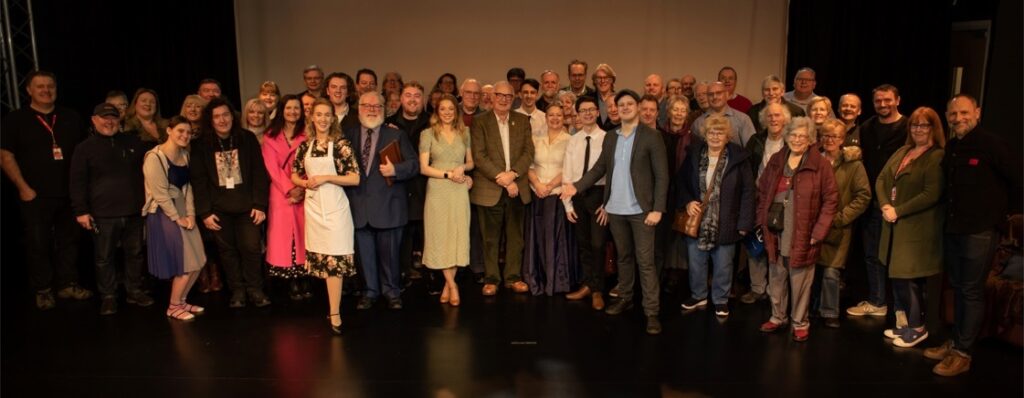
Cast, crew, friends, and Orwell Society Members
Echoing the last time that the Orwell Society went to Wigan, it was interesting to hear how Wiganers’ attitudes to Orwell modified when they read his books. Along with the show, this provided a rich vein of conversation in the Swan and Railway Hotel where we had lunch – pies, of course, as Wigan runs on pies. They alone should guarantee the town’s resurgence.
Orwell in a sense put Wigan right on the map – but at what cost? Wigan is still a deprived town, but that isn’t its totality. So how to make the best of their famous visitor’s legacy? The Orwell Society has collaborated with the Museum of Wigan Life to create a permanent exhibition called, with Orwell’s clarity, “Orwell at the Museum of Wigan Life”. It is located in the Wigan Archives, the library on the first floor of the museum building – the very library in which Orwell did his research. Aside from the modern lighting, the library, which holds Peter Davison’s collection of books by and about Orwell, is almost unchanged since Orwell made such great use of it in the 1930s.

Where Orwell conducted his archives research
It was here that Richard Blair and the Mayor of Wigan officially opened the exhibition at the start of an afternoon event which included several stimulating and contrasting talks. Class issues came up repeatedly, along with Orwell’s stance as an outsider apparently judging Wigan by southern middle-class standards. Local student Chloe Heaton, winner of the Orwell Foundation’s Youth Prize, compared deprivation in Wigan in 1936 with the situation today, contrasting the forms of deprivation and musing on the “othering” that continues to dog consideration of equality issues in the north of England; Yvonne Eckersley looked at how magistrates treated miners in 1844, continuing the theme of the odds being stacked against the workers through a system designed to benefit others, though adversity also brought pride and solidarity. By contrast, Michael Howard revealed the astonishing works of working-class Wigan artist Theodore Major who saw his art as a means of arriving at the truth and of illustrating injustice – in his “Wigan Crucifixion” it is Authority which kills the people. Of a similar age to Orwell, Major’s view of him was, er, vigorous, however.
Alan Gregory and local poet Terry Burtonwood rounded off the afternoon on a lively note with a sketch about Orwell in a modern context (if we’re all so much better off, how come there are food banks?) and then a selection of Terry’s lively, poignant, and hilarious poems, several of which dealt with Orwell in Wigan (and generally). He then presented Richard Blair with his paintings based on Orwell’s life and writings, and generously gave us all A5-sized printed copies as souvenirs.
On the way to the last event of the weekend – short monologues and dialogues based on Orwell’s writings, and more of Terry Burtonwood’s delightful poems – we detoured to what appeared to be a random bit of hummocky grass unclaimed after slum clearance. There, by the side of a dimly-lit street was a mossy stone plaque memorialising the site of the Brooker’s tripe shop – 22 Darlington Street. It wasn’t just the bitter wind that made us shiver.
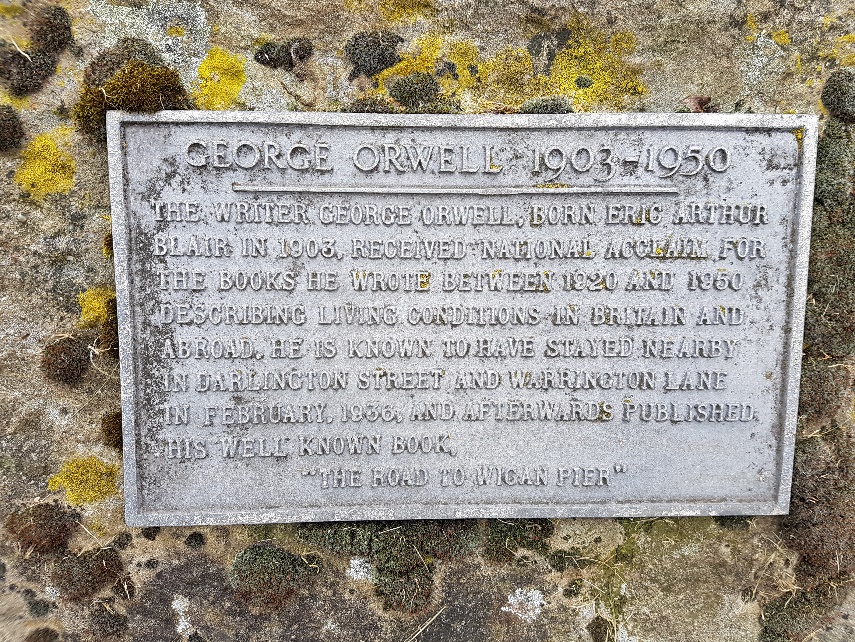
Plaque in Scoles on the Darlington Street/Warrington Street Junction Wigan
The event was held in Sunshine House, a vibrant community centre in the midst of an inner-city community. Sunshine House provides a space for support groups, advice services on social and welfare rights, and classes – it’s where Terry Burtonwood was encouraged to write. It runs a café with affordable prices and, during the pandemic, kept local people going. It epitomises the best in community spirit and would undoubtedly have Orwell’s whole-hearted approval – though what he would have made of the coffee machine, with its lattes and cappuccinos, is anyone’s guess.
What would George do now? In the troubled times in which we made the visit to Wigan Orwell, ever relevant, seemed even more prescient (President Putin had just outlawed the use of the word “war” in Russia). By contrast, Wigan’s cheerful and determined resurgence pointed to the triumph of common decency that Orwell constantly advocated. If Orwell’s definition of socialism is “common decency”, then everyone we met in Wigan is a socialist.
A great and hopeful trip.
*
Leave a Reply