
Orwell’s Elephants
In Orwell’s Burmese Days, John Flory works with elephants; in his essay “Shooting an Elephant,” Orwell kills one. Lieutenant-Colonel James Howard Williams, the author of Elephant Bill (1950), explains what it was like to handle elephants in the jungle and to confront a dangerous animal during musth (sexual heat). Wikipedia provides some useful biographical background. Williams (1897-1958) was a British soldier in World War I and elephant expert in Burma when Orwell worked there in the 1920s. He was born in St. Just, Cornwall, the son of a Cornish mining engineer, who had returned from South Africa, and his Welsh wife. Educated at Queen’s College in Somerset and at the Camborne School of Mines in Cornwall, he was an officer in the Devonshire Regiment in the Middle East and served with the Imperial Camel Corps as a transport officer.
After demobilization he read H. P. Hawkes’ The Diseases of the Camel and the Elephant (1898), and sought work in Burma. In 1920 he became a Forest Assistant with the Bombay Burmah Trading Corporation, which used 2,000 elephants to extract teak logs. He set up his headquarters on the banks of the Chindwin River in Upper Burma, and was responsible for 100 elephants and their oozies (elephant handlers). His ten camps, covering about 400 square miles, were seven miles apart and surrounded by hills four thousand feet high. After being marked for three years—seasoned, waterproof and light enough to float—the trees were cut down.
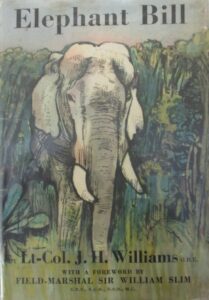
Elephant Bill, written in a clear and lively style, reads like a boys’ adventure book, with many thrilling dangers and narrow escapes. Williams gives the animals human qualities: he describes what elephants think and feel, and what they would say if they could speak: an elephant “seemed to look at me as if to say: ‘And you call yourself a jungle man!’ ” (138). To build up their herds, the Bombay Burmah Corporation imported most of their elephants from Siam. During his two decades in Burma, Williams acquired extraordinary expertise: “I could speak Burmese, I knew the roads, rivers and railways of Burma, I knew the Irrawaddy River area, and most marvellous of all I knew the jungle tracks!” (184-5). He explains that “as teak grows best in country which is inaccessible to tractors and machinery, elephant power is essential for hauling and pushing the logs from the stump to the nearest stream” (23). After the elephants hauled the teak down to the river, the logs were rafted to the sawmills in Rangoon.
Williams notes, “June to the end of February are working months, while during the hot weather season, from March to May, animals should not work, there being insufficient fodder and water for them in the teak-bearing deciduous forest areas. Each month consists of only eighteen working days and twelve rest days, animals working three days in succession and then resting two” (76). All the animals were frequently and closely inspected. The most common wounds came from the rubbing of equipment on their hides and the bamboo splinters in their feet. When an elephant died, Williams crawled inside the massive corpse to discover the cause of death. He also discovered some unusual facts. The ravenous Burmese ate the dried and cured meat of the elephant. It can accurately use its trunk to fling dung at people. Elephants can swim as long as a mile when crossing a wide river and “will submerge entirely for brief periods when in deep water” (95).
Williams was well suited to the lonely life in the jungle, which included drinking, shooting and riding. Orwell’s Flory, who hated that life, added bitching, mocking and fornicating. Unlike Flory, Williams was in a remote place, without machinery, completely dependent on elephants to do the work and entirely on his own. Orwell writes that Flory “had no right to be loitering in headquarters, for at this time of year the work of timber-extraction was in full swing, and in his absence everything went to pieces. . . . One of the elephants was ill, the engine of the light railway that was used for carrying teak logs to the river had broken down, fifteen of the coolies had deserted.” When Flory returns to the jungle, he must deal with these pressing problems: “the sick elephant was worse than ever, and a vast pile of teak logs which should have been sent off ten days earlier were still waiting because the engine would not work.” Orwell describes the machine as if it were an animal when Flory “struggled with the bowels of the engine until he was black with grease. . . . The sick elephant was discovered to be suffering from tapeworms” (Burmese Days, 119, 207). Dr. Veraswami sends medicine for the elephant, and Flory manages to unravel and extract a disgusting, serpentine 20-foot tapeworm. He was lucky to be only 20 miles from town and able to get medicine from his friend.
Williams also explains how a dangerous animal behaves during “musth.” Elephants and camels are the only animals in which both males and females come into heat. Elephants’ “musth” causes heightened aggression and unpredictable behavior from a surge in the level of testosterone. Williams writes that the condition is “shown by a slight discharge of a strong-smelling fluid from the musth glands near the eye. . . . It occurs annually during the hot months, the mating season. It may last about two weeks, during which time he is very temperamental. . . . A male elephant will mate when he is not on musth, in fact he usually does. But when he is on musth all the savage lust and combative instincts of his huge body come out. . . . Unless he is securely chained to a large tree while on musth he is a danger to his oozie and to other elephants. His brain goes wild, as though nothing would satisfy him, and nothing will”—except a female elephant (63).
An incident, similar to Orwell shooting an elephant in heat, was reported under the headline “Rogue Elephant Shot” in the Rangoon Gazette on March 22, 1926. Major E. C. Kenny, subdivisional officer on tour, “came across a rogue elephant and brought it down to the delight of the villagers. The elephant had killed a villager and caused great havoc to the plantation. It is not known whether or not this is the elephant claimed by the Bombay Burmah Trading Corporation” (Meyers, 344n21).
George Stuart, Orwell’s police colleague who was on the scene when Orwell shot the elephant, recalled: “When a message was brought to the club in Moulmein one Sunday morning, Orwell ‘went off in his old Ford to pick up a rifle and went in search of the elephant which was causing great damage on a semi main road and causing danger to life and limb and shot this elephant.’ He was very nonchalant about the whole affair, but got into serious trouble because the elephant was valuable and because of the ‘influence these big timber firms had over the government’ ” (Meyers, 70-71). In the 1920s a Burmese elephant was worth more than £100 ($4,400 in today’s money). The police chief was especially angry and transferred Orwell to the less desirable post in Katha.
Orwell’s autobiographical account, which differs in many ways from Stuart’s factual report, describes the tropical atmosphere, the swelling audience and his own troubled feelings. At the beginning of the rainy season, Orwell hears that an elephant in heat has broken loose from its restraining chains and that its handler has disappeared. Instead of driving a car, carrying a lethal rifle and maintaining a cool attitude, he mounts a pony and grabs an old Winchester rifle that is much too small to kill an elephant. He rides to the poverty-stricken shanty-town where the elephant has ravaged the bazaar and crushed a Dravidian (south Indian) coolie, whose face is twisted in agony. Emphasizing the power of the wild animal, Orwell writes, “the elephant had come suddenly upon him round the corner of the hut, caught him with its trunk, put its foot on his back and ground him into the earth” (“Shooting,” 10.503). Orwell sends back his pony, “not wanting it to go mad with fright and throw me if it smelled the elephant” (503). He is naturally nervous about confronting the rampaging animal in front of a large and hostile crowd of 2,000 people, who have gathered to witness the spectacle, and does not intend to kill the elephant.
The logic of Orwell’s essay, which makes the moribund elephant symbolize the British Empire, is not entirely convincing. For dramatic effect Orwell is not nonchalant, but deeply conflicted and faced with a genuine dilemma. Just as he arrives to shoot the elephant, it unrealistically goes off “musth,” suddenly calms down and quietly eats grass with a gentle, feminine and grandmotherly air. The temporarily peaceful elephant could eventually be recaptured by handlers and chained down. But his “musth” has lasted for a month and made it dangerous during that time, and with the next surge of heat he could quickly revert to savage and aggressive behavior. It has already killed one man and could certainly kill others.
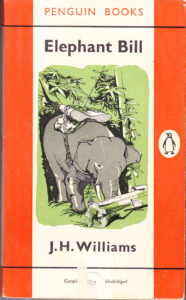
Brutalized by the colonial system, out for blood and glory, and surging with adrenalin, Orwell not only has to shoot the elephant to save face but actually wants to shoot it. In contrast to Stuart’s report, he does not get into serious trouble. His official position allows him to legally destroy the huge and valuable four-ton elephant, and to get away with it. As a policeman, he has a valid excuse. Since the owner is only an Indian (like the dead coolie), not a powerful timber company, he cannot claim compensation. It takes considerable skill, especially for a novice, to kill an elephant for the first time. Orwell admits, “I was a poor shot with a rifle and the ground was soft mud into which one would sink at every step” and be crushed like the coolie (504). It’s useful to know, when Orwell shoots it “sideways on,” that “an elephant cannot see behind it by merely turning its head, it has to half turn its body” (Williams, 137). Orwell hits the elephant with the first shot and keeps firing till he has no more bullets. But he sympathizes with the senescent victim and feels guilty about the cruel slaughter: “[The elephant] looked suddenly stricken, shrunken, immensely old, as though the frightful impact of the bullet had paralysed him without knocking him down. . . . He was dying, very slowly and in great agony” (505).
*
References
This contribution complements my article, “The Timber Industry in Burmese Days,” Orwell Society Journal, 16 (Spring 2020), 19-21.
Meyers, Jeffrey, Orwell: Wintry Conscience of a Generation, NY: Norton, 2000.
Orwell, George, Burmese Days (1934) and “Shooting an Elephant” (1936), Davison, Peter (ed.) The Complete Works, Vols. 2 and 10, London: Secker & Warburg, 1998.
Williams, J. H., Elephant Bill, Garden City, NY: Doubleday, 1950.
Jeffrey Meyers, FRSL, has published A Reader’s Guide to George Orwell, Orwell: The Critical Heritage and Orwell: Life and Art.
Thanks Jeffrey,
cheers
Quentin