
Airstrip Two
The Orwellian Story of the World’s Busiest Airport
*
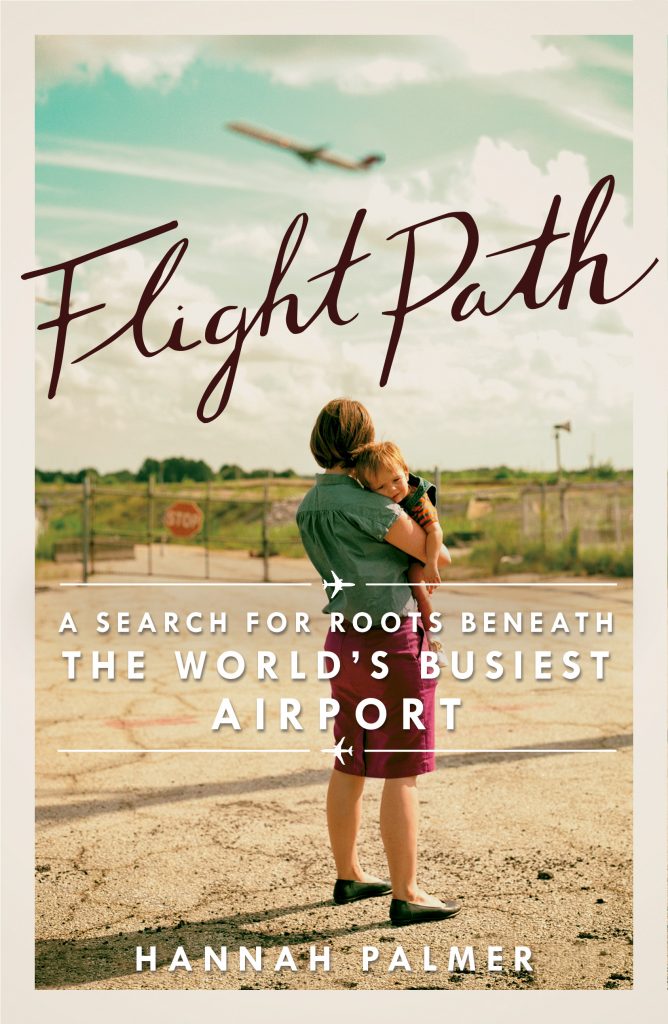
A peculiar thing happens when you read George Orwell’s Nineteen Eighty-Four too many times: you begin to see the dystopian world Orwell envisioned everywhere you look. With a prescience that foresaw the horrors that would offset the boons of technological advancement and a keen grasp of a human nature driven by power and profit, Orwell forewarned the world of a time when the quality of life would be subordinated to economic expediency and the will of the state. And even in seemingly stable democratic societies, morphed yet tangible glimpses of the world Orwell imagined are easy to discern, creating, in a sense, sequels and threequels to his novel ad infinitum, though Orwell, we know, would have frowned on the Latin term. I recently experienced one such case of this Orwellian déjà vu when I came across Hannah Palmer’s 2017 memoir Flight Path while searching for some local lore during a pre-Covid-19 trip to Savannah, Georgia.
While Savannah seems almost stuck in time, Hannah Palmer hails from the other side of the Peach State, and her formative years, as she describes them, were not exactly steeped in the slow-going, genteel traditions of the old South. Instead, Palmer spent her childhood in Atlanta, home of the world’s busiest airport, and growing up in its shadows marked her indelibly in ways she continued to struggle with into adulthood. Palmer says of her youth: “it felt like a giant eraser followed me from place to place, wiping away my past” (10), and in many ways it did. Palmer’s family, it seems, had occupied at least four different houses in Atlanta while she was growing up, yet all of her family’s former homes share the bizarre distinction of having been demolished or moved (yes, physically hoisted and relocated) to accommodate the ever-expanding Hartsfield-Jackson International Airport. But it wasn’t only Palmer’s former homes that were swallowed up by the memory holes of urban “progress”; vast swaths of the working class Atlanta suburb disappeared as well, leaving Palmer—and surely many others—strangely bereft.
In an attempt to make sense of it all, Palmer embarks on a quest to revisit the landscape of her childhood. The unsettling account of her findings is not only rivetingly Orwellian, but also eerily analogous to Orwell’s novel in the quirkiest of ways. It seems a stretch of the imagination to suggest that a 21st century southern American memoir could in any way parallel Orwell’s thoroughly British novel, and admittedly, on the surface, the two narratives have little in common. Yet for those with an eye for the Orwellian, it is easy to recognize the same thread of despair woven throughout each. This very strand, in fact, serves as the driving force behind Winston Smith’s diary and Hannah Palmer’s memoir, both born of a desire not only to leave behind a warning for future generations, but also to reify a past Smith and Palmer can only viscerally intuit. And examined together, the two texts suggest a universality of emotions associated with the loss of rootedness or sense of place, an experience Orwell poignantly, if only peripherally, described in 1949 and Palmer, in a curiously comparable way, revisited and explored 68 years later.

Winston Smith’s subconscious pining for an almost forgotten past is made evident the moment he takes pen in hand to scrawl random thoughts on the creamy leaves of a diary made a half century earlier. The gloom of his surroundings paradoxically prompts a nebulous yet unquestionable awareness of a happier time in the past, impelling him to ponder: “Why should one feel [the present] to be intolerable unless one had some kind of ancestral memory that things had once been different?” (55). Hannah Palmer, though less subliminally, also yearns for a connection to a past in a place that has been utterly changed. Prodded by these longings, the two set out on personal journeys. Thwarted by various roadblocks, however, they find few concrete signs that confirm the terrain of their respective childhoods ever existed at all, and proof, when it can be found, amounts to little more than gut feeling.
In the hostile topography of the new normal, trinkets and shards of a shattered past assume a haunting relevance in both accounts. An antique glass paperweight found at a junk shop enchants Winston Smith; as he gazes at its embedded pink coral through fathoms of ripply, watery glass, its seeming depths arouse primal memories of an equally unfathomable past. A pink relic appears in Palmer’s narrative, too—a fractured piece of tile—worthless, yet for a local judge, a treasure steeped in emotion and memory. A family friend, the judge accompanies Palmer on a search for the site of her old Barnett Road residence. Palmer fears the house may have been burned to the ground in a fire department training exercise, though she never finds conclusive evidence to confirm this suspicion. The dwellings that once surrounded hers, including the home of the judge’s grandmother, have since been bulldozed and replaced by a warehouse complex bearing the oddly Orwellian designation “Air Logistics Center II” (81). The judge recounts returning to the site after the demolition and finding the fragment of tile that had once adorned the walls of his grandmother’s bathroom. Regrettably, he eventually misplaces it; thus, even this little memento, proof of a past that now exists only in his memory, is lost to the judge forever. In much the same way, Winston’s paperweight, seemingly imbued with the mysteries of the past, is ultimately smashed to bits, leaving Winston, as Orwell perhaps thought of it, one orb less, one world less.
The two texts again explore the power and implications of memory in passages describing the nostalgic fascination triggered by old children’s jingles. While neither Smith nor Palmer can precisely pinpoint the association, an evocative rhyme sensorily stirs lost or buried memories in each of them: for Smith, it is the verses of “Oranges and Lemons,” and for Palmer, the lines of “Poole Creek.” When each receives unexpected validation of the former prevalence of the jingles, the two react in nearly identical ways. Winston Smith, for example, remembering a “fragment of a rhyme” he had learned from Mr. Charrington, one day recites it, “half-nostalgically”: “‘Oranges and lemons say the bells of St. Clement’s!’” He is astounded when Julia caps the line for him, and her words affect him almost like an incantation:
“‘You owe me three farthings, say the bells of St. Martin’s,
‘When will you pay me? say the bells of Old Bailey— ’” (135).
Julia explains it was her grandfather, vaporized when she was eight, who taught her the rhyme (136), and while she “can’t remember how it goes on after that,” she knows it ends ominously: “‘Here comes a candle to light you to bed, here comes a chopper to chop off your head’” (135).
Palmer has a nearly identical experience researching the proletarian neighborhoods of Plunkett Town and Poole Creek, former black neighborhoods that were swallowed up by airport expansion. Searching for information about the area on online message boards, Palmer says: “a strange line jumped out at me: ‘I can tell by your feet that you come from Poole Creek.’” She immediately recognizes it as “an insult, a playground taunt,” and a local familiar with the region confirms this, explaining: “‘It means you look broke.’” Later discussing the incident with her father, however, Palmer experiences the same thrill of amazement Winston had felt:
Imagine my surprise when I start to share this little artifact with my dad and he finished the rhyme for me. He remembered the line from childhood and said it had a similar meaning for white kids in Forest Park in the 1950s. It was a way of calling someone poor or low class. It was an insult lobbed at the kids from Blair Village [Blair Village!]. But he couldn’t explain clearly what Blair Village was, or where, exactly (170-171).
In both cases, a children’s rhyme evokes a nebulous memory with roots that begin at least a generation earlier, and an almost hardwired significance continues to resonate in profound if little understood ways in both Smith and Palmer.
Even the very act of speaking has been oddly complicated in equal yet opposite ways in Airstrip One and the environs of that other Oceanic airstrip, the Atlanta Airport. Ever cautious of being surveilled or overheard, the disgruntled Party members of Orwell’s novel become adept at speaking without moving their lips in order to shield themselves against any unconscious labial betrayal (119). Similarly, Palmer points out how the art of reading lips has become a vital skill for those forced to communicate in the ever-present din of the airport. She describes a conversation with Dell Thompson, former owner of Dell Air, an equivocally named heating and air conditioning shop in one of her old airport-bordering neighborhoods: ‘The whole time we were talking, we were also lip reading. It’s a skill, he joked, that was part of growing up in Mountain View” (75).
Perhaps the most disturbingly Orwellian passage of Palmer’s entire narrative, however, is the one that describes how a College Park neighborhood was literally blown up in the making of Chuck Norris’s action thriller Invasion USA, filmed in Atlanta—(should we not by now expect it?)—in 1984. Palmer describes the neighborhood as depicted in the film:
It . . . looked like any early 1960s neighborhood on the southside—modest brick ranch houses notched into a hill, surrounded by full and towering pines. They had picture windows with white shutters and long driveways and carports where station wagons and boats were parked. The scene was shot at night, presumably on Christmas Eve, and their eaves and holly bushes were loosely draped with strings of red and green bulbs (113).
It begins innocuously enough: “The scene opened with an instrumental version of ‘Hark the Herald Angels Sing’ as a pack of kids scampered from their bikes to their front doors for supper” (113-114). Noticing the unadorned bough at the top of the tree they had been decorating, a young girl precariously ascends a tall ladder to place a star. But the film then takes a sinister turn as bazooka-laden bad guys roll up in a large pickup before taking aim at the humble houses. Palmer describes the shocking scene:
The first blast jogged the camera. Blurry extras ran screaming as the house exploded. In slow motion, the fireball hurled an entire door, still attached to its jamb, across the yard. [The] ladder toppled away from [the] Christmas tree. (114)
Reading her words with an Orwellian eye evoked images of the war film Winston Smith described in his diary (8), and I could not help but envision a child’s arm flying into a night sky backlit by fire.
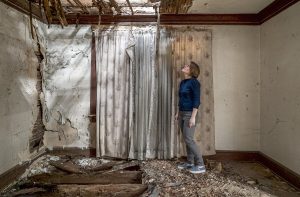
Hannah Palmer in the former King/Goss house.
Photo by David Naugle
Although Palmer says she could not bear to watch the entire film, viewing that single YouTube clip provided her with enough information to put the location in context. She explains: “The production crew didn’t bother to change the street signs, so I was able to freeze on a frame that included a tiny ‘First Ave’ sign and then locate First Avenue on a 1969 airport map. . . . The airport’s rental car center covers it now” (114). Doing some sleuthing in local archives, Palmer found detailed records of airport-acquired properties dating from the 1980s through 2009, including the First Avenue parcels used in the film. She describes the “strange and unbearable” experience of scrolling through “pages and pages” of real estate transactions: “I knew that every single line of data represented a family, a business owner, or a pastor seated across from a team of attorneys at a closing table. Each line on the spreadsheet marked a turning point.” Of the 571 transactions she counted in the airport’s “Noise Land inventory,” which included the First Avenue properties, she says:
Closing dates clustered around 1984, 1985, and 1986, which means that during the production of the film, this area wasn’t completely vacant. While the buyouts were still in progress, high-powered explosives were violently shaking the neighborhood. Invading, indeed. (116)
Orwell’s novel once again came to mind, and I found myself wondering whether a severed hand, covered in white plaster dust, might have landed at some College Park curbside, to be kicked aside by one of the residents who had not yet evacuated the neighborhood.
Palmer points out that the director of a documentary called The Making of Invasion USA, proud of his work, even boasted about the blasting: “We did, in fact, really destroy the neighborhood” (116). Palmer’s personal feelings about the explosive demolition of blue-collar homes her mother had given the plebeian nickname “breeder boxes” (188), however, clearly differs from those of the director. She describes watching “some B-roll footage of the crew decorating the outside of houses with tinsel and lights in their final hours . . . ,” adding:
The interior shots of pyrotechnicians rigging one house with mortars were even more poignant. Here were rooms from 1984 that matched a whole catalog of ghost houses from my childhood. A quick shot of patterned linoleum in the kitchen, a dark floor register in the carpet, candy pink tile in the bathroom. I watched this part in slow motion. (116)
It is unlikely that the director ever considered the emotional repercussions the destruction might have on former residents whose childhood memories were linked to things like pink bathroom tile, but Palmer makes it clear:
An attack on suburbia on Christmas Eve is an intentionally disturbing scene, but it made my stomach hurt for different reasons. While most airport homes were unceremoniously demolished, the near-pornographic destruction of this corner of College Park is stashed on YouTube for all to witness. (114)
In one of the final chapters of the memoir, Palmer describes the redevelopment of the small-town Hapeville section of Atlanta into the high-flown (pun intended) Aerotropolis Atlanta. Intrigued by the concept of a city built to accommodate an airport, I visited the Aerotropolis Atlanta website and was greeted with a slogan steeped in doublethink: “Land Here, Take Off.” To accommodate the masses the Aerotropolis was projected to attract, an upscale new residential complex named Asbury Park was erected nearby and marketed with the slogan “When You’re Here, You’re Everywhere.” While never directly labeling the logically untenable marketing slogan of the complex “doublethink,” its contradictory nature had clearly registered with Palmer, who questions: “How could you be here AND everywhere?” and “How was that different from being nowhere?” (188).

I recently asked Hannah Palmer what she had learned from this exploration of her past, and she replied: “That the feeling of loss and exile I felt over these houses was specific to the ambitions of Atlanta but also universal to anyone with complicated feelings about ‘home’ and how places change.” And in referring to the geographically orphaned and their feelings of loss and exile, Palmer had unwittingly identified the complex emotions that crystallize as the very thread that curiously connects her memoir to Orwell’s Nineteen Eighty-Four. Or perhaps I’ve just been reading too much Orwell . . .
This may be, but one thing is certain: people all the world over are now aware of what was going on in George Orwell’s Airstrip One in 1984. But outside of Atlanta, Georgia, not many know that in that same year, in another part of Oceania, entire towns were being consigned to the memory hole, forever obliterated in the name of “progress”: the building of Airstrip Two, the Atlanta Airport.
*
Carol Biederstadt expresses her sincere thanks to Hannah Palmer. Our thanks to her for the photo permissions.
Works Cited
Orwell, George. Nineteen Eighty-Four. 1949. Longman, 1983.
Palmer, Hannah. Flight Path. Hub City Press, 2017
Leave a Reply