
Barcelona and Aragon 2026: I
Orwell Society trip to Barcelona and Aragon
2026
Barcelona report
by Russ Davidson
Monday 11th May
The evening of the 11th began with an unexpected benefit—a sold-out talk we were invited to attend by the West Bank-based journalist Mariam Barghouti given in Barcelona’s Centre for Contemporary Culture. Part of the city’s ‘Día Orwell’ events and entitled “Orwell and Palestine: Language as a Weapon,” her talk illustrated how Orwell’s lessons on the manipulation and deceptive use of language have continuously played out in the Western media’s coverage of events in Gaza and the West Bank. Richard and Quentin also made some remarks around the Orwell Society’s visits to Spain and the various purposes they serve, not only to retrace some of Orwell’s footsteps and personal experience in the Spanish Civil War but to help keep alive the message he conveyed in Homage To Catalonia. Then, on a lighter note, it was off to dinner at the Can Margarit restaurant, notable—as previous reports have described—for its huge wine barrels past the entryway and its specialty dish of grilled rabbit.
Tuesday 12th May
There was nothing on the agenda for the next day until the middle of the afternoon, but several in the group decided to take in an installation of some fifty charcoal sketches by the Spanish artist José Luis Reyes Vila (better known as “Sim”) currently up in the National Museum of Catalan Art. These recently acquired sketches, in which Reyes Vila tried to capture—as an on-the-ground witness—the street fighting, trauma, and violence of the first days of the war form part of the Museum’s permanent ‘Art and the Spanish Civil War (1936-1939)’ exhibition. Following Barghouti’s talk, this museum excursion more than set the stage for the first ‘official’ event on the program—a tour later that day of some of the bomb shelters, in this case those snaking under the Plaza Diamant, built to protect citizens from enemy bombardment. [Picture 1B] The shelters, in which women and children sat and men stood, with barely enough room for each, lie thirteen meters below street level. The tour was led by a local historian (and translator Ana Sánchez) who has worked for years with colleagues to preserve the shelters as testimony to the solidarity among workers and residents in this still working class, left-leaning neighbourhood.[Picture 2B] After emerging from the shelter tunnels, we walked some blocks to get on a bus which took us to the site of the evening’s event, and a definite highlight of the time in Barcelona: visiting the Benjamin Franklin International School.
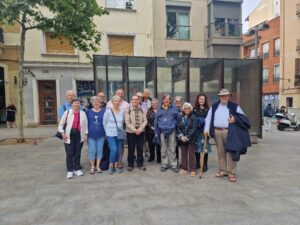
Plaze Diamant
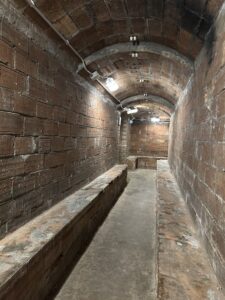
Air Raid Shelters
One of the school’s buildings, as many already know, was formerly the Sanatori Maurin where Orwell convalesced after taking a bullet in the neck. The building is now called the Orwell Building because—as Quentin related in the Autumn 2024 issue of the OS journal—the School recognizes and celebrates the match between its values and those that Orwell stood for and defended. We were warmly greeted (bottles of cava included!) by Head of School Lila Jorge and her staff, who were all curious to know what motivates Society members to return regularly to Spain. There was a tour of the upper part of the building where Orwell recuperated, though the exact room where he stayed is unknown. Everyone then moved to the library, where along with staff and families we were treated to a lovely meal and remarks by Richard and Quentin, [Picture 3B] who answered questions from parents and students about George Orwell, his writings, the work of the Society, and the connection to Spain and Barcelona. It was an inspiring evening.
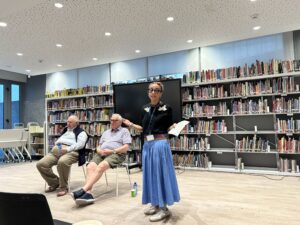
Wednesday 13th May
The next morning began with a walk up the Ramblas (currently a frightful mess because of extensive renovations) to the Poliorama, where we were met by Nick Lloyd whose book Travels Through the Spanish Civil War came out in late 2025. This building, the elegant Royal Academy of Science and Art, was where Orwell holed up in early May 1937 as Barcelona gave way to fateful in-fighting and open street battles between factions and parties of the left. Nick led us up to the top floor of the building, where a large vertical glass bookcase has been placed, containing multiple editions of Homage to Catalonia (many donated by Nick). From there we climbed, two by two, up the fragile spiral staircase that leads to the building’s roof, on which Orwell spent three consecutive days (with brief intervals to dart across the street for food) during the May Days fighting, and down which he eventually climbed, famously, with a rifle concealed in his trousers:
Even a man as tall as I am cannot wear a long Mauser down his trouser-leg without discomfort. It was an intolerable job getting down the corkscrew staircase of the observatory with a completely rigid left leg. Once in the street, we found that the only way to move was with extreme slowness, so slowly that you did not have to bend your knees.
After the visit to the Poliorama, we were led by Nick to other sites in the vicinity that pertain to Orwell’s time in the city, among them the Teatro Principal, which served as the headquarters of the local committee of the POUM militia when Orwell arrived in Barcelona, and the former Hotel Falcón, where foreigners associated with the POUM typically stayed. [Picture 4B] The latter, taken over by the POUM in July 1936, is now the Biblioteca Gotìc Andreu Nin. Nin, POUM’s leader, was assassinated in June,1937. There is a commemorative plaque to him on the Ramblas that we had viewed shortly after leaving the Poliorama. Our final activity of the late afternoon involved returning to the Andreu Nin library to hear a talk by historian Andy Durgan on the topic: Orwell, the POUM and the Spanish Revolution, drawing out themes from his book Voluntarios por la revolución: la milicia internacional del POUM en la Guerra Civil Española (English-language paperback edition to appear in November 2026).
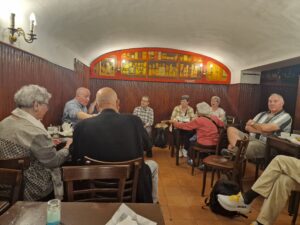
The day was topped off by a festive dinner at one of Barcelona’s most iconic restaurants, Los Caracoles, where on the way into the labyrinthine interior one passes through the kitchen. After dragging ourselves down the next morning to the common room of our Barcelona hotel (do not contemplate this trip if you wish to go to bed before midnight!), we set off for the Metro, first leg on the day’s journey to reach our next destination: Huesca, in Aragón.
*
Russ extends thanks to Maureen Gilbert for her copious notes that helped contribute to the compilation of this report.
Part Two of the ‘Orwell Society trip to Barcelona and Aragon 2026’ can be read here.
Thanks for the excellent report Russ, which brings back great memories of this unique experience in Barcelona. I enjoyed recalling highlights such as the visit to the Poliorama under the expert guidance of Nick Lloyd, and the gracious welcome we received by the staff, students, and parents of the BFIS (formerly the Sanatorium Maurin). Great work!