
Barcelona and Aragon 2026: II
Orwell Society trip to Aragon
Huesca report by Angela Smith
Thursday 14th May
We left our hostel in Barcelona to travel in a fleet of two hire cars towards our next accommodation in Huesca. This is about 180 miles west of Barcelona and is the site of the front line where Orwell served during his time in POUM. The motorway route offered us spectacular views of mountains outside Barcelona and across the plains of Aragon, which distracted us from a friendly rivalry between the cars as to the use of satnav (Team Glynn) or personal recollection (Team Quentin).
We stopped in Sariñena, where the local Orwell enthusiasts have for several years organised Aragón Orwell Days. Richard and Quentin took part in a Q&A to help launch the English language version of Homage to Catalonia and Aragon. [picture 1] This book, by Salvador Trallero, enhances our understanding and appreciation of Orwell’s work through the addition of a new section, liberally illustrated with contemporary photographs and maps, to better explain the Spanish Civil War. We all purchased copies, some of us leaving with several! After the Q&A, we were shown a plaque to Orwell on a near-by building, featuring a mural of a bunch of red roses. We were then treated to a fantastically Orwell-themed lunch with members of the Monegros tourist board. [picture 2] They also organised a pre-emptive birthday cake for Richard. The enthusiasm for all things Orwell continued, as we were shown an exhibition in café Trallero, where there is a permanent exhibition of photos and posters relating to Orwell. The Barnhill slate plaque that had been gifted to the Aragón Orwell Days members on their last visit was unveiled by Quentin and Richard as a permanent reminder of link between the Orwell Society and Sariñena. [picture 3]
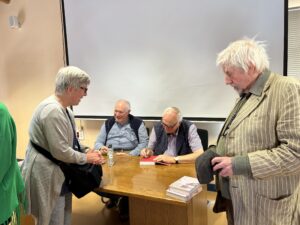
Aragon: Picture 1
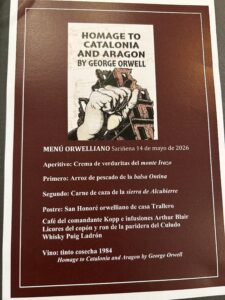
Aragon: Picture 2
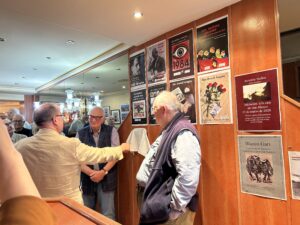
Aragon: Picture 3
We finally arrived in Hotel Abba in Huesca with just enough time to deposit our bags before heading out for dinner.
Friday 15th May
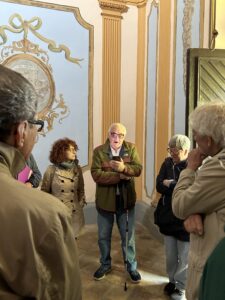
Another early start, with the morning set aside for a guided tour of Huesca. We were met by our wonderful guide, Deborah, from the Huesca Tourist Office. This tour started in the amazing La Confana, a grocer’ shop on the old market square that claims to the oldest in Spain (established in 1871). The shop’s basement houses a display of automatons and curios made and assembled by the current proprietors. We then visited the Abbey of San Pedro el Viejo, which is a beautiful former Benedictine monastery built in the Romanesque style of the 12th century. We were shown the restored pillars of in the Cloister, showing scenes from the Bible and in particular the Seven Sins. [picture 4]
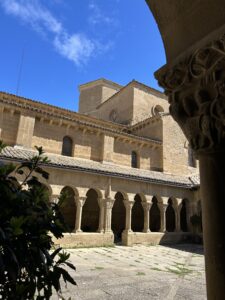
Aragon: Picture 4
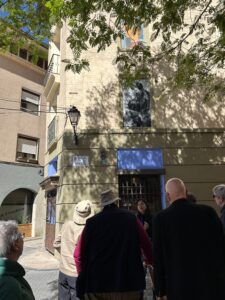
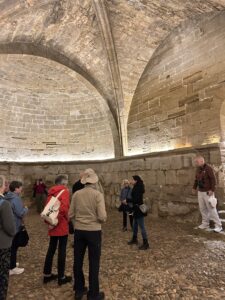
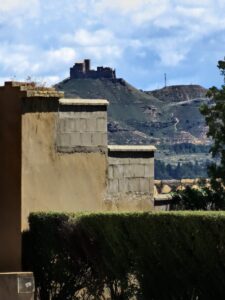
On our way up to the Cathedral, we saw murals to the artists Conchite and Ramon Acin, Anarchists who were murdered in 1936 for their anti-fascist beliefs. [picture 5] After our visit to the Cathedral, Deborah’s excellent tour took us into the town hall where she showed us an immense Huesca Bell picture by José Casado del Alisai, which depicts the legend of how Romaro II of Aragon cut off the heads of twelve nobles who did not obey him in order to bring the rest of the militant nobles to order. We were then treated to a tour of the windowless chamber where this grisly legend is said to have taken place, after which we were very glad to emerge into the sunshine. [picture 6] The town hall stands on the highest point of the hill at the heart of Huesca and, thanks to recent tree-cutting, there is now a clear view over the plain to Montearagón castle, which we would be visiting on Sunday. [picture 7]
Aragon: Picture 5
Aragon: Picture 6
Aragon: Picture 7
After our walking tour of Huesca, we met our guide for the next few days, Victor Pardo Lancina, and the wonderful Elena, our translator. Victor is a long-time friend of the Society and has a genuine passion for battlefield archaeology and local history. He would be our guide for the tour of the Orwell-related sites around Huesca. As we drove out of Huesca, we were treated to the sight of huge white storks in the surrounding fields, giving the whole place a rather exotic feel. We started in Poleñino, which is the site a front-line hospital during the Spanish Civil War. Victor explained the international nature of the medical staffing, with nurses from Australia and doctors from Spain and Britian.
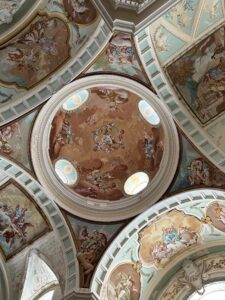
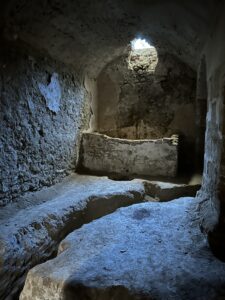
We then drove off into the hills and to the preserved bunker at Lanaja. This bunker offers views across the Aragon plain of the white roads that connect Huesca to the wider Aragonese area. From this windswept hillside, we were glad to reach the shelter of La Cartuja de las Fuentes, a monastery at Sariñena. This building complex is the subject of a long-running restoration project. The site was used by both sides during the Civil War, and the amazing murals by Goya’s brother-in-law, Manual Bayeu, have recently been restored with the detail in the painting only visible when seen on the photos in a small exhibition there. [picture 8] Our site guide, Martín, also took us through an overgrown cloister to an old store house, the basement of which was used as an ammunition dump. The soldiers had hewn trenches into the rock to better store and move the ammunition. [picture 9] We were also shown the tracks made by Soviet T26 talks on the monastery’s tiled floor. All around the site, evidence of the Civil War is clear in the graffiti made by soldiers, and Martín told us that this is being preserved and, in some cases, the descendants of the soldiers who made individual marks have been traced.
Aragon: Picture 8
Aragon: Picture 9
On our way back to Huesca, we stopped at farmhouse at La Granja. This was our first direct link with Orwell, as in 1937 the farm was a store and cookhouse complex where Orwell was billeted a couple of times. It was here that Orwell recalls a fellow soldier singing
There are rats, rats,
Rats as big as cats,
In the Quartermaster’s store!
Orwell vividly describes the squalor of the scene at La Granja, where “every room that was not in use had been turned into a latrine”. The current owners invited us to look around the chapel, which Orwell described as “perforated by shell-holes […] its floor inches deep in dung”. Richard dramatically read out Orwell’s description of the scene at La Granja when a queue for food is shelled. [picture 10] Peacocks now live in a corner of the yard, although the farmer admitted that there are still plenty of rats around.
Aragon: Picture 10
We then travelled the short distance back into Huesca for our evening meal in a local restaurant.
Saturday 16th May
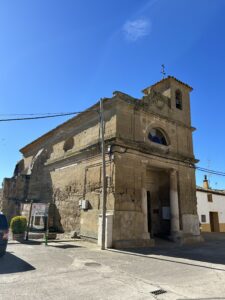
We started the day by meeting up again with Victor and Elena to travel to Monflorite, which is the location of the hospital where Orwell received treatment for a septic hand in late March, 1937. No doubt he would have also been entranced by the swooping and chattering swallows and martins that provided the soundtrack for our own visit. The church in the town square still bears the scars of the Civil War in that it lacks one of its two towers. In Orwell’s words, it had been “knocked about a bit”. Elena read an extract from the Spanish translation of Homage, dealing with this episode. The actual location of the hospital is disputed locally, with the mayor insisting it was in the building that houses her office, whereas locals point to it being on the opposite side of the square.
Aragon: Picture 11
From Monflorite, we drove to to the trenches at the Fascist side of the line. The top of the hill here is capped by a large Franco-era memorial to the Fascists. Elena reported that this is a popular meeting point for local right-wing groups, which added to the sense that the issues relating to the Civil War in the 1930s are ominously pertinent and unresolved today.
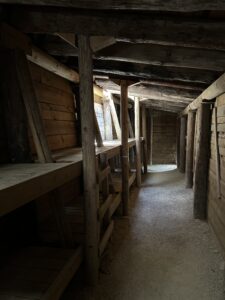
We moved over the old front line where the Los Monegros trenches have been recreated under Victor’s advice. The area served as a refuge for the Franco’s troops, who made use of the natural caves and ditches. It housed rest shelters, kitchens, command posts and communication branches. We looked out over the fields of waving corn, where swallows and corn bunting swooped and sang, making it very difficult to think of this being a battle front. However, Victor showed us a reconstructed rest shelter, with double-storey bunks that he explained would be used by troops both day and night.
Aragon: Picture 12
En route to our next Orwell Route site, we paused in the small town of Leciñena which, Victor told us, was the location of a concentration camp in the Second World War, housing Communists and those suspected of being linked with the Republican cause. The Nazis moved many of the inhabitants to Ravensbrück where countless perished through the inhuman conditions in the camp. There is a small memorial to these later victims of the Spanish Civil War in Leciñena, where it sits incongruously between the church and a children’s playground.
We returned to the Orwell route, rejoining it at Pocición Monte Izaro. This recreated trench and bunker sits on a windswept hillside. Nature has largely reimposed itself, and Orwell would have recognised many of the plants, such as yellow ‘London rocket’, starwort, and helianthemum; purple tassel hyacinth; giant ferrel; pale pink bindweed; and red poppies and oxeye daisies, as well as seeing Mediterranean flowers such as yellow dandelion-like pallenis. Liz unravelled a large POUM flag which she proudly held with Richard.
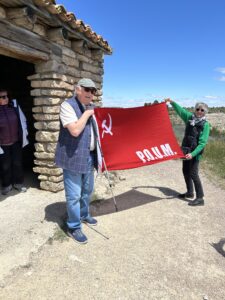
Aragon: Picture 13
After lunch, we went to the Centro de Interpretación y Estudios de la Guerra Civil en Aragón in Robres. The particular link with the Orwell Society again led to our special treatment as the museum was opened specifically for us by the Head of Tourism for the Monegros, who was otherwise on annual leave. Victor again gave us the benefit of his knowledge of the war, and later the curator showed us around the medical equipment display, allowing us to open boxes and generally have a hands-on exploration of the artefacts. These artefacts had been donated to the Museum during the Orwell Society visit in 2022 by a family whose forbears had used them in the Civil War.
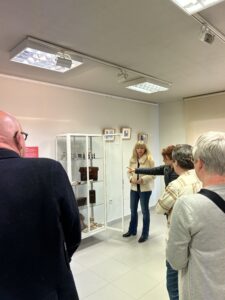
Aragon: Picture 14
Sunday 17th May
Our final day in Huesca dawned and we packed up the cars before walking over to Parque Miguel Servet where the monument to Orwell was unveiled during the Society’s last visit. The ‘coffee in Huesca’ sculpture had settled in very nicely and now sits in the shade of the surrounding trees, with sparrows and collared doves pecking around the base. We met several of the people who had worked so hard to get the monument erected, and Maureen spoke for us all when she said it was a great honour and deeply emotional to be present. Further around the park, we were shown the sculpture Las Pajaritas, which is dedicated to Ramón Acín, the Anarchist artist we first came across during our guided walk on Thursday.
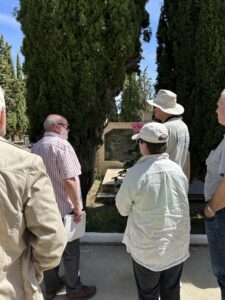
Aragon: Picture 15
We then drove out to the Municipal Cemetery, where several Civil War victims are buried outside the main walls. As vultures circled above us, we heard about the massacre of hundreds of local anti-fascists and saw the moving monument to them in a gap between the walls where they were shot. The names of all the victims are engraved on stainless steel strips on either side of the gap. Victor took us for a guided walk around the cemetery, showing us the tombs of victims of the war on both sides. We also saw the tomb of Ramón and Conchita Acín, which features an example of a relief panel he was working on.
Our final trip of the morning was to Montearagón Castle, which we had first seen from the town hall square earlier in the week. A wonderful young tour guide explained the history of castle, dating from the 11th century when it was a fort that reflected the Arab influence in architecture. It was later used as an abbey, and during the Civil War was occupied by both sides because of its strategic importance and spectacular 360-degree views. Rock sparrows and swallows are the only inhabitants now, but we could clearly see the anti-fascist trenches to the east, where Orwell was injured. The steep banks leading up to the castle were awash with colour: the purple of mallow; the blue of flax and splashes of red poppies.
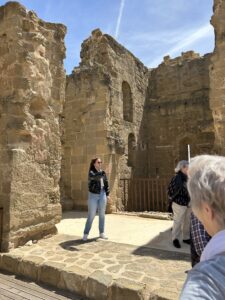
Aragon: Picture 16
We had a long lunch, where we were joined by members of the local fund raising group for the Orwell Takes Coffee in Huesca (Orwell toma café en Huesca) monument, then returned to Barcelona late in the evening. Team Glynn claimed a technical navigation victory, whilst Team Quentin (mostly) declared the human victory.
Part One of the ‘Orwell Society trip to Barcelona and Aragon 2026’ can be read here.
Thanks Angela for this great report on the Huesca/Aragon Orwell in Spain tour! The details brought back happy memories, and I especially liked the details of flora and fauna in the report. Very informative and detailed. Great work!