
Charles De Gaulle 1940 – 1942
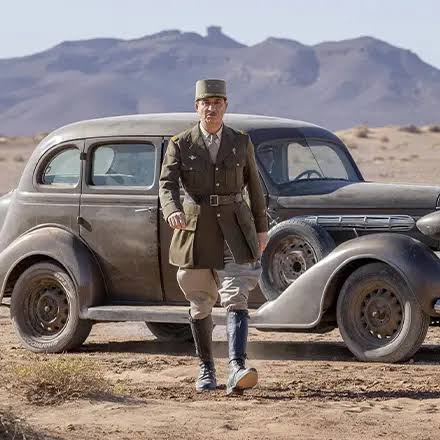
The 2026 film De Gaulle: Resistance deals with the period 1940-1942; here we have collated a review, a letter and an analysis of then current events all by George Orwell evidencing how De Gaulle was presented to the public, and what a detailed eye such as Orwell’s was capable of noticing.
Review of Charles de Gaulle by Philippe Barrès
Mr. Philippe Barrès’s book may be taken as the “official” biography of General de Gaulle, and it probably gives as full and frank an account of the Free French movement as was possible at the time when it was written—that is, some time during the summer of 1941. Necessarily silent on certain points, such as the Syrian campaign and the unsuccessful Dakar expedition, it gives much valuable detail about the circumstances of the French collapse, and it has the merit of quoting most of the relevant documents in full.
As is now widely known, General de Gaulle’s views on mechanised warfare, ignored by his own countrymen, were taken up and acted upon by the Germans, who seem actually to have built up their armoured divisions for the Polish campaign on the specifications set forth in de Gaulle’s book, published five years earlier. In the years between Hitler’s rise to power and the outbreak of war de Gaulle had agitated as best he could, chiefly through Paul Reynaud, for a more modern conception of war than was implied in the Maginot line and a five-million conscript army, and Chapter V. of Mr. Barrès’s book gives the text of the memorandum which he submitted to the High Command in January of 1940, after five months of “phony” war. In general terms this document foretold exactly what did happen a few months later.
Needless to say, his warnings went unheeded. De Gaulle languished in obscurity till the Battle of France, when for a brief period he held an important command and won some minor successes with the inadequate forces at his disposal. It was fortunate that in these few weeks he earned sufficient renown to make him the natural rallying-point of those Frenchmen who wanted to go on fighting. But why had no one, outside Germany, listened to his teachings earlier? If one thinks simply in technical terms, this is easy enough to understand. The two wars were only twenty-one years apart, and the generals who had won the war of 1914, or thought they had, were still in command. It was their instinct to see that nothing was changed, just as the Duke of Wellington struggled to keep the British Army the same in the eighteen-fifties as it had been at Waterloo. There was also the pacifism of public opinion, disillusioned by victory and only too ready for an inert defensive policy, as in England. But Mr. Barrès barely touches on the deeper political and economic causes of the French collapse. A book of this kind, written while events are still in the making, is bound to avoid certain issues. The delicacy of the situation lies in the fact that whereas in France the “collaborators” are the politicians of the Right, the Free French are of literally all political colours. General de Gaulle himself, denounced daily over the radio as a Jewish Marxist and freemason, is a Catholic of the provincial aristocracy and perhaps of royalist antecedents. Mr. Barrès is naturally rather anxious to avoid tying a political programme on to the Free French movement, though since the book was written some steps in that direction have been taken.
In his pages de Gaulle appears simply as the personification of “la patrie,” of the simple instinct which makes decent men of all shades of opinion unite against a foreign conqueror. On that level this book is a worthy tribute. The American translation could be improved upon.
The Observer, 2 August 1942
Letter To Basil Liddell Hart
12 August 1942
I am sorry I accepted too readily the legend of the Germans having taken their tank theories from de Gaulle. The “Observer” had to compress my review of Barres’s book by cutting out a passage from de Gaulle’s memorandum of early in 1940. I hadn’t seen this memorandum till seeing it in Barres’s book, and it certainly did seem to me to foretell what happened a few months later with considerable prescience. The story of “the man the Germans learned from” had already been built up elsewhere, and I had already more or less accepted it, not, of course, being much versed in military literature. I had read many of your own writings but didn’t realise that the Germans had drawn on them to that extent. And I was more ready to accept de Gaulle as a revolutionary innovator because of the obviously old-fashioned nature of the French army as a whole. I was in French Morocco from the autumn of 1938 to the spring of 1939, and with war obviously imminent I naturally observed the French colonial army as closely as I could, even to the point of getting hold of some of their infantry textbooks. I was struck by the antiquated nature of everything, though I know very little of military matters. I could if you wish write to the “Observer” and say that I was mistaken and had transferred some of your thunder to de Gaulle, but from a political point of view I don’t like writing de Gaulle down. It was a misfortune that we didn’t succeed in getting a leftwing politician of standing out of France, but since de Gaulle is the only figure we have at present to represent the Free French we must make the best of him.
News Commentary, 48 [Extract]
21 November 1942
In Morocco and Algeria the French put up only a token resistance to the American landings, and in Tunisia they are already fighting against the Germans. But the support we are getting from the local French authorities has its liabilities. Most of the local French military and naval commanders seem to have come over to the Allied side, including some who were strong supporters of Vichy and the policy of so-called collaboration. In particular Admiral Darlan, who only a little while ago was one of the most anti-British of the Vichy gang, appears to have changed sides and also appears to have been confirmed in some kind of position of command in French North Africa. [We don’t know how long this unsatisfactory state of affairs will last.] The Fighting French National Committee under General de Gaulle has very naturally washed its hands of the whole affair and refused to cooperate with any of the supporters of Vichy. It has evidently done this with the full understanding of the British Government. President Roosevelt has stated that all present arrangements are merely provisional. He has also asked the French authorities in Africa to open up the concentration camps where anti-Fascist refugees—25,000 of them—were interned, and to revoke the anti-Jewish laws which the Germans had forced on Vichy. We may hope that this will happen quite soon. Meanwhile the political set-up in North Africa is of a temporary kind, and we perhaps ought to suspend judgement on it till the Axis armies are destroyed.
BBC Eastern Service
Great stuff Les.
De Gaulle may have been frozen out by Churchill, Roosevelt and Stalin from the major decision making conferences, but he was formidable in his own right.
The downside of keeping from these decisions was to make him forever hostile to what he called Anglo Saxons.
The taking of Stuttgart showed a particular consequence. The French arrived at the Bridge Orwell describes in Revenge is Sour. The US army had all the resources to restore order to the city. De Gaulle told his army to go into the City which they occupied alone for several days during which chaos ruled.
We learned this on our recce for the April 2nd to 9th 2027 Orwell, War Reporter event at the end of August.