
Down the Memory Hole
Introduction. In his article Mark Twain – The Licensed Jester (Tribune, 26 November 1943), George Orwell praises Samuel Langhorne Clemens i.e. Mark Twain’s portrayal of life on the Mississippi and in the American West; but criticises him, for not going deeper in his satire; and implies that Twain was an intellectual coward.
George Orwell clearly had not read all of Twain’s work. He had read The Adventures of Tom Sawyer and Huckleberry Finn (which he says are not children’s books), Roughing It, Life on the Mississippi, The Innocents Abroad; the Life of Joan of Arc; A Connecticut Yankee at King Arthur’s Court which he calls a deliberate flattery of all that is worst and most vulgar in American Life; and the pessimistic What is Man?
 Mark Twain, photographed by A F Bradley
I want to defend Twain by examining some of the books and essays that Orwell did not mention. I suspect that Orwell would have qualified his opinion had he known some of the following details.
1. Following the Equator. In this book, published in 1897, Mark Twain reveals a hatred of imperialism much deeper than Orwell’s. He had seen the genocide of the Australian aborigines and many other horrors, rather than the seedy squalid British rule in 1920’s Burma. These were the more spacious times the older colonial officials Orwell met were nostalgic for. To quote Chapter 21:
In many countries we have chained the savage and starved him to death….In many countries we have burned the savage at the stake; ….In more than one country we have hunted the savage and his little children and their mother with dogs and guns through the woods and swamps for an afternoon’s sport and filled the region with happy laughter over their sprawling and stumbling flight and their wild supplications for mercy; In many countries we have taken the savage’s land from him and made him our slave and lashed him every day and broken his pride and made death his only friend and overworked him till he dropped in his tracks.
2. The North American Review was a monthly journal founded in 1815 by Nathan Hale whose uncle Nathan Hale, an American spy, was hanged by the British during the American War of Independence. It is now the USA’s oldest monthly journal. Between 1901 and 1905 Twain had eight articles published in it. They concerned:
A. The Twain-Ament Controversy. The first article To the Person Sitting in Darkness opened with a newspaper description of conditions in a New York City red light district. It then criticised the Reverend William Scott Ament of the American Board of Commissioners for Foreign Missions (the ABFM). The Reverend Ament had visited China and collected monetary indemnities for each Chinese Christian convert in his flock killed by the Boxer rebels; compensation for property damage; and allegedly fines of thirteen times the value of the indemnity. This extra money would subsidise the propagation of the gospel.
Mark Twain wrote that the indemnities and fines extracted from the pauper peasants to square other people’s offenses, would condemn them and their women and innocent little children to inevitable starvation and lingering death. Doing this to propagate the Gospel was a blasphemy so hideous and so colossal that, without doubt, its mate is not findable in the history of this or of any other age.
Mark Twain attacked the Blessings of Civilization i.e. glass beads and theology, and Maxim Guns and Hymn Books, and Trade Gin and Torches of Enlightenment (parent adjustable ones, good to fire villages with upon occasion). He criticised British behaviour in South Africa, German behaviour in China and American behaviour in the Philippines. The Reverend Dr Judson Smith, the ABFM Secretary, replied that Twain had been misled by a newspaper typo. The actual value of the fines over and above that of the indemnities was one third (1/3) extra not thirteen (13) times; and this money was being used to support widows and orphans.
In March 1901 Twain admitted in the North American Review that he had believed a typo, yet extracting money from innocent people for the crimes of others was wrong. It did not matter if it was used for a good purpose.
B. General Funston. In 1898 President McKinley took the USA to war with Spain. He was goaded on by big business, and the Hearst press. The Spanish Navy was easily defeated. The Spanish forces on Cuba and the Philippines were defeated after some fighting. Cuban and Filipino guerrillas in rebellion against Spain fought alongside the Americans. Cuba gained its independence (?) but McKinley annexed the Philippines. The Filipino leader Emilio Aguinaldo objected because the Filipinos had been promised independence. There was a guerrilla war in which the Americans suffered much heavier casualties than the Spanish had inflicted on them. Brigadier General Frederick Funston and four of his officers posed as Americans captured by purported Filipino nationalists who were actually disguised pro-American Filipinos. On 23 March 1901 they captured Aguinaldo and killed most of his bodyguard. As part of the ruse Funston accepted food from Aguinaldo before the trap was spring.
Mark Twain was outraged at this breach of hospitality and his sarcastic article A Defence of General Funston appeared in the May 1902 North American Review. It contrasted Funston with Aguinaldo’s American counterpart George Washington. Emilio Aguinaldo submitted to American rule after his capture; and died in 1964 aged ninety-four, eighteen years after the Philippines gained independence.
Brigadier General Funston was given the Congressional Medal of Honour. Mark Twain’s article was reprinted as a pamphlet which was widely circulated including in the modern Arab world.
C. Christian Science. Mark Twain wrote a three part article criticising Mary Baker Eddy and her Christian Science sect. It was published in the December 1902 and January-February 1903 editions of the North American Review. He admitted Christian Science’s emotional appeal to hypochondriacs, but pointed out that real injuries and illnesses need medical care; exposed its obsession with money; and prophesied a world it completely controlled.
The Christian Scientists replied denying that they regarded Eddy as God’s anointed. He replied in the April 1903 North American Review that he could clearly show that she was the absolute monarch of Christian Science.
D. The Tsar’s Soliloquy. A March 1905 North American Review Twain article purported to be the Tsar musing after his morning bath while undressed. He says that without elaborate clothes and titles a despot is just another person; and that:
The swarming Russian millions have for centuries meekly allowed our family to rob them, insult them, and trample them under foot, while they lived and suffered and died with no purpose and no function but to make that family comfortable! These people are horses – just that – horses with clothes and a religion. A horse with the strength of a hundred men will let one man beat him, starve him, drive him; the Russian millions allow a mere handful of soldiers to hold them in slavery;-and these very soldiers are their own sons and brothers!
The Tsar muses that his best allies are those who argue that violence never achieved anything. In fact it establishes and maintains all despotisms and only it can overthrow them. The article then reproduces two press clippings. One describes Cossack atrocities against Polish women; and the other the Tsar’s claim to be God’s anointed ruler. Mark Twain was a friend of the Russian revolutionary writer Maxim Gorky.
3. The Congo. In 1885 the European powers at the Congress of Berlin divided the Congo into three. The largest part became the Congo Free State ruled by a Chartered Company personally owned by King Leopold II of Belgium. A smaller part was given to France and a smaller area to Portugal. Leopold II’s company had on paper very noble aims including civilising the Congo and suppressing slavery. In reality Leopold was only interested in money. Initially this meant rubber and ivory. Forced labour i.e. slavery was routinely used and ferocious punishments were inflicted upon those that resisted and their families.
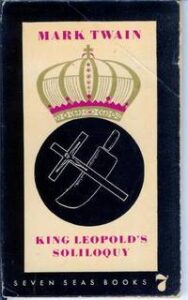
King Leopold’s agents and their native subordinates committed atrocities including large scale massacres and chopping off hands. Christian missionaries reported these crimes. At first they were disbelieved but the invention of the Kodak camera enabled them to prove their allegations. A Congo Reform Association was set up in Britain and got many supporters. One of its founders Edmund Dene Morel asked Twain to publicise Leopold’s behaviour. The result was a pamphlet, King Leopold’s Soliloquy, published in 1905. It purported to be Leopold musing to himself about the atrocities and the criticisms of him. That year a Belgian official commission composed of conservative officials published a report which confirmed the charges against the company.
Copper was discovered in the Congo and Leopold cut American millionaires in on his act. In 1908 the Belgian government took control of what became the Belgian Congo. King Leopold died in 1909 of natural causes. Before the Belgian government took over his company he had destroyed most of its records. Belgian government rule in the Congo was far less brutal than Leopold’s but it was still harsh and oppressive. It remained so until the Congo became independent in 1960.
Mark Twain’s pamphlet was not reissued until 1961 when Seven Seas Books, an East German publisher, reprinted it with an introduction by Stefan Heym. Stefan Heym later became a dissident but remained a socialist until his death in 2001 aged eighty eight. Seven Seas Books was of course owned by the East German government and published radical English language books.
The Belgian Congo became Zaire and later the Democratic Republic of the Congo. It is still a very troubled place. The French Congo is today a separate country. The Portuguese Congo became the Cabinda Enclave and is today part of Angola.
4. Europe and Elsewhere. Mark Twain died in 1910 aged seventy five. His last book Europe and Elsewhere was published posthumously in 1923, thirteen years after his death. It is a collection of essays including some that had already been published elsewhere; and others that he had deliberately left unpublished. My edition was reissued by Forgotten Books in 2018 in its classic reprint series.
One of the bitterest previously unpublished essays was The United States of Lyncherdom. It condemned the lynching of three African Americans in Pierce City in the southwest of Twain’s home state Missouri in 1901. He said that it would discredit the whole state; and that there would be copycat incidents. He blamed lynching on the human tendency to imitate others; and the moral cowardice of most decent people. He praised two Southern sheriffs who had successfully resisted lynch mobs.
Two other previously unpublished essays were As Regards Patriotism (written circa 1900) and The War Prayer (written in 1905). They contrast cheerful exuberant public displays of patriotism with the realities of war. Mark Twain knew that violence is sometimes necessary but he also knew what it meant.
Conclusion. When George Orwell wrote ‘Mark Twain, except perhaps in one short essay (What Is Man?) never attacks established beliefs in a way that is likely to get him into trouble’ he may have been mistaken. Mark Twain was a brave but cautious man. George Orwell had read some of Twain’s writings but not others. This is not surprising as they had been deliberately consigned to the memory hole of oblivion.
*
I must find these essays and read them. Thank you.