
Evidence of Past Reality
Sometimes one can mine backwards from literary works to realise that multiple authors have turned similar experiences to very different ends, and equally those mutual developments are evidence that some experiences – and the circumstances that lead to them – must have occurred, and not just once. That is, fiction can be evidence of past reality.
As an example, let us look at a few paragraphs from Cyril Hare’s detective story With A Bare Bodkin, published just after the Second World War, realising that they have similarities to paragraphs in George Orwell’s Nineteen Eighty-Four published three years later. Hare came from a legal background, but turned his experience to government service during the War when he worked for the Ministry of Economic Warfare. Orwell began the War as a freelance journalist, joined the BBC as a talks producer, and ended as literary editor of a weekly magazine, while his wife Eileen had worked for the Ministry of Information and later the Ministry of Food.
… for the next ten days after the encounter at the Gamecock [a pub] (Pettigrew) had little leisure to reflect on it. A sudden spate of work descended on the legal advisor, which necessitated long and ever longer hours at the office, culminating in a flying visit to London where the question of the new amendment was threshed out at what in political circles are known as “the highest levels”. During this period he caught an occasional glimpse of (Inspector) Mallet … and plunged to work again.
At last, little by little, the pressure eased. The files of papers began to dwindle, swollen by the reinforcements that for days past had overflowed his “In” tray. The telephone remained silent for hours together. Soon he was able to look across his desk to where Miss Brown, rather pale but unshaken by the crisis, patiently took down his interminable memoranda. Then a day came when, quite suddenly, it seemed, there was nothing left to do. The last draft was approved, the last letter signed, the last minute added to the last file. And Miss Brown, conscientious to the last, was positively saying “Is there anything else you want to me to do to-day, Mr. Pettigrew?”
Pettigrew yawned, stretched himself and cast incredulous eyes at his empty tray.
Cyril Hare: With A Bare Bodkin (1946), Chapter 6 “A Question Of Insurance” (Faber paperback edition 1985, pages 46-47)
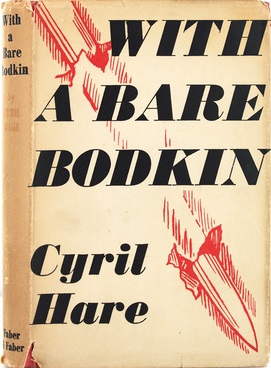
Cyril Hare’s With A Bare Bodkin
Compare Orwell’s Nineteen Eighty-Four:
Winston was gelatinous with fatigue. Gelatinous was the right word. It had come into his head spontaneously. His body seemed to have not only the weakness of a jelly, but its translucency. He felt that if he held up his hand he would be able to see the light through it. All the blood and lymph had been drained out of him by an enormous debauch of work, leaving only a frail structure of nerves, bones, and skin. All sensations seemed to be magnified. His overalls fretted his shoulders, the pavement tickled his feet, even the opening and closing of a hand was an effort that made his joints creak.
He had worked more than ninety hours in five days. So had everyone else in the Ministry. Now it was all over, and he had literally nothing to do, no Party work of any description, until tomorrow morning…
[Oceania has changed sides]
Everyone in the Records Department worked eighteen hours in the twenty-four, with two three-hour snatches of sleep. Mattresses were brought up from the cellars and pitched all over the corridors: meals consisted of sandwiches and Victory Coffee wheeled round on trolleys by attendants from the canteen. Each time that Winston broke off for one of his spells of sleep he tried to leave his desk clear of work, and each time that he crawled back sticky-eyed and aching, it was to find that another shower of paper cylinders had covered the desk like a snowdrift, half-burying the speakwrite and overflowing onto the floor, so that the first job was always to stack them into a neat-enough pile to give him room to work. What was worst of all was that the work was by no means purely mechanical. Often it was enough merely to substitute one name for another, but any detailed report of events demanded care and imagination. Even the geographical knowledge that one needed in transferring the war from one part of the world to another was considerable.
By the third day his eyes ached unbearably and his spectacles needed wiping every few minutes. It was like struggling with some crushing physical task, something which one had the right to refuse and which one was nevertheless neurotically anxious to accomplish. In so far as he had time to remember it, he was not troubled by the fact that every word he murmured into the speakwrite, every stroke of his ink-pencil, was a deliberate lie. He was as anxious as anyone else in the Department that the forgery should be perfect. On the morning of the sixth day the dribble of cylinders slowed down. For as much as half an hour nothing came out of the tube, then one more cylinder, then nothing. Everywhere at about the same time the work was easing off. A deep and as it were secret sigh went through the Department. A mighty deed, which could never be mentioned, had been achieved. It was now impossible for any human being to prove by documentary evidence that the war with Eurasia had ever happened. At twelve hundred it was unexpectedly announced that all workers in the Ministry were free till tomorrow morning.
Part Two Chapter 9
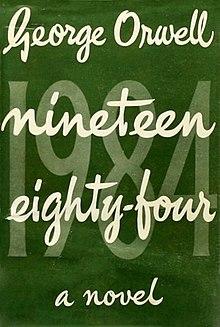 George Orwell’s Nineteen Eighty-Four
Manic work rates clearly stayed in the minds of the very different authors, and they re-worked the wartime experience in their fiction. Actually, in some ways the authors were not so different – both authors wrote under pseudonyms. Perhaps because of his overwork Hare contracted tuberculosis during the War and died aged only 57, eight years after Orwell. Both determined to record those periods of demanding work.
Thanks Les, a very interesting comparison.