
Food For Thought: III
Celebrating the British kitchen
In 1946, Orwell is commissioned by the British Council to write an essay on British cooking (Orwell 1946). They probably expect him to laud the nation’s restaurants while adding some astute critiques of British cuisine. This is not what they are sent. Orwell, typically, praises home-made meals and downplays the delights of restaurants. Thus, he begins saying British cooking British cookery ‘is best studied in private houses, and more particularly in the homes of the middle-class and working-class masses who have not become Europeanised in their tastes. Cheap restaurants in Britain are almost invariably bad, while in expensive restaurants the cookery is almost always French, or imitation French’. Perhaps, inevitably, Orwell is sent a rejection note on 3 May 1946, which, while it stresses it’s an ‘excellent essay’, adds that ‘it would be unfortunate and unwise to publish it for the continental reader’. All the same, he is sent the payment – 30 guineas.
In the extraordinary 6,000-word essay, Orwell displays a remarkable knowledge – indeed, love – of cooking.
He starts with some typical Orwellian, provocative generalisations to attract the attention of the reader. For instance: ‘One may say that the characteristic British diet is a simple, rather heavy, perhaps slightly barbarous diet, drawing much of its virtue from the excellence of the local materials, and with its main emphasis on sugar and animal fats. It is the diet of a wet northern country where butter is plentiful and vegetable oils are scarce, where hot drinks are acceptable at most hours of the day, and where all the spices and some of the stronger-tasting herbs are exotic products.’
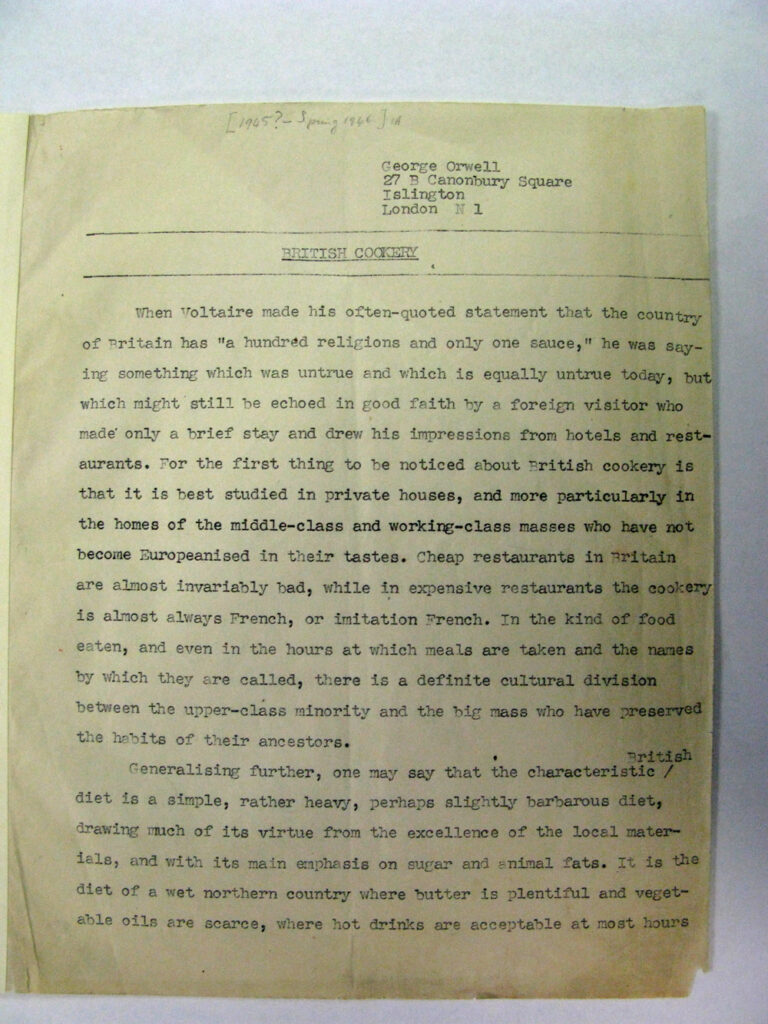
George Orwell’s original typescript
Continuing, he painstakingly goes through the typical contents of each meal eaten through the day beginning with the breakfast – all in impressive detail. There are problems in considering the mid-day meal which he confronts head-on, highlighting intriguing social, regional and class factors. ‘The richer classes have their midday meal at one-thirty in the afternoon and call it “luncheon”. At about half-past four in the afternoon they have a cup of tea and perhaps a piece of bread-and-butter or a slice of cake, which they call “afternoon tea” and they have their evening meal at half-past seven or eight, and call it “dinner”. The others, perhaps ninety percent of the population, have their midday meal somewhat earlier – usually about half-past twelve – and call it “dinner”. They have their main evening meal at about half-past six and call it “tea” and before going to bed they have a light snack – for instance cocoa and bread-and-jam – which they call “supper”. The distinction is regional as well as social. In the North of England, Scotland and Ireland many well-to-do people prefer to follow the working-class time scheme, partly because it fits in better with the working day, and partly, perhaps, from motives of conservation: for our ancestors of a century ago also had their meals at approximately these hours.’
As for the content of the meal, he writes: ‘The British midday meal consists essentially of meat, preferably roast meat, a heavy pudding, and cheese. And here one comes upon the central institution of British life, the “joint”: that is, a large piece of meat – round of beef or leg of pork of mutton – roasted whole with its potatoes round it, and preserving a flavour and a juiciness which meat cooked in smaller quantities never seems to attain.’
Orwell moves on to consider the delights of British sauces: ‘Here also we may mention the special sauces which are so regularly served with each kind of roast meat as to be almost an integral part of the dish. Hot roast beef is almost invariably served with horseradish sauce, a very hot, rather sweet sauce made of grated horseradish, sugar vinegar and cream. With roast pork goes apple sauce, which is made of apples stewed with sugar and beaten up into a froth. With mutton or lamb there usually goes mint sauce, which is made of chopped mint, sugar and vinegar. Mutton is frequently eaten with redcurrant jelly, which is also served with hare and with venison. A roast fowl is always accompanied by bread sauce, which is made of the crumb of white bread and milk flavoured with onions, and is always served hot. It will be seen that British sauces have the tendency to be sweet, and some of the pickles that are eaten with cold meat are almost as sweet as jam.’
And so on through cooking birds and fish, puddings, pastry, a vast range of sweet dishes including of jellies, blancmanges, custards, soufflés, ice puddings, meringues and pancakes. Tea, he says, is invariably drunk with the evening meal. ‘It is very unusual to drink any alcohol at this meal. British working-people, in any case, do not often drink alcohol in their own homes. They like to bring home a few bottles of beer for midday dinner on Sundays, but for the most part their drinking is done in the public house, which serve as a kind of club.’
Towards the end, he lists ‘the foodstuffs, natural or prepared, which are especially good in Britain and which any foreign visitor should make sure of sampling’. First mentioned are apples. ‘The best are the Cox’s Orange pippin, the Blenheim Orange, the Charles Hoss, the James Grieve and the Russet. These are all eaten raw. The Bramley: Seedling is a superlative cooking apple.’ Then there are fish and drinks – and finally a word in praise of British bread. ‘It is a good general rule that small, old-fashioned shops make the best-flavoured bread. Throughout a great deal of the North of England the women prefer to bake their bread for themselves.’
As a final flourish, Orwell ends by presenting a set of recipes – for Welsh rarebit, Yorkshire pudding, treacle tart, orange marmalade, plum cake and Christmas pudding – complete with cooking directions.
Blake Perkins, in a highly considered essay in the specialist cooking journal, Petits Propos Culinaires, argues that in ‘British cookery’ Orwell is displaying above all his gloomy side while much of it ‘bears scant resemblance to the traditional foodways of the archipelago’ (Perkins 2014: 74). He writes: ‘The overall tenor of “British Cookery” is so grim (even, perhaps, “Orwellian”) that it would not only deter the most intrepid traveller from hazarding a journey to Britain but would also depopulate the islands of the indigenes if true.’ I would tend to totally disagree. But then, I guess it’s all a question of different tastes in writing…
Enjoying Xmas Pud
Later, just before Christmas in 1946, Orwell devotes another wonderfully inventive, witty and joyous ‘As I Please’ column in Tribune to considering the four necessary ingredients for a successful Christmas: a roast turkey, Christmas pudding, a dish of mince pies and finally a tin of –‘s Liver Salt (CWGO XVIII: 517). But this time, given the progressive views of his expected readership, he does not ignore the plight of the poor and hungry in Europe, India and China. ‘In India there are, and always have been, about 100 million people who only get one square meal a day. In China, conditions are no doubt much the same. In Germany, Austria, Greece and elsewhere, scores of millions of people are existing on a diet which keeps breath in the body but leaves no strength for work…’ (CWGO XVIII: 517).
Before this sobering point, Orwell has had a great deal of fun celebrating the joys of the Xmas feast. He writes: ‘The whole point of Christmas is that it is a debauch – as it was probably long before the birth of Christ was arbitrarily fixed at that date. Children know this well. From their point of view Christmas is not a day of temperate enjoyment, but of fierce pleasures which they are quite willing to pay for with a certain amount of pain’ (ibid: 518). And he proceeds with delight to detail the elements of an imaginary, pleasure-packed Xmas day: ‘The awakening at about 4 a.m. to inspect your stocking, the quarrels over toys all through the morning, and the exciting whiffs of mincemeat and sage-and-onions escaping from the kitchen door; the battle with enormous plateloads of turkey, and the pulling of the wishbone; the darkening of the windows and the entry of the flaming plum-pudding; the hurry to make sure that everyone has a piece on his plate while the brandy is still alight; the momentary panic when it is rumoured that Baby has swallowed the threepenny bit; the stupor all through the afternoon; the Christmas cake with icing an inch thick; the peevishness next morning and the castor oil on 27 December – it is an up-and-down business, by no means all pleasant, but well worth while for the sake of its more dramatic moments’ (ibid).
Typically, Orwell shifts his attention to writings about Christmas – again focusing on what’s ‘missing’. ‘How enormous is the literature of eating and drinking, especially drinking, and how little that is worth while has been said on the other side! Offhand I can’t remember a single poem in praise of water, i.e. water regarded as a drink. It is hard to imagine what one could say about it. It quenches thirst: that is the end of the story.’ He continues in the same comical vein: ’Curiously enough, I can’t remember a poem in praise of stout, not even draught stout, which is better than the bottled variety, in my opinion. There is an extremely disgusting description in Ulysses of the stout-vats in Dublin. But there is a sort of back-handed tribute to stout in the fact that this description, though widely known, has not done much towards putting the Irish off their favourite drink’ (ibid: 519).
He moves on to consider the literature about eating. And he concludes: ‘In all the writers who have enjoyed describing food, from Rabelais to Dickens and from Petronius to Mrs Beeton, I cannot remember a single passage which puts dietic considerations first. Always food is an end in itself.’
Having highlighted the plight of the global poor, Orwell concludes, promoting, as ever, the pleasure principle: ‘In such circumstances we could hardly have a “proper” Christmas, even if the materials for it exist. But we will have one sooner or later, in 1947, or 1948, or maybe even in 1949. And when we do, there may be no gloomy voices of vegetarians or teetotallers to lecture us about the things that we are doing to the linings of our stomach.’
*
References will follow Part IV
*
Leave a Reply