
From the Beginning to the End
The Extraordinary Compton Mackenzie
*
One man who played a major role in George Orwell’s life is Compton Mackenzie. Yet he is largely marginalised in most of the conventional biographies. He is mentioned en passant by Michael Shelden (1991) and Jeffrey Meyers (2000) but not at all by D. J. Taylor (2003) and Robert Colls (2013) – nor by Sylvia Topp in her biography of Eileen O’Shaughnessy, Orwell’s first wife (2020). Only Bernard Crick (1980) and Gordon Bowker (2003) give any hint of his importance.
Yet Mackenzie’s novel Sinister Street is one of Orwell’s favourites while he is a pupil at St Cyprian’s prep school in Eastbourne and significantly it is amongst the books he owns at the time of his death in 1950. It may well help inspire him to explore the world of tramps and beggars when he returns from five years’ of service as an Imperial Policeman in Burma (1922-1927).
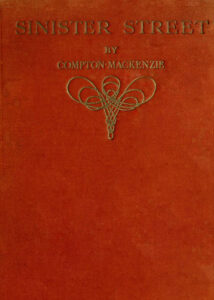 Compton Mackenzie’s Sinister Street (One volume edition)
Moreover, Mackenzie provides significant support to Orwell early on in his writing career giving favourable reviews in the Daily Mail. And most crucially, it is Mackenzie who helps plant the idea in Orwell’s mind of retreating to a Scottish island. This is to culminate with Orwell withdrawing with his son, Richard, and sister, Avril, to the remote isle of Jura in the Inner Hebrides. And here he spends what are to prove the last years of his short life composing his dystopian masterpiece, Nineteen Eighty-Four.
A Prep School Passion
In a letter to Julian Symons in 1948, Orwell remembers his childhood admiration for H. G. Wells as a writer and recalls while at St Cyprian’s (from 1911-1917) he and his friend Cyril Connolly (later as editor of Horizon, in the 1940s, to publish some of Orwell’s most celebrated essays) read with delight Sinister Street. ‘We also got into severe trouble (and I think a caning – I forget) for having a copy’ of the novel (Crick 1980: 87). Mackenzie’s biographer Andro Linklater reports that the 15-year-old Connolly kept a copy hidden by his bed and could quote it by the page. ‘It may well be that some of its aura of wickedness came from the opinion of schoolmasters, but without doubt for four or five decades it ranked high on the index of forbidden adolescent literature’ (Linklater 1987: 128; see also Lewis 1998: 34).
Bowker comments astutely on its likely appeal to the young Eric Blair: ‘It’s hero, Michael Fane, is studying classics at a prep school and moves with his mother from the countryside to Kensington (close to where Aunt Nellie lived). He spends holidays in Cornwall (as the Blairs did), visits Bournemouth (where uncle Charlie lived), and meets a girl from an Anglo-Indian family whose father is away in Burma. He visits Eastbourne and thinks what a lovely place (hollow laughter from Blair and Connolly, no doubt). Fane envies a wild-looking, unkempt boy he sees wandering down Kensington High Street and longs to be a “raggle-taggle wanderer”. He is bullied on his first day at school but stands up to the bullies’ (Bowker 2003: 46).
The novel achieves a succès de scandale when published in two parts 1913 and 1914 being banned by the powerful circulating libraries – hence the reaction of St Cyprian’s headmistress, Mrs Wilkes (nicknamed Flip – apparently because of her floppy breasts) and headmaster, Mr Wilkes (nicknamed Sambo). They are to be the target of Blair/Orwell’s vitriol in his memoir of his years at St Cyprian’s, ‘Such, Such Were the Joys’, published only after his death because of libel worries. John Sutherland suggests that the Wilkes probably found its satire of the prep school (Randell House) the hero attends particularly offensive (Sutherland 2016: 68).
Today, it’s difficult to understand the outrage that greets the novel – a monster, 829-page, semi-autobiographical, 200,000-word bildungsroman. In the final part, Fane does descend into what is described as ‘London’s evil underworld’ of seedy prostitution, dancing girls and grinding poverty in his desperate attempts to find the love of his life, Lily. And this may have been one of the many influences – along with Jack London’s People of the Abyss (1903) and W. H. Davies’s The Autobiography of a Super-Tramp (1908) – behind Orwell’s later tramping expeditions, captured so colourfully in his part memoir/part fictional Down and Out in Paris and London (1933). Fane mixes fascination, detachment and disgust towards the (sometimes violent) scenes he witnesses. And while, in one scene, he ends up in the bedroom of a prostitute he merely asks about her life and plight and quickly leaves. There is never any hint of sex.
Praise for Early Novels
Following the publication of Down and Out in Paris and London, under the pseudonym George Orwell for the first time, he commits himself entirely to the life of a ‘man of letters’ – writing over the next few years novels, poetry, literary essays, reviews and an investigation into poverty in the north of England. One reviewer who remains consistently positive about his writings over this period is the Daily Mail’s Compton Mackenzie. On Down and Out, he comments: ‘A clearly written human document which at the same time is written with so much simple force that in spite of the squalor and degradation thus unfolded, the result is curiously beautiful with the beauty of an accomplished etching on copper’ (Crick 1980: 236). And on his first three novels, Burmese Days (1935), A Clergyman’s Daughter (1935) and Keep the Aspidistra Flying (1936), Mackenzie, again in the Mail, offers these striking words of praise: ‘I have no hesitation in asserting that no realistic writer during the last five years has produced three volumes which can compare in directness, vigour, courage and vitality with these volumes from the pen of Mr Orwell’ (Linklater 1987: 258). But he adds: ‘Among the aspidistra, Mr Orwell seems to lose touch with reality … There is some searching talk, and one or two ideas are given an airing which, though not strictly fresh, will pass as original. A novel, however, needs something more than this.’ Orwell would have probably agreed – he later dismisses the novel as one of his ‘silly potboilers’ (Lucas 2003: 30).
Orwell is later able to repay the compliment to Mackenzie. Much of Orwell’s early journalism is published in Adelphi, edited by his friend and fellow old-Etonian Sir Richard Rees. And reviewing Walls Have Mouths, W. F. R. Macartney’s gruelling account of his years in Parkhurst Prison (Macartney served eight of a ten year sentence), in November 1936, he is able to highlight approvingly Mackenzie’s contribution. Orwell writes that ‘the cold, rigid discipline of a modern English jail, the solitude, the silence, the everlasting lock-and-key … is more cruel and far more demoralising than the barbarous punishment of the Middle Ages’ (CWGO X: 514). He ends: ‘Mr Compton Mackenzie’s prologue and comments might appear at first sight to be unnecessary, but actually they have the effect of pulling the book together and supplying useful corroboration. Probably without Mr Mackenzie’s help the book would not have been published, in which case everyone who cares for decency must be deeply grateful to him’ (ibid: 515).
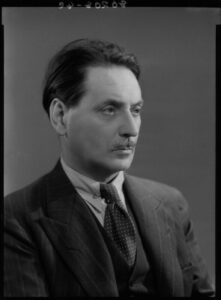
Compton Mackenzie in 1939 (National Portrait Gallery)
The Crucial Meeting
One of Orwell’s most celebrated essays focuses on the writings of Charles Dickens which appears in the collection Inside the Whale, of 1940. Soon after its publication, on 25 May, Orwell addresses the thirty-fourth annual conference of the Dickens Fellowship at the Comedy Restaurant, Panton Street, London. He says he has been reading Dickens’s principal novels since early childhood – with David Copperfield his favourite (CWGO XII: 167). And he argues that Dickens’s tradition ‘moves outside the realm of literature’. According to a report of the meeting: ‘Mr Orwell said that ten years ago he had been among the hop-pickers and there he had met men who, although they had not read the book, nevertheless knew about Oliver Twist; they knew it instinctively and felt that the author had struck a memorable blow on their behalf’ (ibid).
Most importantly, Mackenzie, who proposes the toast to the Immortal Memory of Dickens, and Orwell meet here for the first time. As Bowker comments (2003: 263), it is to prove a ‘fateful meeting’. For in their chat a seed is planted that is to flower in Orwell’s decision a few years later to withdraw to the remote Scottish island of Jura. According to Bowker: ‘It was Mackenzie who excited Orwell – always fascinated by Robinson Crusoe – with the prospect of one day living the self-reliant island life, remote from the horrors of the modern world, its streamlined falsity and genocidal wars’ (ibid).
Mackenzie ‘The Man Who Loved Islands’
Today largely forgotten, Mackenzie (1883-1972) is one of the most extraordinary characters of the last century. A child prodigy who reads Don Quixote when only four, he goes on to write fiction, biography, children’s stories, ten volumes of memoir, reviews, satires, poetry, cultural commentaries and spy stories though he is best known for his best-selling comic novels set in Scotland, The Monarch of the Glen (1941) and Whiskey Galore (1947). During the First World War, he is a master spy running British intelligence operations in Greece. For his wartime services he is awarded an OBE, while the French grant him the Legion of Honour, the Serbs the Order of the White Eagle, and the Greeks the Order of the Redeemer. But following the publication of his no-holds-barred account of his spying years in Greek Memories, in 1932, he is prosecuted at the Old Bailey under the Official Secrets Act for quoting from supposedly secret documents. He is fined and has to pay substantial costs. A man of varied interests, a Roman Catholic convert, Rector of Glasgow University from 1931-1934, keen gardener, celebrated raconteur, a popular broadcaster for the BBC and lover of Siamese cats, in 1923, he and his brother-in-law Christopher Stone launch the still-surviving Gramophone magazine.
He also loves living on islands. While on Capri, in 1919, he finds a flat for D. H. Lawrence and his wife, Frieda, whom he has known since meeting them in Buckinghamshire in 1914. And the two men spends hours together sharing their dreams of living in the South Pacific. Nothing comes of their plans and Lawrence leaves for Sicily. But Mackenzie’s island obsession continues. So in 1920 he purchases two tiny Channel Islands, Herm and Jethou. Then, in the early 1930s, dissatisfied with his Channel Island adventure, he purchases the Shiant Islands in the Western Isles for the knockdown price of £500, flaunts his Scots ancestry and identity and becomes a fervent advocate of Scottish Nationalism. Lawrence never forgets Mackenzie and Cathcart, the central figure of his short story, ‘The Man Who Loved Islands’, of 1926, is loosely based on him. But as John Worthen comments in his biography of Lawrence: ‘It is a story which draws on so many of the tendencies and potentialities in Lawrence’s life and temperament that it goes far beyond the elements of Mackenzie’s life which had been its starting point’ (2005: 346).
Orwell and the Jura Dream
Having met Mackenzie, Orwell confides to his diary on 20 June 1940: ‘Thinking always of my island in the Hebrides, which I suppose I shall never possess nor even see. Compton Mackenzie says even now most of the islands are uninhabited (there are 500 of them, only 10 per cent inhabited at normal times), and most have water and a little cultivable land, and goats will live on them’ (CWGO XII: 188). Bowker comments astutely: ‘The dream would one day come true, but only when it was rather too late for him fully to savour the idyll’ (2003: 263).
In 1944, Orwell learns that his friend and Observer journalist, David Astor, owns property on Jura, a sparsely populated island off the west coast of Argyllshire, and he sets off in September to explore. He immediately falls in love with the island. His wife, Eileen, dies tragically in March 1945 – just months after they adopt baby Richard – while he is away on the Continent reporting on the final days of the war for the Observer and Manchester Evening News. He returns to Jura the following September for a two-week break, discovers a large deserted farmhouse, Barnhill, near the northern tip of the island, and applies to the Laird, Robin Fletcher, to lease it. The deal is quickly done. And so Orwell’s final years are to be spent living his island dream – discussed all those years ago with Mackenzie.
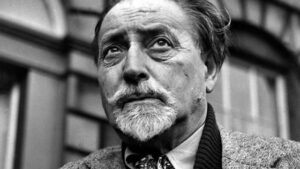 Compton Mackenzie 1952, a guest on Desert Island Discs
Indeed, Orwell never forgets Mackenzie. Significantly in the list of 144 books he reads, amazingly, during 1949 when he is suffering terribly from TB and close to death, Sinister Street appears between J. Langdon-Davies’s Russia Puts the Clock Back and Agatha Christie’s Sparkling Cyanide (CWGO XX: 222). And in the list of 389 books owned by Orwell at his death, it falls between A. E. Macglagen’s The Bayeux Tapestry and A. M. Maclennan’s A Pronouncing and Etymological Dictionary of Gaelic Language (ibid: 294). In a way, then, Mackenzie has been with Orwell – from the beginning right to the end.
*
References
Bowker, Gordon (2003) George Orwell, London: Little Brown
Colls, Robert (2013) George Orwell: English Rebel, Oxford: Oxford University Press
Crick, Bernard (1980) George Orwell: A Life, Harmondsworth, Middlesex: Penguin
CWGO (Collected Works of George Orwell) (1998) XX Volumes, Davison, Peter (ed.) London: Secker & Warburg
Lewis, Jeremy (1998) Cyril Connolly: A Life, London: Pimlico
Linklater, Arno (1987) Compton Mackenzie: A Life, London: Chatto & Windus
Lucas, Scott (2003) Orwell, London: Haus Publishing
Meyers, Jeffrey (2000) Orwell: Wintry Conscience of a Generation, New York and London: W. W. Norton and Company
Shelden, Michael (1991) Orwell: The Authorised Biography, London: Heinemann
Sutherland, John (2016) Orwell’s Nose: A Pathological Biography, London: Reaktion Books
Taylor, D. J. (2003) George Orwell: The Life, London: Chatto & Windus
Topp, Sylvia (2020) Eileen: The Making of George Orwell, London: Unbound
Worthen, John (2005) D. H. Lawrence: The Life of An Outsider, London: Allen Lane
- Richard Lance Keeble was chair of The Orwell Society from 2013-2020.
Leave a Reply