
The Elusive America
‘Riding Down from Bangor’ 74 Years On
George Orwell never visited the United States, but American literature provided a window through which he developed vivid mental images of the various regions of the country. The re-publication of John Habberton’s 1876 novel Helen’s Babies in 1946 inspired him to pen the essay ‘Riding Down from Bangor’, in which he explored some of these impressions, and the article was first published in Tribune on November 22nd, exactly 74 years ago today.
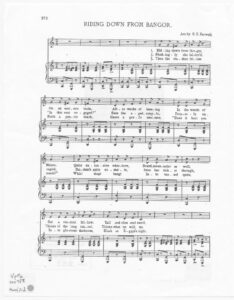
Sheet Music to ‘Riding Down From Bangor’ (University of Maine)
There is a peculiar Englishness about Orwell’s prose that can leave even the most informed and appreciative American reader feeling a bit of an outsider, so it at first seems a rare treat to ponder his speculations about the US and for once feel privy to inside information. The satisfaction proves short-lived, however, for in ruminating on his perceptions, one soon realizes that the characteristics Orwell believed conveyed the ‘American flavour’ are even more intangible today than they were in his time. Sadder yet, that peculiar American quality Orwell found so attractive, which he described as ‘a sort of sweet innocence’, is about as prevalent in today’s America as copies of Helen’s Babies are in a Barnes and Noble.
Still, if it is possible for Americans to momentarily divert their attention away from the toxic zeitgeist of 2020 America, most will no doubt find Orwell’s impressions of the US amusing. American fiction, he says, conjured in his child’s mind a freewheeling nation peopled with somewhat schizoid stock characters. Typifying the American South, for example, he imagined:
. . . a tall, angular man, with a shapeless hat pulled down over his eyes, leaning against a wooden paling and whittling at a stick. His lower jaw moves slowly but ceaselessly. At very long intervals he emits some piece of wisdom such as “A woman is the orneriest critter there is, ‘ceptin’ a mule’, or “When you don’t know a thing to do, don’t do a thing . . . .” (20)
Having a stronger hold on the reluctantly conventional Orwell, however, was the image he associated with New England, but which in fact seems more accurately to meld a Puritanical Northeast with the Lincolnesque Midwest. He envisioned ‘a boy sitting in a whitewashed stone schoolroom’ who
. . . wears braces and has patches on his shirt, and if it is summer he is barefooted. In the corner of the school room there is a bucket of drinking water with a dipper. The boy lives in a farmhouse, also of stone and also whitewashed, which has a mortgage on it. He aspires to be President, and is expected to keep the woodpile full. Somewhere in the background of the picture, but completely dominating it, is a huge black Bible. (20)
The ‘log cabin to White House’ trope is a recurrent theme in Orwell’s few writings about America and had appeared earlier in his 1943 essay ‘Mark Twain – The Licensed Jester’ (371). Perhaps it is not surprising that the young Orwell, ever fretting over the position his family occupied in Britain’s complex social hierarchy, would be drawn to this aspect of 19th century America.
Unlike the critical views he expressed about Mark Twain and much of his writing, Orwell heaped praise on Habberton’s Helen’s Babies, asserting that ‘in its day’ it was ‘one of the most popular books in the world’, and indeed, his assessment seems valid (20). In a 1903 list of suggested summer reading, for example, The Journal of Education recommended Helen’s Babies along with classics such as The Pickwick Papers and Tristram Shandy (341), and in 1904, the same journal featured the novel in a literary quiz, this time alongside the works of not only Charles Dickens, but also Elizabeth Barrett Browning, William Makepeace Thackeray, Nathaniel Hawthorne, George Eliot, Charlotte Brontë, Henry David Thoreau, and Lewis Carroll (282). So popular was Helen’s Babies that in 1924, a silent film of the same title was released, and a 1925 article about a screening of the film began: ‘It is said that every fourth family in the civilised world has read or is reading Helen’s Babies’ (‘Helen’s Babies at the Kinnaird’). Yet another write-up about the film claimed that ‘[t]he book is a house-word in nearly every home’ (‘Helen’s Babies at the Capitol’). Orwell himself compared the novel to Little Women, and though he was somewhat disappointed with the quality of the 1946 reissue (among his objections was the fact that ‘various American dialect words appear to have been cut out of it’, God dang it!), he was nonetheless pleased it had been re-published, calling it one of the best of the little library of American books on which people born at about the turn of the century were brought up’i (20).
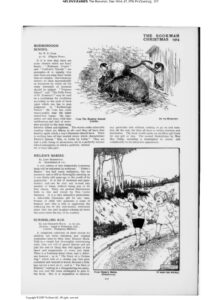 1914 Review of Helen’s Babies
While the novel may have been popular at the turn of the century, however, Orwell’s legendary intuition seems to have missed the mark when he placed it on a par with the Louisa May Alcott novel, for although Orwell then supposed that her novel was just ‘still flickeringly in print’, Little Women remains a classic – a filmed version starring Saoirse Ronan was released in 2019, in fact – while Helen’s Babies has fallen into obscurity. Christopher Hitchens once aptly noted that America was ‘the grand exception to Orwell’s prescience about the century in which he lived’ (75), and in some minor way, his assessment of these two American novels seems to support his claim.
Orwell may have missed the mark on America, yet here in the New World of 2020 he is more relevant than ever before. Both the left and the right claim Orwell as one of their own, and it is difficult to refrain from speculating about how he might have responded to the fraught reality of 21st century America. What would Orwell, a liberal socialist so ironically conservative that he famously scorned ‘fruit-juice drinkers, nudists, sandal-wearers, sex-maniacs, Quakers, “Nature Cure” quacks, pacifists and feminists’ (Road to Wigan Pier 174)—not to mention vegetarians and ‘Nancy boys’—have thought of this nation, committed to social justice yet so mired in increasingly divisive identity politics that it now seems irreparably polarized? As both a fierce defender of the common man and one who not only recognized but dared to write about the privilege white men enjoyed in the days of Empire, how would he now square white privilege with the legions of ‘deplorable’ working-class whites who in 2016 felt alienated and ‘unprivileged’ enough to help put a megalomaniacal political outsider in the nation’s highest office? Would Orwell have expanded the ‘log cabin to White House’ trope to encompass the golden escalator of Trump Tower as well?
It seems safe to assume that Orwell would have taken a giant sigh of relief knowing that Trump had been ousted from office. But how would he have felt about the fact that the massive blue waveii predicted for 2020 seems once again to have petered out at sea? Trump may have lost the election, but with over 73 million Americans voting for him, it is clear that he was in no way repudiated in the way most pundits predicted. Orwell once said: ‘If you want to make an enemy of a man, tell him that his ills are incurable’ (Road to Wigan Pier 168), yet this is precisely what the left, with the support of Silicon Valley, the media, academia, and Hollywood, has spent the last four years doing, not only to Trump, but to his supporters as well. Is it any wonder they were afraid to tell pollsters how they planned to vote? So divided is this nation, after all, that a rash of criticism even forced The Gap to pull a seemingly innocuous post-election Tweet. The contentious message? An image of a half-blue and half-red sweatshirt being zipped up the middle accompanied by the slogan: ‘The one thing we know, is that together, we can move forward’. By way of apology, the Gap later commented that it was ‘just too soon’ (Lang).
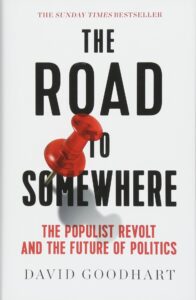
Orwell never lived in one location for more than a few years, yet he was in many ways deeply rooted, if not to a particular place, then at least to British culture. In his 2017 book The Road to Somewhere, David Goodhart set forth ‘an explanation for the two upsets of 2016—Brexit and Trump—in terms of the new value divisions in developed democracies’, and I have long wondered where Orwell—were he alive today—might be situated on the spectrum of David Goodhart’s notion of ‘Somewheres’ and ‘Anywheres’. The ‘Somewheres’ of Goodhart’s model are comprised of a less-educated working class strongly attached to their culture and community who ‘feel that their more socially conservative intuitions have been excluded from the public space in recent decades’ (vii). ‘Anywheres’, in contrast, are a mobile, educated elite—often the product of the boarding school tradition—who identify with an intellectual class independent of place. Orwell himself was a product of the English boarding school tradition, yet he possessed both a deep empathy for the common man as well as ‘homely’ inclinations, manifested in much of his writing as well as his decision to rent both the cottage in Wallington and the farmhouse in Jura, suggesting he was an ‘Anywhere’ longing to be a ‘Somewhere’. Because of both his own internal polarity (another of Orwell’s complexities) and an extraordinary gift for empathy, I believe Orwell would have perceived the frustration and despair of many of those who supported Trump and understood the folly of concluding that every second person in this country is a racist, a fascist, or a hate-monger. He would have seen that in many ways, America is no longer one country but two: an urban, Democratic nation of ‘Anywheres’ and a less populated, Republican land of ‘Somewheres’, whose problems, priorities, morals, and values are increasingly at odds. Orwell, I am convinced, would have realized that no real healing of this nation will ever begin until the vitriol on both sides stops and real communication begins. Perhaps Orwell could have dispensed some healing insights at a time when the nation is desperately in need of a salve for its collective soul.
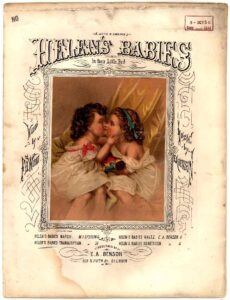 Sheet music (Library of Congress)
America is no longer the country it was when Orwell wrote ‘Riding Down from Bangor’ 74 years ago. (Bangor, incidentally, is the county seat of Penobscot County, Maine, which at the latest count, was carried by Trump, 52.5% to 44.3%.) Though Orwell would not live to know it, a turning point in American history was to occur on November 22, 1963 when President John F. Kennedy was assassinated, 17 years to the day after Orwell’s essay was first published.iii Another 57 years have passed since then, and the country is now more divided than it has been since the election of Lincoln in 1860, an event that precipitated both secession and the start of the Civil War. Despite the war and the marked ‘social distinctions’ and poverty of the era, Orwell still viewed 19th century America as a decent age; free from the modern nightmares of unemployment and ‘State interference’, Orwell wrote: ‘‘there was not, as there is now, an all-prevailing sense of helplessness’ (‘Riding Down from Bangor’ 21). If only he could see us today, battling both a pandemic and our fellow Americans. One can only wonder whether Orwell would have viewed that fateful day in November, 1963 as the beginning of the end of the American innocence he had once found reflected in works such as Helen’s Babies.
*
Footnotes:
i Not every reviewer, it should be noted, was as enthusiastic about Helen’s Babies; a review of the novel in The Contemporary Review stated: ‘Fitz-Greene Halleck would have pitched both these books [Helen’s Babies and another Habberton novel, The Barton Experiment] out the window, and told the author to go back to school for a few years, and then to study good authors, and leave comic periodicals and penny papers alone for a time before writing another line’ (168).
ii In the United States, blue is associated with the Democratic Party and red with the Republican Party.
iii Coincidentally, Aldous Huxley and C. S. Lewis, two other authors about whom Orwell had written – not always favourably – both died on the same day.
Works Cited
Bass, Emily F. “Vacation Companions.” The Journal of Education, vol. 57, no. 22,
28 May 1903, pp. 341-342, JSTOR, http://www.jstor.org/stable/44057061.
Accessed 18 Jan. 2018.
Goodhart, David. The Road to Somewhere: The New Tribes Shaping British
Politics. Penguin, 2017.
“Helen’s Babies.” The Contemporary Review, vol. 30, 1 June 1877, pp. 167-70,
ProQuest, https://search-proquestcom.proxy.libraries.rutgers.edu/docview/1294586012?rfr_id=info
%3Axri%2Fsid%3Aprimo&imgSeq=1. Accessed 18 Jan. 2018.
‘Helen’s Babies at the Capitol.’ The Bioscope, 28 May 1925, p. 31.
‘Helen’s Babies at the Kinnaird.’ Dundee Courier, 10 Nov. 1925, p. 3.
Hitchens, Christopher. Orwell’s Victory, Allen Lane/Penguin, 2002.
Lang, Cady. “The Gap’s Deleted Post-Election Tweet Shows Just How Uninterested
Many Americans Are in Unity Right Now.” Time, 4 Nov. 2020.
https://sports.yahoo.com/gap-deleted-post-election-tweet-222846687.html.
Accessed 10 Nov. 2020.
Orwell, George. “Mark Twain. The Licensed Jester.” The Collected Essays, Journalism,
and Letters of George Orwell Volume 2: My Country Right or Left 1940-1943.
1968. Edited by Sonia Orwell and Ian Angus, Penguin, 1971, pp. 369-74.
—. “Riding Down from Bangor.” Tribune, no. 517, Nov 22, 1946, pp. 20-
21. ProQuest, https://login.proxy.libraries.rutgers.edu/login?url=
?url=https://www-proquest.
com.proxy.libraries.rutgers.edu/docview/1861548540?accountid=13626.
Accessed 25 Oct. 2020.
—. The Road to Wigan Pier. (1937). Harvest/HBJ, 1958.
“Questions in Literature – (II).” The Journal of Education, vol. 60, no. 17, 27 Oct.
1904, p. 282, JSTOR, http://www.jstor.org/stable/44065775.
Accessed 18 Jan. 2018.
Links:
Fitz-Greene Halleck link:
https://www.poetryfoundation.org/poets/fitz-greene-halleck
Penobscot County voting results:
https://www.politico.com/2020-election/results/maine/
Saoirse Ronan:
I read this article completely concerning the difference of most recent and preceding technologies, it’s remarkable article.