
Orwell’s Love of Lawrence
Currently, I’m looking closely at two aspects of Orwell – his childhood (the subject I’ve been commissioned to consider for a major new Oxford University Press handbook on the author of Animal Farm and Nineteen Eighty-Four) and the (surprisingly substantial) impact of D. H. Lawrence on his writings. Both these aspects come together in a remarkable essay Orwell contributes to the leftist weekly journal, Tribune, in November 1945 (Davison 1998 Vol. XVII: 385-388).
Quite out of the blue, Orwell presents a review of Lawrence’s The Prussian Officer and Other Stories, first published by Duckworth in 1914 but now, just after the end of the war, reprinted as a Penguin. In the process, he reveals a great deal about himself, his childhood, his ideas – and his admiration for the author of Lady Chatterley’s Lover.
Orwell’s essay, ‘Such, Such Were the Joys’ (1970, 4 [1952]) composed in the late 1940s but not published until after his death because of libel problems, focuses on his largely unhappy times at St Cyprian’s prep school, in Eastbourne, and is one of the very few articles in which he dwells on his childhood at any length. It could be argued that a great deal of the essay is, in any case, fiction.
But it is wrong to suggest that Orwell is strangely reticent about his childhood: in fact, he refers to it many times throughout his writings. Perhaps the most evocative representation appears in his novel Coming up for Air (1939), in which he draws on his memories of his childhood in Shiplake with the Buddicom children to capture George Bowling’s urge to rediscover the ‘Golden Age’ of his youth in Lower Binfield. As biographer Gordon Bowker comments, the scenery around Shiplake ‘would haunt Orwell’s consciousness and reshape his imaginary world’ becoming, with Henley, the Lower Binfield, of Coming up for Air ‘while the countryside around inspired the visionary landscape of Winston Smith in Nineteen Eighty-Four’ (Bowker 2003: 41).
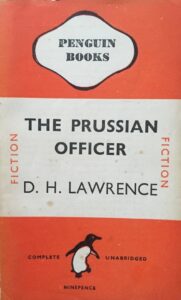 Penguin Edition, 1945
The many references to his youth dotted about his writings and radio broadcasts – while he was a talks producer at the BBC from 1941-1943 – in the end form quite a fascinating ‘autobiography’. Here, for instance, in this review of The Prussian Officer, Orwell begins with a personal reminiscence – telling of how he first became acquainted with Lawrence. ‘In 1919, I went into my schoolmaster’s study [at Eton] for some purpose and, not finding him there, picked up a magazine with a blue cover which was on the table. I was then sixteen and wallowing in Georgian poetry. My idea of a good poem would have been Rupert Brooke’s Grantchester. As soon as I opened the magazine I was completely overwhelmed by a poem which describes a woman standing in the kitchen and watching her husband approaching across the fields. On the way he takes a rabbit out of a snare and kills it. Then he comes in, throws the dead rabbit on the table, and his hands still stinking of rabbit’s fur, takes the woman in his arms.’
Orwell continues, saying that more than the sexual encounter, the celebration of the ‘beauty of Nature’ impressed him, particularly the lines, referring to a flower: ‘Then her bright breast she will uncover/And yield her honeydrop to her lover.’ But in the rush, he fails to notice the name of the author or even the magazine, though he presumes it’s the English Review. Indeed, Peter Davison, in the Collected Works, Vol. XVII, page 388, confirms that the poem was most likely Lawrence’s ‘Cruelty and Love’ which was first published in that journal.
Still dwelling on his personal story, Orwell tells of how four or five years later, still not having heard of Lawrence, his picks up a copy of The Prussian Officer (possibly at the Smart & Mookerdum bookshop in Rangoon while he is serving as an Imperial Policeman in Burma, though he does not say this) and is again impressed by Lawrence’s writing – in the story that leads the collection and in ‘The Thorn in the Flesh’. Both reflect Lawrence’s horror and hatred of military discipline. But, according to Orwell, his understanding of its nature is particularly striking. So just months after the end of the Second World War, Orwell is moving away from his stance of patriotic belligerence and focusing, approvingly, on the writings of an outspoken anti-militarist and his powerful imagination. ‘Something told me that he had never been a soldier, and yet he could project himself into the atmosphere of an army, and the German army at that. He had built all this up, I reflected, from watching a few German soldiers walking about some garrison town.’
Orwell now takes the opportunity to explain in more detail his fascination with Lawrence. ‘He was in essence a lyric poet and an undisciplined enthusiasm for “Nature” i.e. the surface of the earth, was one of his principal qualities, though it has been much less noticed than his preoccupation with sex.’ Indeed, Orwell’s descriptions of nature throughout his writings often have a particular ‘Lawrentian’ feel to them (as do his depictions of sex – particularly during Winston and Julia’s secret, passionate affair in Nineteen Eighty-Four).
He continues his review: ‘And on top of this he had the power of understanding, or seeming to understand, people totally different from himself such as farmers, gamekeepers, clergymen and soldiers – one might add coalminers.’
Orwell’s own interest in coalminers appears most notably in The Road to Wigan Pier (1937), his account of his travels in the north of England examining the plight of the poor. And his account of going down a mine and crawling through tiny, water-logged tunnels to the coalface to observe the near-naked miners at work is one of the most memorable scenes of the book. Here, Orwell writes that Lawrence had worked in a pit at the age of thirteen, though he was ‘clearly not a typical miner’. But he is mistaken. Lawrence’s father, Arthur, was a miner all his life – and Paul Morel’s drunken, abusive father in Sons and Lovers is loosely based on him – but the writer Lawrence never worked down a pit.
Orwell goes on to highlight Lawrence’s ‘extraordinary power’ of imagination. Significantly, Orwell, who wrote so powerfully of ‘Shooting an Elephant’ (1936) while a policeman in Burma and of being a Republican soldier during the Spanish civil war, in his memoir Homage to Catalonia (1938), admires Lawrence’s ability to capture in words the experience of shooting at a wild animal! ‘… the action is not the same as shooting at a target. You do not look along the sights: you aim by an instinctive movement of the whole body, and it is as though your will were driving the bullet forward. This is quite true, and yet I do not suppose Lawrence had ever shot at a wild animal.’
Next, Orwell praises Lawrence’s account of the death scene in his short story, ‘England My England’, even though it is not included in The Prussian Officer collection, for being ‘emotionally true, and therefore convincing’. Orwell clearly titles his patriotic essay ‘England, Your England’ – composed in 1941 at a critical moment in the Second World War when invasion by Nazis appeared a distinct possibility – as a way of acknowledging Lawrence’s legacy though he deliberately changes Lawrence’s overt anti-war stance to a stirring, pro-war one. Now, in the Tribune review, Orwell is much more sympathetic to Lawrence’s pacifism. Indeed, it is interesting to wonder how much Lawrence’s account of Egbert being shot in the head in a Flanders battlefield in ‘England My England’ reminds Orwell of his extraordinary description of being shot in Homage to Catalonia.
For Egbert: ‘A shell passed unnoticed in the rapidity of action. And then, into the silence, into the suspense where the soul brooded, finally crashed a noise and a darkness and a moment’s flaming agony and horror. Ah, he had seen the dark bird flying towards him, flying home this time. In one instant life and eternity went up in a conflagration of agony, then there was a weight of darkness. When faintly something began to struggle in the darkness, a consciousness of himself, he was aware of a great load and changing sound. To have known the moment of death! And to be forced, before dying, to review it. So, fate, even in death.’
Egbert has a split second to think about the experience of being shot: ‘There was a resounding of pain. It seemed to sound from the outside of his consciousness: like a loud bell clanging very near. … After a time he seemed to wake up again, and waking, to know that he was at the front, and that he was killed. … Bit by bit, like a doom, came the necessity to know. He was hit in the head. It was only a vague surmise at first. But the swinging of the pendulum of pain, swinging ever nearer and nearer, to touch him into an agony of consciousness and a consciousness of agony, gradually the knowledge emerged – he must be hit in the head – hit on the left brow…’ He remembers his life with his wife, Winifred, and the children but the memories bring on nausea. So inwardly he cries: ‘To forget! To forget! Utterly, utterly to forget, in the great forgetting of death.’ And the long account of the death agony ends with questions and exclamations, not in darkness but in a terrible light as the German cavalry arrive: ‘What was that? A light! A terrible light! Was it figures? Was it legs of a horse colossal – colossal above him: huge, huge?’ (Lawrence 1974 [1922]: 313).
In contrast to Lawrence’s imaginative account, Orwell’s is drawn from the actual experience of being hit by a fascist sniper on 20 May 1937 while fighting on the Huesca frontline. It is written from the benefit of hindsight months after the event. Egbert’s instinct is to think about being shot – Orwell, in contrast, reflects on the ‘interesting’ experience as being ‘worth describing in detail’. Like Egbert, Orwell is struck by the sound: ‘Roughly speaking it was the sensation of being at the centre of an explosion. There seemed to be a loud bang and a blinding flash of light all round me and I felt a tremendous shock, such as you get from an electrical terminal; with it a sense of utter weakness, a feeling of being stricken and shrivelled up to nothing. … I had a numb, dazed feeling, a consciousness of being very badly hurt, but no pain in the ordinary sense’ (italics in the original). Egbert’s memories of his family are shrouded in trauma; Orwell’s thoughts of his wife, in contrast, have a light, ironic, humorous tone: ‘Not being in pain, I felt a vague satisfaction. This ought to please my wife, I thought; she had always wanted me to be wounded, which would save me from being killed when the great battle came’ (Orwell 1962 [1938]: 177-178).
One of the many intriguing aspects of Orwell’s career is that he published in many genres – poetry, essays, journal columns, polemical articles, social and cultural commentaries, war reports, radio broadcasts, book, drama and film reviews, novels, diaries, letters – but never short stories. While in Paris in the early 1930s he composed some short stories but destroyed them as worthless; at the end of his life he was drawing the outline of a 40,000-word novella he titled ‘A Smoking-room Story’. It is interesting, then, that Orwell, in his review of The Prussian Officer, directs particular praise on Lawrence’s short stories.
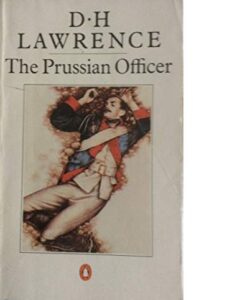 Penguin Edition, 1976
He writes: ‘With few exceptions Lawrence’s full-length novels are, it is generally admitted, difficult to get through. In the short stories his faults do not matter so much because a short story can be purely lyrical, whereas a novel has to take account of probability and has to be cold-bloodedly constructed.’ He singles out for praise ‘Daughters of the Vicar’ by Lawrence which is part of The Prussian Officer collection, concisely summarising its plot. The elder daughter, Mary, marries a comparatively well-to-do clergyman, who happens to be a dwarf and an ‘utterly inhuman creature’. The younger daughter, Louisa, ‘whose vitality is not to be defeated by snobbishness, throws family prestige overboard and marries a healthy young coalminer’. In Orwell’s description of her as ‘the underfed, downtrodden, organ-playing daughter of a clergyman wearing out her youth’ does she not resemble in some way Dorothy Hare, the central character of his novel A Clergyman’s Daughter (1935)? And while the plots of the two novels are certainly different, in the choice of title is not Orwell acknowledging once again his literary debt to Lawrence?
Orwell ends his review expressing the hope that Penguin will reprint Lawrence’s collection of short stories England My England. One of the stories he highlights is ‘Fanny and Annie’ (he spells it incorrectly as ‘Fannie and Annie’). In it, Fanny returns with a heavy heart to ‘a little ugly town on top of the hill’ to marry her first love – foundry worker Harry Goodall. A chapel service they both attend is interrupted by the loud shouts of a ‘stoutish, red-faced woman’ denouncing Harry for making her daughter, Annie, pregnant. Does this, then, not remind you of the end of Orwell’s first novel, Burmese Days (1933), when the anti-hero John Flory is denounced at a church ceremony by his mistress Ma Hla May? ‘Look at me you white men, and you women, too, look at me! Look how he has ruined me! Look at these rags I am wearing!’ she yells. Flory never recovers from this public humiliation and ends up committing suicide.
How much ‘Fanny and Annie’ inspired the end of Burmese Days we will never know. Orwell is clearly determined to keep quiet about that in his fascinating Tribune tribute to Lawrence.
References
Bowker, Gordon (2003) George Orwell, London: Little, Brown
Davison, Peter (ed.) (1998) The Collected Works of George Orwell, XX Vols, London: Secker and Warburg
Lawrence, D. H. (1976 [1914]) The Prussian Officer and Other Stories, Harmondsworth, Middlesex: Penguin Books
Lawrence, D. H. (1974 [1922]) England My England, in The Collected Short Stories of D. H. Lawrence, London: Book Club Associates pp 286-313
Orwell, George (1962 [1938]) Homage to Catalonia, Harmondsworth, Middlesex: Penguin Books
Orwell, George (1970 [1952]) Such, Such Were the Joys, Orwell, Sonia and Angus, Ian (eds) The Collected Essays, Journalism and Letters, Vol. 4: In Front of Your Nose 1945-1950, Harmondsworth, Middlesex: Penguin Books pp 379-422; Partisan Review, September-October
- Richard Lance Keeble, Professor of Journalism at the University of Lincoln and Honorary Professor at Liverpool Hope University, was chair of The Orwell Society 2013-2020. He has written and edited 42 books on a wide range of media-related topics. His latest books are Journalism Beyond Orwell (Routledge, 2020) and George Orwell, the Secret State and the Making of Nineteen Eighty-Four (Abramis, 2020).
Leave a Reply