
He’s Dead But: A Popular Song
George Orwell prefaced his last two novels of the 1930s with quotations as epigraphs, both of them needing qualification. In the case of Keep The Aspidistra Flying (1936) he took St Paul’s First Letter to the Corinthians, chapter 13, and, as his note says, ‘adapted’ it: Orwell replaced the word ‘love’ with ‘money’ throughout. For instance, ‘And now abideth faith, hope, charity, these three; but the greatest of these is charity’ becomes ‘And now abideth faith, hope, money, these three; but the greatest of these is money.’
He gave an epigraph to his next novel, too. That was much shorter. On the first page of Coming Up For Air (1939) we can see:
‘He’s dead, but he won’t lie down’
Popular song
Over eighty years after the novel appeared it would be easy to misunderstand what ‘Popular’ means, and Orwell may have meant that misunderstanding deliberately. A popular song is not a traditional song nor a folk song, for ‘He’s dead, but he won’t lie down’ was only six years old when Orwell used it. Whether he realised its recency is something unknowable today.
‘He’s dead, but he won’t lie down’ was sung by Gracie Fields in her second film, Looking on the Bright Side, released in September 1932. In his biography of the actress, Pride of Our Alley, Sebastian Lessandro says
‘Following on from the popularity of her first film [Sally In Our Alley], a similar down-to-earth comedy storyline was used …’
Lessandro goes on to say
‘Strangely, only one of the songs Miss Fields sings is a broad comedy type, for which she is famous, and this was written by Bill Haines, Maurice Beresford, and James Harper, and titled “He’s dead[,] but He Won’t Lie Down,”’
The reason why the song became well-known, Lessandro has already explained:
‘As with her first film, the popularity of the five songs Gracie performed was publicised with 78rpm record releases and sheet music covers for each of the songs, featuring Gracie’s image’.
Watching the film and listening to the record makes it clear that the record is a re-recording, and a different arrangement of the song.
*
Although two of the three writers contributed to another song on the soundtrack none of the five songs have the same writers. From Sebastian Lessandro’s note one can see why: that the process of mass film making had become a production line. Equally, the chance to contribute or work was exactly that, chance. Lessandro says of the title song
‘Much like the film’s predecessor, Gracie relied on a catchy theme song to carry her through, and this came from composer Howard Flynn… He [Flynn], like thousands of other writers, sent his song along to [Gracie Fields’ manager] Bert Aza for consideration to be used by Gracie, and was delighted when the song was not only picked for use in the film, but chosen to be its title…’
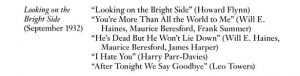

Song list from Music Hall Mimesis
*
The phrase ‘He’s dead, but he won’t lie down’ quickly became popular even if the song may have been forgotten, but it is clear that it became a metaphor in conversation for political figures who had failed but also failed to go away. In a long reportage from Britain in Life magazine in July 1940, about a year after Orwell’s novel was published, Clare Boothe [Luce] reported on a lunch she had attended. J L Garvin was present but it seems it was not he who spoke as she memorialised:
‘Chamberlain … “’E’s dead but ‘E won’t lie down” somebody quoted a Gracie Fields’ music-hall song’
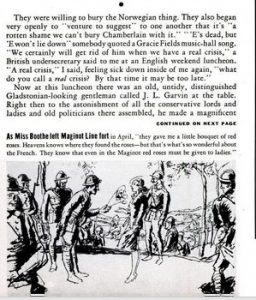 Life 29 July 1940 page 81
If Orwell heard the phrase in general circulation as Chamberlain’s incompetence became widely recognised he may have felt a grim satisfaction.
Miss Boothe may have reported her companion accurately, but she was mis-quoting Gracie Fields, who pronounces the aitch of ‘He’ in all occurrences though she drops them elsewhere in her rendition: “bald ‘ead”, for instance, presumably for comic effect. Orwell mentions this class-based loss of aspirates when he quotes lines of poetry written by Rudyard Kipling in his war-time review, rebuking Kipling whose intention was not comic.
Orwell worked unhappily as a film reviewer during the first year of the Second World War but would have learned more about the background to the industry as he mingled with his fellow professional reviewers. Later this would feed into the visions of the writing departments of the Ministry of Truth in Nineteen Eighty-Four. Meanwhile, an investigation of a line he quoted helps to expose the process to us today in another way.
Orwell never mentioned Gracie Fields and her writers as the source of his epigraph, but neither did he ever name George Formby Senior as the music hall artiste who originated the Wigan Pier-as-a-holiday-destination joke which he used in 1937. As a consequence it may never be clear whether George Orwell knew that the phrase he applied to George Bowling, his harried insurance agent character, had come from the celluloid factory and not from the people. It does feel appropriate, though, does it not?
*
Acknowledgements:
This article was suggested by Dr David Craik, who identified Looking On The Bright Side as the origin of He’s Dead But He Won’t Lie Down.
References (other than hyperlinks):
Sebastian Lassandro, Pride of Our Alley: The Life of Dame Gracie Fields Volume I; 1898-1939
Paul Matthew St. Pierre, Music Hall Mimesis in British Film, 1895-1960: On the Halls on the Screen
*
Thanks Les, another interesting insight
Wonderful article. A colleague said of a colleague in my office… “he died on the job years ago but he won’t fall over” which sounds like a variation.