
Orwell and the Atomic Bomb
George Orwell’s reflections about the atomic bombings of Hiroshima and Nagasaki on 6 and 9 August seventy-five years ago – in a wide range of writings – are among his most important and insightful.
His first major statement comes in an essay, ‘You and the Atom Bomb’, published in Tribune on 19 October 1945 where he concentrates on the Bomb’s impact on the state. ‘The discovery of the atomic bomb, so far from reversing history, will simply intensify the trends which have been apparent for a dozen years at least,’ he says. The great age of democracy and of national self-determination was the age of the musket and the rifle. Most nations could get hold of rifles so that Boers, Bulgars, Abyssinians, Moroccans and Tibetans could fight for independence, sometimes with success. Thereafter, every development in military technique has favoured the state. In 1939, there were only five states capable of waging war on the grand scale – now there are only three – and perhaps only two.
He writes: ‘So we have before us the prospect of two or three monstrous super-states, each possessed of a weapon by which millions of people can be wiped out in a few seconds dividing the world between them. … It has been rather hastily assumed that this means bigger and bloodier wars and perhaps an actual end to the machine civilization. But suppose – and really this is the likeliest development – that the surviving great nations make a tacit agreement never to use the atomic bomb against one another? Suppose they only use it, or the threat of it, against people who are unable to retaliate? In that case, we are back to where we were before, the only difference being that power is concentrated in still fewer hands and that the outlook for subject peoples and oppressed classes is still more hopeless.’ The outcome is indefinite ‘peace that is no peace’.
This is Orwell, then, in his bleakest mood. Is there any hope? Only if cheap and easily manufactured weapons can be developed that are ‘not dependent on huge concentration of industrial plant’.
He takes James Burnham’s The Managerial Revolution (1941) to task for predicting that Germany, not Russia, would dominate the Eurasian land mass. Yet Burnham’s essential world view has turned out correct. ‘More and more obviously, the surface of the earth is being parcelled off into three great empires, each self-contained and cut off from contact with the wider world and each ruled, under one guise or another, by a self-elected oligarchy.’ Without directly saying so, Orwell suggests that most likely some combination of Western Europe and the United States, a nuclear-armed Soviet Union and East Asia, led by China, will dominate this new, permanent state of ‘cold war’. All this clearly anticipates the world of Nineteen Eighty-Four in which three super-states, Oceania, Eurasia and Eastasia, are at constant war. As Dorian Lynskey comments in The Ministry of Truth: A Biography of George Orwell’s 1984 (2019): ‘Having invented the phrase “cold war”, he also anticipated the doctrine of mutual assured destruction.’
The Tribune essay significantly draws a response from Alex Comfort, the pacifist with whom Orwell has earlier engaged in a controversy in verse over the cases for and against waging war. Following the spat, the two, remarkably, become friends. In an article in War Commentary, just three weeks after the atomic blasts, Comfort condemns them as acts of ‘criminal lunacy which must be without parallel in recorded history’. Now, in his letter to Tribune, Comfort begins by praising Orwell for putting his finger ‘as usual, on the wider analytical point’ that different types of weapons tend to produce particular types of societies. Yet, he stresses, ‘another conclusion is possible besides mere resignation to the omnipotence of tyrants equipped with nuclear energy. Not only are social institutions dictated by weapon-power: so are revolutionary tactics, and it seems to me that Orwell has made the case for the tactical use of disobedience, which he has tended to condemn in the past as pacifism’.
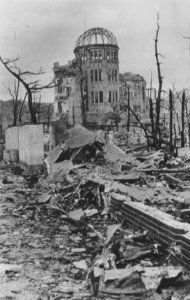 The Genbaku Dome in October 1945. Photograph by Shigeo Hayashi
Early in 1946, Orwell gives a talk to the Red Flag Fellowship and again expresses concern over the coming of the atom bomb. If war breaks out between the US and the USSR, he says, he would choose the US, since, despite all the faults of uncontrolled capitalism, they had at least liberty. The Soviet Union was so despotic there was little hope of liberty ever emerging there.
His fears over the emergence of phony wars between a tiny number of super-states, first expressed in ‘You and the Atom Bomb’, appear again in his essay ‘Toward European Unity’ for the July/August 1947 issue of Partisan Review. Within each nuclear-armed state, he says, the ‘necessary psychological atmosphere would be kept up by complete severance from the outer world and by a continuous phony war against rival states. Civilization of this type might remain static for thousands of years’. As Bernard Crick comments in his 1980 biography: ‘This is Nineteen Eighty-Four.’ But this time a new mood of idealism mixes with the pessimism. There is hope – and it lies in European democratic socialism ‘where people are relatively free and happy and where the main motive in life is not the pursuit of money or power’. ‘Apart from Australia and New Zealand, the tradition of democratic Socialism can only be said to exist … in Scandinavia, Germany, Austria, Czechoslovakia, Switzerland, the Low Countries, France, Britain, Spain and Italy. Only in those countries are there still large numbers of people to whom the word “Socialism” has some appeal and for whom it is bound up with liberty, equality and internationalism.’
Atomic warfare plays a crucial role in Nineteen Eighty-Four. On one occasion, Winston Smith meets Julia, the ‘girl from the Fiction Department’, with whom he has a passionate affair, in the ruins of a church destroyed in a nuclear attack ‘thirty years’ earlier – which suggests the revolution which allowed the Party to seize power occurred in 1954. And when Winston reflects on his childhood in London, one of his earliest memories is of a sudden air raid. ‘Perhaps it was the time when the atomic bomb had fallen on Colchester. He did not remember the raid itself, but he did remember his father’s hand clutching his own as they hurried down, down, down into some place deep in the earth…’
To a certain degree, Orwell’s retreat to the remote Scottish island of Jura in the last years of his life in order to concentrate, away from the drudgery of journalism, on writing what was to become his dystopian masterpiece, was also inspired by his fear of atomic warfare. As he confides to his friend Tosco Fyvel in December 1947: ‘This stupid war is coming off in abt 10-20 years, and this country will be blown off the map whatever happens. The only hope is to have a few animals in some place not worth a bomb.’ And to his friend, Julian Symons, in December 1948, he writes: ‘If the show does start and is as bad as one fears, it would be fairly easy to be self-supporting on these islands provided one wasn’t looted.’
After the publication of Nineteen Eighty-Four on 8 June 1949, in London, and five days later in New York, Orwell discusses with his publisher, Fredric Warburg, who visits him at Cranham sanatorium, his serious concerns over the misinterpretations of his great novel’s focus – in particular, on its warnings about atomic warfare. In Warburg’s follow-up note on the discussion, which appears in Volume 20 of the Collected Works, edited by Peter Davison, Orwell makes clear that the Soviet Union is not the primary target. Rather, ‘the danger lies in the structure imposed on Socialist and on Liberal capitalist communities by the necessity to prepare for total war with the USSR and the new weapon, of which of course the atomic bomb is the most powerful and the most publicized. But danger lies also in the acceptance of a totalitarian outlook by intellectuals of all colour.’
So right until near the very end of his life, atomic warfare is a major preoccupation of George Orwell – a fact worth remembering as people all around the country gather to mark the 75th anniversary of the attacks on Japan.
*
Richard Lance Keeble was chair of The Orwell Society from 2013 to 2020. His latest books are Journalism Beyond Orwell (Routledge 2020) and George Orwell, The Secret State and the Making of Nineteen Eighty-Four (Abramis, 2020).
Like Orwell, I’m a rightist from a mode that has more currency in European modes than American as most American “conservatives” really are Classical Liberals or economic Libertarians not traditionalists as the USA broke all ties with traditional governance in its War of Independence that really wasn’t a revolution actually! We on the Right need to assess in the age of Maoist China’s COVID 19 the reality of Hiroshima and Nagasaki, whether it was right in being necessary militarily to make peace with beaten Japan because there was no moral justification as it was aimed primarily at civilians not military targets. Also, the results of Maoist China as the last totalitarian Super Power left to keep their system of organized oppression with no one able to censure them due to their weaponry and wealth for it even when their actions affect the peoples of other nations like they have! We Americans lost all moral high ground we could have because in Hiroshima and Nagasaki we did what no other country has done against a foe’s civilian centers to the extent we did it for what I say objectively were negligible military justifications for it!
True rightist historian John Toland and George Orwell would have been in agreement on the action of unleashing atomic destruction on densely populated centers twice especially when once was more than enough as the Japanese were trying to make a honorable truce as Toland proves. Sad reality is that it seems the US authorities of the Harry Truman Administration were genuinely more interested to see the extent of the destruction their weapons could do not so much concerned about beating Japan as they knew it was militarily beaten. The Japanese had no Navy nor Air Force left. Tojo had been overthrown by the Emperor who wanted a peaceful truce.
Sir Winston Churchill suggested restraint as he was afraid of China going Soviet if the Japanese were removed without there being any resistance to the Stalin’s USSR forces from the East. Japan had been an ally of the U.K.’s in WWI. Like Orwell’s fear of nukes, Churchill’s fear of a communist victory in China was correct!
I would argue that the world today is a more scary place because of what happened at Hiroshima and Nagasaki when negotiations were not utilized in favor of seeing the destructive effects of nukes while paving the way for the Sovietization of Asia which occurred with the Korean and Vietnam Wars as a result! The USSR and all the Powers became interested in acquiring and developing greater nukes once the effects they could do was shown with the atomic effects of nukes not going away with the rubble of explosions like conventional weapons.
Is that all a good thing helpful to anybody of any political persuasion? As a Rightist, I’m a Luddite type who says “No”! Personally, as a history researcher and Rightist not happy with Maoist China’s influence in the world, I don’t think the long-term results justified that action when a negotiated settlement could have been pursued for Japan and its anti-communist allies in Asia!
This is a very illuminating article, thank you for publishing it. The Outer Hebrides are a marvelous and (still) quiet place on planet earth. The vision of Mr. Orwell producing his masterpiece 1984 at a rented farmhouse on the Isle of Jura is compelling. Mr. Orwell was unique, perhaps, in that he was able to so clearly and admirably foresee the future. Remember his last words: “It is up to is to prevent it.” IT being the horrific, anti-human, anti-love, anti-sex world painted in the novel 1984.
We still have the power to prevent IT, but we must not fail ourselves nor fool ourselves nor turn our backs on our brothers ans sisters.