
Mr Foster Knowles
*
Introduction. George Orwell had few happy memories of St Cyprian’s, his prep school, but two of his teachers received his praise. I have already mentioned one: the other was Foster Knowles.
Orwell (then Eric Blair) attended St Cyprian’s, a prep school (that is, it prepared boys for an English Public School) in Eastbourne from 1911, aged eight, to December 1916 when he was thirteen. He then went to Eton on a scholarship for which St Cyprian’s staff had crammed him, via Wellington College. His memoir ‘Such, Such Were the Joys’ bitterly criticised the married couple who ran it i.e. the headmaster Lewis Chitty Vaughan Wilkes and his wife Cicely Ellen Philadelphia Wilkes.
Still, in ‘Such, Such Were the Joys’ Orwell mentioned two teachers who he liked or at least respected. One was the Second Master Robert Lawrence Sillar, whose life I briefly outlined in part one of my article about St Cyprian’s. The other one, Mr Foster Knowles, was non- resident. George Orwell wrote of Mr Knowles that:
Some of the scholarship boys received extra tuition from a certain Mr Knowles, a likeable, very hairy man, who wore shaggy suits and lived in a typical bachelor’s “den” – book lined walls, overwhelming stench of tobacco – somewhere in the town. During the holidays Mr Knowles used to send us extracts from Latin authors to translate, and we were supposed to send back a wad of work each week. Somehow I could not do it. The empty paper and the black Latin dictionary lying on the table, the consciousness of a plain duty ducked, poisoned my leisure, but somehow I could not start, and by the end of the holidays I would only have sent Mr Knowles fifty or a hundred lines. Undoubtedly part of the reason was that Sambo and his cane were far away.
In most published versions of ‘Such, Such Were the Joys’ Mr Knowles was called Mr Batchelor while Mr Sillar was called Mr Brown. This was so even in the 2009 Penguin edition of Orwell’s articles titled, Shooting an Elephant. Only in the Collected Works were the two men given their true names, and even then Mr Knowles was called by his surname alone. Orwell wrote of the two men:
He [Mr Sillar] and Mr Knowles were the only adults in any way connected with the school whom I did not either dislike or fear.
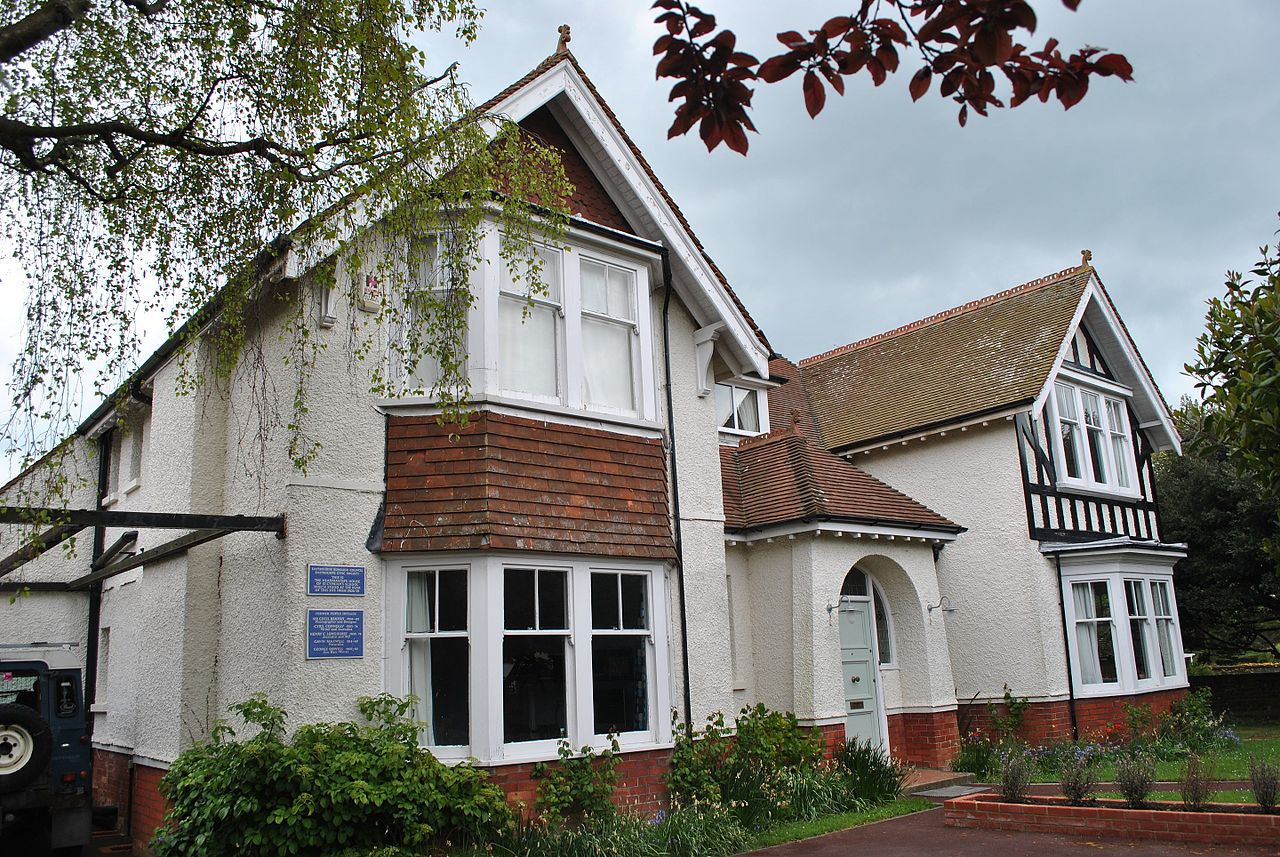 St Cyprian’s School, or such as remains
In the rest of this article I look at the life of Foster Knowles, in so far as it can be reconstructed from publicly available records and historic newspapers.
Family Background. Foster Knowles was born on 26 November 1867, in Henge Road, New Park, Clapham Sub-Registration District, Wandsworth Registration District, in Surrey. He was the oldest of thirteen children of William Knowles and Emma Letitia Knowles née Paxton. The birth was registered on 6 January 1868.
William Knowles a merchant and banker was born on 30 March 1841, the oldest of the eleven children of John Knowles and Mary Anne Knowles née Heming; married Emma Letitia Paxton on 29 November 1866 at St James’s Church in Shoreditch; and died on 6 November 1889, at Langley House, Slough, aged forty eight, leaving £125, 891 2s 6d.
Emma Letitia Paxton was born in January 1849 at Epping in Essex, one of the four children of William Paxton and Ann Esther Paxton née Gibbons. According to family tradition, which is probably true, Sir Joseph Paxton, the landscape gardener and architect, of Chatsworth and Crystal Palace fame, was a relative. Emma Letitia Knowles, née Paxton, died on 10 February 1924, aged seventy five.
Education. The 1881 census lists Foster Knowles, aged thirteen, as boarding at the Reverend John White Tottenham’s Uplands Preparatory School at St Leonard’s, a Hastings suburb. It had more than fifty other boarders. From there Knowles went to Harrow and then to Trinity College, Cambridge, where he matriculated in 1887, achieved his BA in 1890 and his MA in 1894*.
Early Career and Marriage. Foster Knowles became a teacher working at Cothill House, a Preparatory School at Abingdon in Oxfordshire, founded in 1860, which took boys from eight to thirteen.
On Thursday 22 December 1898 Foster Knowles, a school master, thirty one, married Loui Dorothy Scott Coode, twenty. She was born on 1 February 1878 at Hammersmith, one of the six children of John Charles Coode a Civil Engineer and Clara Louisa Coode née Griffiths. John Charles Coode’s father, Sir John Coode, was, to quote the Dictionary of National Biography, ‘probably the most distinguished harbour engineer of the nineteenth century’.
Foster Knowles and his bride married at the Anglican Parish Church of Christ the Saviour, Broadway, Ealing (built in 1852 and designed by Sir George Gilbert Scott). The reception was held at Victoria Hall which opened in 1886, and was designed by Charles Jones the first Ealing Council architect, engineer and surveyor.
The Reverend Robert Jones, the Rector of Banham in Norfolk, conducted the marriage service. He was assisted by the Reverend William Templeton King, the vicar of the church where it took place, and the Reverend Septimus Hebert, the Vicar of Ivor in Buckinghamshire.
The bridesmaids included the bride’s sister Barbara Coode, and the groom’s sister Evelyn Knowles. They wore pale blue Bengaline dresses with black violet hats and carried bouquets of violets. The train of their dresses was carried by ‘Miss Mollie Bullock, Lady Nelson’s grandchild, who, attired in white satin, with a satin bouquet, was next to the bride the observed of all observers’ to quote the Saturday 24 December 1898 Middlesex County Times.
Mollie Bullock was Mary Louisa Bullock, aged six. Her mother Ethel Bullock née Nelson was the oldest of the four children of Sir Edward Montague Nelson of Warwick, who made his fortune importing New Zealand meat, and was High Sheriff of Middlesex in 1892.
In 1948 aged fifty six Mary Louisa Bullock married Roger Edgcome Rimell. His younger brother, Raleigh Edgecome Ainsworth Rimmel, had died in 1923, aged twenty two, with Colonel Percy Harrison Fawcett and Fawcett’s son Jack on their ill-fated-expedition to the Mato Grosso in Brazil in search of the Lost City of Z. Mary Louisa Rimell née Bullock died in 1974 aged eighty one.
The Middlesex County Times article about Foster Knowles’s wedding concluded with a long list of the wedding presents given to him and his bride. It makes fascinating social history but is too long to be reproduced here.
Married Life. Foster and Loui Knowles had three children. They were:
William Maurice Foster Knowles was born on 4 October 1900 at Abingdon; was listed as a schoolmaster in 1921 at St Peter’s School, Seaford and lived with his father in Eastbourne; married Doris Edith Elson on 20 January 1927; was by 1939 an Analytical Technical Research Chemist at Portishead in Somerset; and died on 13 January 1986 aged eighty five at Burnham-on-Sea, leaving £1,558.
Helen Gwendoline Doris Knowles was born at Abingdon on 2 August 1902; was listed as a pupil at Miss Edith Sarah Dumbrell’s private North End House School in the 1921 census; was teaching there in 1939; and died unmarried on 31 January 1993 aged ninety at Brighton, leaving £202, 414.
Geoffrey Arthur Knowles was born at Abingdon on 6 September 1909; in 1939 was a merchant’s clerk living in Fulham; married Hilda May Bulpin in 1947; and died in London on 29 May 1972 aged sixty two, leaving £3,425.
Foster Knowles was Joint Headmaster of Cothill Prep School by 1906 but then something happened. When Orwell knew him Knowles was a ‘Visiting Master’ at St Cyprian’s and at Ascham St Vincent’s, two rival Eastbourne Prep Schools. This was a comedown from being a head but the reasons for such a fall cannot have been dishonourable or he would never have taught again in Britain.
The 1911 census lists Loui Dorothy Scott Knowles as living with her three children at their maternal grandparents’ house in Henley-on-Thames. The children’s uncle, Charles Arthur Penrose Coode, a solicitor, aged thirty seven, also lived with his parents. The Coode family employed a cook, a lady’s maid, a parlour maid, a house maid and a nurse. I have not found Foster Knowles in the 1911 census and he was probably abroad.
The First World War started in 1914. Foster Knowles was forty six and remained a teacher.
On 20 May 1916 the Eastbourne Gazette reported that:-
a collision occurred in Compton Place Road on Tuesday between a motor car driven by Captain Painton, of Vicarage Road, and a schoolmaster, Mr Foster Knowles of Lewes Road who was riding a bicycle. Mr Knowles, who was riding from Paradise Drive into Compton Place Road, was thrown heavily from his machine, and received injuries to his head. After being attended to by Dr Merry he was taken home.
Captain George Henry Painton aged fifty five was a retired Royal Army Medical Corps officer. Dr William Joseph Collings Merry was an Eastbourne GP.
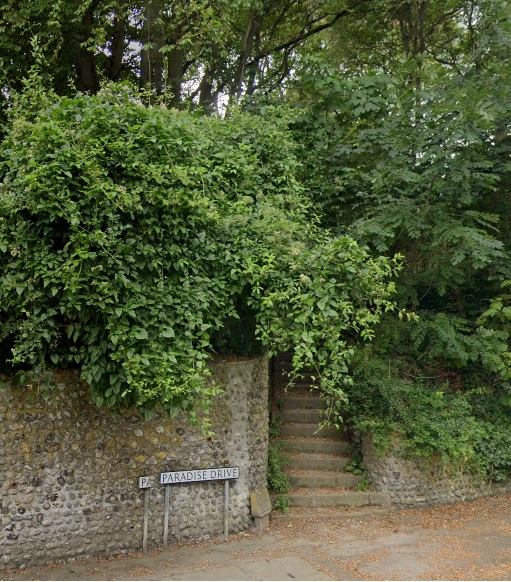 Paradise Drive today (via Google streetview)
Some of Loui Knowles’s brothers served in the armed forces. Her brother John Griffiths Coode, a gamekeeper in California, who was married with two children, joined the Canadian Expeditionary Force in 1917, was a Private, and was killed in action on the Western Front on 20 August 1918, aged forty five.
Later Life. The 1921 census lists Foster Knowles as a tutor working on his own account in Eastbourne. Information from the online Cambridge alumni confirm that he worked for both St Cyprian’s and Ascham St Vincent’s between the two World Wars. He lived in Eastbourne with his son William Maurice Foster Knowles (see above); and a Housekeeper, Ethel Roper aged forty one.
Loui Dorothy Scott Knowles does not feature in the 1921 census. She was abroad visiting British Colombia in Canada to see relatives. She had sailed from Britain on the Empress of France, landed in Quebec in June 1920, and then travelled by train. She had with her tickets for the Canadian Pacific Railroad and £50 in cash. Her father died in 1923 at Devizes aged seventy eight leaving £49, 278 3s 5d.
The 1939 Register lists Foster Knowles as a tutor living at 10 Moat Croft Road in Eastbourne with five other people all with different surnames i.e. it was a residential home. It lists Loui Dorothy Scott Knowles as living on private means at Coombe Croft at Chanctonbury in Sussex.
Foster Knowles died on 14 May 1942 aged seventy four, of a heart attack, at The Redoubt, an Eastbourne Nursing Home. His youngest son Geoffrey Arthur Knowles was present at his father’s death and informed the authorities of it. I have found no record of Foster Knowles’s death in the probate records.
Loui Dorothy Scott Knowles died on 8 January 1962, aged eighty three at Warrenton, in Sussex, leaving £3,570 8s 9d. Probate was granted to her oldest son William Maurice Foster Knowles, a technical and research chemist; and to a solicitor Ralph Macdonald Ward.
Conclusion. We cannot know why Foster and Loui Knowles lived separately after having three children. Perhaps Loui Knowles was used to having servants and resented housework especially after her husband ceased being a head.
The reason why Foster and Loui Knowles never divorced was probably because until 1937 a husband or wife who wanted a divorce, had to allege that their spouse had committed adultery. The resultant scandals destroyed reputations, and often lives. In 1937 desertion and various other causes became legitimate grounds for divorce. By then Foster Knowles was seventy and his wife fifty nine.
Foster Knowles was important in Orwell’s life. Eric Arthur Blair/George Orwell as a child was unlikely to learn that Knowles was married with three children, hence he would have thought that he was a bachelor. Foster Knowles was probably a naturally decent man but his kindness to pupils may have been because he missed his own children.
And perhaps Foster Knowles lived on. Although the character of Porteous in Orwell’s 1939 novel Coming Up For Air has been identified with M.R.James it would be easy to see a memory of his former Latin teacher in the character:
He lives in rooms, which luckily are in the lower half of the house, in the old part of the town, near the church. He’s a bachelor, of course. You can’t imagine that kind married. Lives all alone with his books and his pipe and has a woman in to do for him. He’s a learned kind of chap, with his Greek and Latin and poetry and all that.
*
* Although all men are now given the honorific ‘Mister’, in his time of social distinctions Foster Knowles, having a degree, was entitled to be addressed as “Mister”, having no other title.
Leave a Reply