
Review: Forged in Spain
Richard Baxell is the highly acclaimed author of a number of books and articles on the British Volunteers who fought in Spain. His Unlikely Warriors, was short-listed for the 2013 Political Book Awards’ political history book of the year. He was also the Chair of the International Brigade Memorial Trust (IBMT) for a number of years. His most recent book is Forged in Spain, a collection of ten fascinating biographies of extraordinary men and women (mainly men) who risked their lives in Spain during the bitter Civil War between 1936-1939.
This book will obviously be of great interest to both specialists and general readers who want to learn more about the Spanish Civil War but also those wishing to understand the role and fluctuating policy of the British Communist Party during this period. Orwell, having written the most famous and widely read book on the Spanish Civil War, Homage to Catalonia, makes an appearance in Chapter Six on Stafford Cottman. Baxell aims to draw Cottman, “Out of Orwell’s shadow”. This is no easy task but I am sure this chapter will particularly interest Orwell scholars and enthusiasts.
The ten biographies in this collection are; Malcolm Dunbar, Peter Kerrigan, Clive Branson, Sam Lesser, Alexander Tudor-Hart, Alexander Foote, Stafford Cottman, Leah Manning, the Haldanes (Charlotte and John Burdon Sanderson) and Peter Kemp. Most fought with the International Brigades (IB) and several were members of the British Communist Party. The Independent Labour Party (ILP) and rather more surprisingly, the Nationalists, also get a look-in. Most of those named above will probably be unfamiliar to the general reader, whilst even those who were once prominent, have now been largely forgotten with the passing of time.
History from Below
Baxell can be associated with the historiographical tradition of “history from below” which seeks to rescue those from the margins of history who have been neglected and over overlooked. The British men and women who volunteered and risked their lives in Spain are a case in point, often simply a footnote in British history. In his book, Baxell allows each individual room to tell their own stories by skilfully drawing upon biographical and oral sources. However, it is his use of new material from both the Russian State Achieve of Social and Political History and the MI5 documents that I found most exciting. The author also worked with IBMT archivist Jim Carmody between 1996 and 2016, putting together an annotated list of all the ‘British’ and Irish volunteers for the Republic in the Spanish Civil War of 1936 to 1939.The list drew upon a wide range of sources held in Britain, Spain and Russia, but primarily those held in the International Brigade Archive (IBA) at the Marx Memorial Library (MML) in London. One of the Library archivist listed in his Acknowledgements is Meirian Jump, the daughter of Sam Lesser who appears in Chapter Four. More on this controversial figure later. The scholarship is extensive and meticulous with the end notes extending to over thirty pages.
We learn that approximately 2,500 British and Irish men and women joined the International Brigades (IB) and fought in Spain. Over 500 never returned and remain buried where they fell. This book focuses on a small selection of volunteers; why they went to Spain, what happened to them whilst there and also the long-term impact on their lives. They were all “forged in Spain”. However, the book is also the story of disillusionment as we follow the twists and turns of the Soviet line and the slavish adherence by the British Communist Party.
There is inevitably some repetition in each chapter but the reader can simply dip into whichever chapter takes their fancy as they can be easily read separately. Whilst the ten individuals come from diverse social backgrounds many of their experiences are similar. For example, the motivation to volunteer, for several, started with opposition to Mosley and the British Union of Fascists. This in turn helped recruitment into the British Communist Party and from there the International Brigade. In Spain we learn of the woeful lack of equipment, limited military training and hardly any practice with live ammunition. The soldier’s experience often consisted of poor food, hours of boredom and moments of terror. We also read of the bravery and appalling casualties of the volunteers as they face Franco’s elite and battle-hardened troops.
To provide a flavour of the book we can briefly look at some of the entries. Alexander Tudor-Hart left no published account of his life and work although one of his ex-wives, Edith, is regarded as one of the most significant Soviet agents to ever operate in the United Kingdom. Tudor-Hart illustrates how the British medical services role in the Spanish Civil War has been overlooked. It was interesting to discover how It played a vital role in the development of traumatological medicine used in both war and peace time. As a surgeon, Tudor-Hart sometimes operated for as long as fourteen exhausting hours a day and he undoubtedly saved hundreds of lives and thousands of limbs due to his procedures for treating fractures. However, veterans of Spain were generally regarded by the British Security Services as “persons of interest “and kept under “discreet” surveillance. This often led to difficulties finding work or joining the armed forces during World War Two. He remained a long-standing member of the Communist Party until expelled in the 1960s for Maoism.
Malcolm Dunbar’s body was discovered washed up on a deserted beach at Milford-on-sea in 1963 having died under mysterious circumstances. He was the Captain of the British Anti-Tank Battery showing great bravery during months of bitter fighting. As a veteran and correspondent for the Communist Daily Worker he also was initially prevented from joining the armed forces during the Second World War as he was considered “undesirable” for morale and discipline. He was eventually accepted by the armed forces but only as a private.
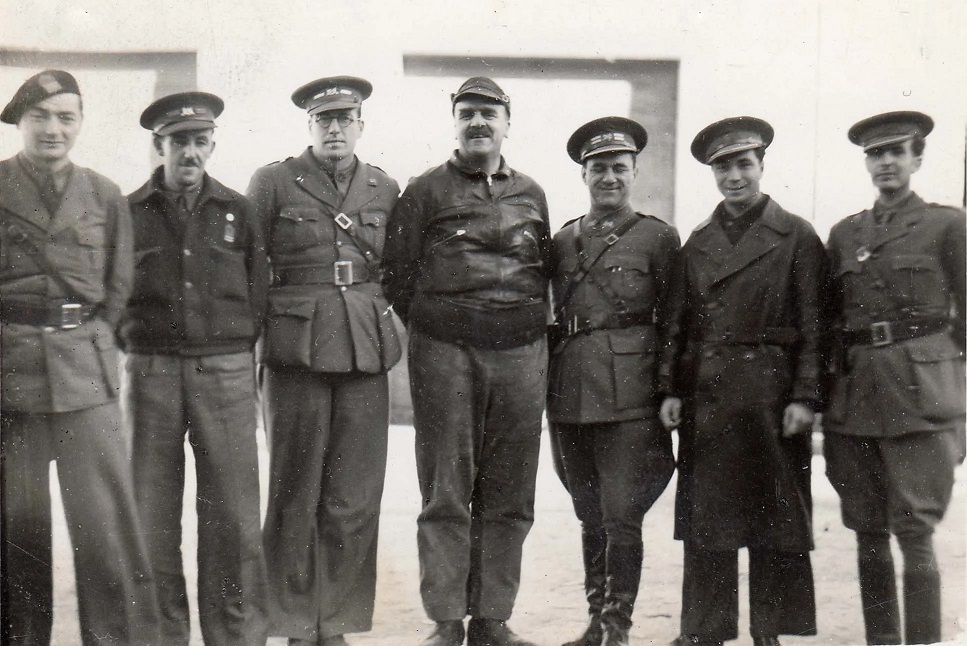 Captain Malcolm Dunbar (far left of photo) and Professor JBS Haldane (centre) alongside officers of the 15th International Brigade in Spain. [Photo: Bishopsgate Institute, London]
Leah Manning may also not be a household name but she is the only woman to get a chapter to herself although the journalist, writer and feminist Charlotte Haldane shares one with her husband the distinguished geneticist and scientist, Professor JBS Haldane. Manning was an educationalist, social reformer and Labour MP who devoted her time and energy to the republican cause. She was single minded, tenacious and involved in the dramatic rescue of 4,000 refugee children from Bilbao during the Spanish Civil War. There is also an account of Clive Branson who was an artist and poet and distant cousin of Sir Richard Branson. Branson was a communist who fought in Spain only to be killed in action during the Second World War. He was the husband of Noreen Branson, the historian of the Communist Party. Their considerable inherited wealth helped them to set up a Marxist library in London which became the Marx Memorial Library (MML). This small library holds the archives of the IBA which Baxell uses so well in his research. It is also the Head Office of the IBMT.
Sam Lesser and the Frankford Letter
Those readers familiar with Orwell’s experiences in Spain may recognise the name of Sam (Manny) Lesser. Also known as Sam Russell, he was from the East End of London and the son of Polish Jewish immigrants. He joined the British Communist Party and fought in Spain with the International Brigade. He was badly injured in battle and invalided out spending the rest of his career as a journalist on The Daily Worker. He later became a founder member of the IBMT. In early June 1937 Frank Frankford, a member of the ILP Militia, was arrested in Barcelona and sent to jail for allegedly trying to sell paintings stolen from museums or looted from churches. He was rescued with the help of an English intermediary, and after his release wrote a letter which was republished in the Daily Worker of September 14th 1937, “They Went to Fight Fascism- were used to aid it”, falsely accusing his ILP comrades of fraternising with the enemy. In the letter, Frankford accused the POUM (United Marxist Workers Party), and especially its commander, Georges Kopp, of secretly helping the Fascists on the Aragon front in northeast Spain and of deliberately rebelling against their Communist allies in Barcelona. According to the work of Bowker (2003) and also Newsinger (2023) the man responsible for the Frankford smear was Sam Lesser and the statement had been the price of his release. This was of course just one part of an orchestrated Stalinist campaign against the POUM and their ILP allies. According to Baxell, Lesser denied that he had been the person involved in the Frankford release and writing the reports to the Daily Worker. For many years he remained unwilling to write his memoirs but eventually produced, I Saw Democracy Murdered (2022) just before his death. Baxell interviewed him and found him “… honest and self-reflective about his role in the Communist Party, expressing regret for ‘perpetrating a lie about Stalin’s Russia’”. (2022:139). Apparently, Lesser regarded himself as “naïve” rather than “cynical” and Baxell generously suggests that his time in the Communist Party had instilled a “certain sense of discretion”. (ibid). For Newsinger (2023), Lesser’s memoir conveniently suppressed the Frankford story as his intention was to present himself as an “unwitting dupe” or “victim” rather than someone who had willingly victimised others by telling lies on behalf of the Stalinist regime in the Soviet Union. Meyer (1999) stresses the seriousness of the Frankford’s accusations which were literally a matter of life and death and harmed former comrades, like Kopp, who was arrested, imprisoned, and tortured, and Orwell, who was hunted down and threatened with execution.
The International Brigade
When Orwell went to Spain he had no preference whether he joined the ILP contingent in the POUM militia or the International Brigade. Harry Pollitt, the Communist Party General Secretary, considered him as “politically unreliable” and vetoed his joining the IB. Therefore, when Orwell arrived in Barcelona in December 1936 with ILP papers he naturally joined the POUM militia. It was not a deliberate political choice but simply an accident of arriving with ILP papers. In his ‘Notes on the Spanish Militias’’ Orwell writes, “At the time I was only rather dimly aware of the differences between the political parties, which had been covered up in the English left -wing press (1970:352-353)
Orwell had come to Spain to write about and fight fascism and became frustrated by the lack of military action on the Aragon front. He attempted to transfer to the British Battalion of the 15th Section of the IB once in Spain and was preparing to do so, along with Stafford Cottman, when he went on leave in Barcelona in May 1937. This is when the Communists started to engage in a systematic campaign against the revolutionary left of the POUM and anarchists. It was here that Orwell experienced first-hand the smears and slanders used by the Communists against their opponents on the bases that it was ethical to lie in the service of Communism. If you want to get a taste of what this character assassination looked like then read the essay on Orwell written by Bill Alexander who was a former IB Commander and the battery’s political commissar. His attack on Orwell can be found in a volume of essays, Inside the Myth, which Newsinger (2018) describes as “a truly disgraceful collection of essays with the sole intention of discrediting George Orwell” (2018:139). Bill Alexander held the position of honorary secretary of the IBA for thirty years and Baxell wrote an obituary for him in 2000 where we are informed that he “ruled with a rod of iron”. Alexander was also president of the Marx Memorial library between 1989-96.
Orwell admired the ordinary men and women who served with the IB for their bravery and sacrifices. The IB was involved in some of the bloodiest battles of the entire Civil War such as Jarama where the British battalion was nearly wiped out with two-thirds killed or wounded. In Orwell’s review of The Spanish Cockpit by Borkenau (1937) he refers to the International Brigade as “a thin line of suffering and often ill-armed human beings standing between barbarism and at least comparative decency.” (1970:311)
Finally, I particularly enjoyed the chapter on Stafford Cottman who at seventeen was one of the youngest of all the British volunteers. Affectionately known as “the boy” he was one of around forty volunteers who served with the ILP section which fought alongside the Spanish POUM militia. This group is less well known but has been researched by Chris Hall (2013), In Spain with Orwell.
As a teenager Cottman had joined the Young Communist League due to his opposition to Mosley and the British Union of Fascists. The conflict in Spain was seen as part of a wider international struggle against fascism and so he bravely volunteered to fight. He had no experience of soldiering and had only ever fired a gun at a fairground. His Corporal was Eric Blair who he appears to have liked, unlike some of the other volunteers such as Frank Frankford. Both Orwell and Cottman decided to investigate leaving the ILP militia and joining the IB and spoke to Walter Tapsell the Senior Commander of the British Battalion and Political Commissar in Barcelona. The idea of transferring came to an abrupt halt with the outbreak of street fighting in early May as the POUM was now seen as politically unreliable and by June a banned organisation with arrests and worse. Cottman and Orwell spent several days on the run sleeping in ruined churches before escaping from Spain.
Back in Britain Cottman’s life was made difficult by the Communist Party who were attacking those ILP members who had been in Spain. His mother’s house was picketed and Orwell and others attended a protest meeting in Bristol about his expulsion from the Young Communist League. Cottman was hounded out of Bristol and eventually joined the RAF as a gunner. He was one of the rare visitors to Orwell’s flat in London and also made the long journey to see Orwell in Scotland before his death in 1950. Cottman subsequently appeared in television documentaries and was interviewed by Chris Hall (2013). He was also consulted by Ken Loach when researching his film, “Land and Freedom” and there were even suggestions that the film was based upon his experiences. This appears to be false. Cottman died of pneumonia in September 1999.
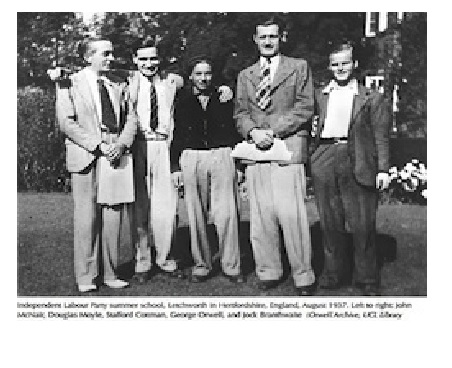 Stafford Cottman centre, Orwell second right
I recommend this book which is thoroughly researched, absorbing to read and will be of much to interest Orwell enthusiasts. Baxell’s long standing involvement with the IMBT comes across in the book but he is fair and honest in identifying the harm caused by the Stalinist regime.
The individuals featured in this collection were all forged in Spain but it is worth remembering that Orwell was also forged in Spain as his experiences here changed his understanding of socialism and shaped his attitude towards Stalinism. It is impossible to really understand his last two great novels without understanding his experiences in Spain. In his essay, “Looking Back on the Spanish Civil War” (1975:246-3) Orwell recalls:
Your name and your deeds were forgotten
Before your bones were dry,
And the lie that slew you is buried
Under a deeper lie.
Forged in Spain – Richard Baxell (Clapton Press, 9781913693336)

References
Baxell, Ricard (2013) Unlikely Warriors
Baxell, Richard (2023) Forged in Spain
Baxell, Richard (2000) “Bill Alexander: British commander in the international brigades whose concern for his fellow veterans outlived the Spanish civil war”
Bowker, Gordon (2003) George Orwell, (Little, Brown, London)
Chambers, Colin and Russell Sam (2022) I Saw Democracy Murdered: The Memoir of Sam Russell, Journalist (Routledge, London)
Hall, Christopher (2013) In Spain with Orwell: George Orwell and the Independent Labour Party Volunteers in the Spanish Civil War, 1936-1939. (Tippermuir Books Limited)
*
Land of Freedom (1995) Directed by Ken Loach [DVD] UK/Spain/Germany: Artificial Eye
Meyers, Jeffrey (1999) ‘Repeating the old lies’, The New Criterion
Newsinger, John (2018) Hope Lies in the Proles, (Pluto Press: London)
Newsinger, John (2023) “A Stalinist Apologies”, International Socialism (177)
Norris, Christopher (ed) (1984) Inside the Myth, (Lawrence and Wishart: London)
Orwell, George (1975 [1938]) Homage to Catalonia And Looking Back on the Spanish Civil War, (Penguin Books, Harmondsworth)
Orwell, George (1970 [1939]) “Notes on the Spanish Militias” in The Collected Essays, Journalism and Letters of George Orwell, Vol.1 An Age Like This, 1920-1940, Orwell Sonia and Angus, Ian (eds) Middlesex: Penguin.
Orwell, George (1970 [1937]) “Review: The Spanish Cockpit by Franz Borkenau…” in The Collected Essays, Journalism and Letters of George Orwell, Vol.1 An Age Like This, 1920-1940, Orwell Sonia and Angus, Ian (eds) Middlesex: Penguin.
A wonderful review. I will look for the book.
The valley from which I come provided one of the flickering lights of Communism
in Scotland.the next village returned a communist councillor, Dan O’Hare. Interesting sociologically: many lapsed Irish immigrant Catholics (think of names like McGahey) turned to face the new Star in the East and its infallible leader.
Any way, Dan went round our valley collecting for ‘Parcels For Spain’. But working class solidarity hadn’t reached as far as Dan’s bosses would have liked.
My mother (a mill girl) was indignant. Why was Dan collecting for Spain when there were so many on the breadline in his native valley?
Dan also ran a fruiterer’s and i asked my mother why he purveyed such petty=bourgeois trade. She said it was because he was blackballed by the bosses of the print works.
This Communist line continued into the seventies. I went to get new glasses when I was seventeen. The optician asked me what i did at School. I said languages- French German and Latin. He immediately decried this. I should learn the language of the future. Russian.
Denis Frize