
Mr Jones, Mr Blair and Mrs Orwell
David Bowie’s Orwellian turn and after
by
Martin Tyrrell
*
This year, now ending, marks the fiftieth anniversary of the release of David Bowie’s Diamond Dogs album. Diamond Dogs was in part salvaged from an abortive stage musical version of Nineteen Eighty-Four. This is why, alongside Rebel, Rebel, When You Rock and Roll With Me and Chant of the Ever-Circling Skeletal Family are the songs Big Brother, We are the Dead and, indeed, 1984.
The background to all this is now reasonably well known. Sometime in 1973, when Bowie was on a roll, he decided his next move would be to write and stage a West End musical based on Orwell’s novel. Before the year was out, the title song had been written and premiered on an American TV special, The 1980 Floor Show, and Tony Ingrassia, a dramatist, drafted in to collaborate. Then came the spoiler. The Orwell estate, which is to say Sonia Brownell Orwell, vetoed the project. Bowie’s management did the asking and got the brisk rejection but that did not prevent Bowie from working up an anecdote in which he had personally gone to Sonia to try to sell the project and got short shrift. ‘Good heavens, put it to music?’ were her supposed words, prompting the singer to conclude: ‘For a person who married a socialist with communist leanings she was the biggest upper-class snob I’ve ever met in my life.’ It is a tale now generally discredited by Bowie and Orwell commentators alike.
In saying no—however she said it—Sonia almost certainly did the artist a favour, saving him from what would in all likelihood have been a hubristic and career-stalling disaster. The track record for original musicals by rockstars is not good and Bowie, though he had previously styled himself ‘the Actor’ and done a little mime with Lindsay Kemp, had no background in theatre. Highly successful among a particular demographic, he lacked the broad appeal a successful musical required. Nor did Ingrassia, the collaborator, bring much by way of reassurance. Worryingly described as an ‘experimental playwright’, his biggest success had been as producer of Andy Warhol’s Pork—simulated sex and nudity interspersed with plot and dialogue.
Diamond Dogs itself was judged a little disappointing on release. Partly, this was down to the critical cooling that befalls all incumbent rockstars, but partly too, on account of a perceived lack of stylistic and thematic unity in the material. Future Legend, for instance, the album’s ominous spoken word opener (rendered against an unsettling Bewitched, Bothered and Bewildered) leads somewhat incongruously into the Rolling Stones-flavoured R&B of the title track. The Orwellian source material, mixed with a dash or two of alternative dystopian imaginings, gives the album what theme it has: Oceania meets A Clockwork Orange with a nod in the direction of Lord of the Flies. But not on every song. Not on Sweet Thing, say, the most achieved of the collection and one of the strongest vocal performances of Bowie’s career, the first to showcase his distinctive baritone. Nor is there anything especially Orwellian in Rebel, Rebel, an enduring classic and the album’s biggest hit.
Two songs that did not make the final cut were Dodo and Candidate (the latter not to be confused with the track of that name which appears on the album proper—the two have almost nothing in common). These rejected songs circulated unofficially for a decade or two before being properly released as bonus items on the first CD version of the Diamond Dogs album in the 1990s. I mention them because they feature clear Orwell references. In Dodo, for instance, there is a neighbour who turns people in to the authorities and someone who believes that he has shielded himself from the man at the top but whose own children know better. Candidate, however, is the wordier and more interesting of the two. This earlier Candidate, as distinct from the album Candidate, tells of a man who is vain, ambitious and cynically exploitative. He appears to be some kind of entertainer, possibly a rockstar, aiming higher, not merely at a political career but at absolute power (the ‘Fuhrerling’), he is perhaps Big Brother in the making.
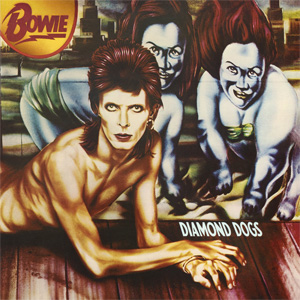
Guy Peellaert’s cover image is discussed in the Wikipedia article
Diamond Dogs was released in a year that is sometimes seen as marking the end of the ‘long sixties.’ The western economies had tipped over into recession and everywhere there were whispers of political fragmentation—rumours in the UK of deep state manoeuvrings to unsettle the new and fragile Labour Government. Signs, too, of a far-right revival—aspirant newcomer parties with ill-disguised roots in the far right of Orwell’s time and offering an alarmingly catchy simplism. Hughie Green would close the Christmas 1976 Opportunity Knocks with a political rant subsequently released as a single, Stand Up and Be Counted. It did not chart.
That same year, David Bowie also took a political turn, and allegedly in the same general direction as Hughie. In May that year, he had arrived at London’s Victoria Station in an open-topped Merc from which he either gave a Nazi salute or appeared to do so. Rob Sheffield, in his 2016 book On Bowie, suggests it was an apparent salute, an innocent wave to the fans snapped at an unfortunate angle. When the New Musical Express reported the story, it made no mention of the salute, its only complaint being that Bowie had not stayed to speak to the journalists. But it also ran the photograph in which the wave, if it was a wave, looked a lot like a salute. And whoever was editing waggishly captioned it Heil and Farewell.
If that had been the extent of Bowie’s rightward turn, it would be forgotten. In an interview in the February 1976 Rolling Stone, however, he had told Cameron Crowe ‘I’d adore to be prime minister’ and ‘I believe very strongly in fascism’ and much the same was said to a Swedish journalist around the same time. Hitler, Bowie said, had staged an entire country like a kind of proto-rock star (‘quite as good as Jagger’). Moreover, if Bowie had not given a Nazi salute at Victoria Station, there were those who said he gave it elsewhere—in Berlin, say, face to face with a bust of the Fuhrer, or at the site of Hitler’s bunker. Looking closely into Bowie’s back catalogue, which some now did, references were found to Himmler, Nietzschean supermen, coming races, and the homo superior.
So how right-wing was David Bowie in the 1970s? The British fascist revival of that decade was fuelled almost entirely by racist hostility to immigration rather than by any great interest in or admiration for fascism as an ideology. Bowie, as far as I can see, was never against immigration nor a racist. I cannot, for example, think of a single racist lyric in his entire output—more than forty years of writing and recording—nor even one interview in which he either espoused racism or opposed immigration. Afro-American music was and would remain a major influence on his own output. Indeed, at the time of the Victoria Station incident, it was pretty much the only influence. Ian MacDonald, in a perceptive essay, White Lines, Black Magic, suggests that Bowie’s fascination with Nazism was not conventionally political and can be traced back to occult and esoteric gleanings from the likes of Pauwels and Bergier’s 1968 Le Matin des Mages (The Morning of the Magicians). Whatever its source, it was a short-lived enthusiasm. Contact with actual Nazis and neo-Nazis in Berlin around 1977 —‘the steady procession of rabid nationalists, racists and moral deadbeats’ as Chris Sandford puts it in his 1996 Loving the Alien—seems to have abruptly ended it.
By the close of the 1970s, Bowie’s politics were conventionally left/liberal, this phase peaking with the 1980 album Scary Monsters and Super Creeps, notably on songs like It’s No Game (‘to be insulted by these fascists is so degrading’), Fashion, in which right-wing thugs disrupt or perhaps enlist hedonism, and Scream Like a Baby (eccentric people sent off for re-processing). A decidedly dystopian vision that marked the end of Bowie’s most creative decade, and that suggested, among other things, that Orwell’s had been a more enduring influence than any of the singer’s more dubious inspirations.
*
Martin Tyrrell is under contract to Athabasca University Press to complete a book entitled Orwell’s Wars—from class war to Cold War. He is currently editing Máirín Mitchell’s 1937 Storm Over Spain for re-publication in 2025.
Very interesting Martin, thanks.