
The Success of Failure
by
Jemima Hawkins
*
Perceptions of individual failure are always relative. They depend on personal standards of success. George Orwell’s Keep the Aspidistra Flying portrays a visceral illustration of poverty, yet this exemplification of poverty cannot be synonymised with writing observing ‘failure’. Orwell’s concepts of prosperity may differ from that of his protagonists, which may differ from our own. Therefore, the only success that failure can be analysed against is that of the individual within a society projecting failure onto him, due to his position in it. By this metric, Gordon Comstock succeeds in achieving his desired outcome to fail. Economic and social failure is his success.
Regardless of the success or failure depicted within the novel, if the writing succeeds in drawing emotion from the reader, then the work can be deemed a success, even if depicting ‘failure’. Orwell adopts this metric in Down and Out, using vivid descriptions to sustain the readers’ indignation at the position of the characters. The novel illustrates how the propaganda motive can strengthen the aesthetic effect of literature. Despite the lack of overt political messaging in ‘I was in the desolation of the cold, filthy kitchen’ (Orwell 96), the description of poverty perpetuates the need for change in the wider ideological system. While the protagonist succeeds in achieving a life of ‘failure’, this existence highlights the need for societal development. Similarly in Aspidistra, Gordon professes that he would rather be the ‘lone wolf than the cringing dog’ (Orwell 73), in escaping from the capitalist system altogether, rather than being subservient to it. He is pitting himself as morally superior to those more ‘successful’ in the capitalist system, but ‘failures’ to their moral code. He has succeeded against the omnipresent forces acting against him. Gordon has succeeded in rejecting societal standards of success.
Slovenian philosopher Slavoj Žižek refers to this pervasive societal authority that represents social norms, laws, and values, as the ‘Big Other’. It is this ‘Big Other’ that the characters in the novel are striving to succeed over (Žižek 10). Gordon succeeds against the ‘Big Other’ in waging ‘war on the money god’ (Orwell 50) and consciously placing himself in a position of immense poverty, and Orwell successfully removes himself from the overbearing capitalist system in Down and Out when permeating into the tramp community. There is success against the ‘Big Other’ that views the characters’ positions in the world as synonymous with failure. Gordon replaces the ‘money god’ by ruling over himself.
As a reader, we must make a conscious effort to distinguish between the focalisation of narrative description and our subjective opinion of the narrator’s position in the world. Again, what the reader may see as failure in the rejection of a good job and acceptance of the lowest social position, Gordon Comstock sees as a success in making ‘it his especial purpose not to ‘succeed’’ (Orwell 50).
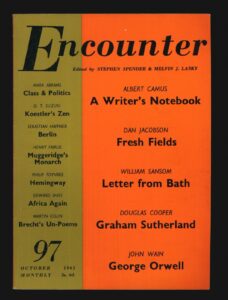
Loraine Saunders has pointed out the importance of free indirect speech in Orwell’s portrayal of Gordon Comstock. The use of free indirect discourse (FID) raises various juxtapositions akin to the division between success and failure, notably a dichotomy between Gordon’s perception of himself (seen in the FID) and the readers’ judgements towards him. The two exist in binary opposition to one another throughout, with the reader willing Gordon to remove himself from the position of failure he has willingly placed himself in. The destructive dichotomy that exists not only between narrator and reader, but also happiness and poverty, is only resolved at the end of the novel when unity is fostered between Gordon, Orwell, and the reader who have been at odds throughout. It is this ‘unity’ that exhibits the only ‘failure’ in the novel. The conflict between artistic integrity and social demands that Gordon outlines in his rejection of the capitalist system is resolved when he returns to a life of conventionality. He secedes to the values he despises, and fails, by accepting success. John Wain notes that ‘in the closing pages everything collapses, tripped up by one of the author’s basic confusions […] what ought to be a fine, gloomy, satiric ending turns unexpectedly into a renascence’ (Wain 76), supporting the view that there is a rebirth of Comstock in the closing pages. Rather oddly, Wain makes no reference to his alternate career as one of the “Angry Young Men” who helped connect Gordon Comstock from the 1930s to Wain’s 1950s (Rodden 237): Wain’s protagonist Charles Lumsley tried to hurry on down.
This rebirth may appear as a shift from failure to success in societal terms. Yet by his own metric – ‘you can be rich, or you can deliberately refuse to be rich’ (Orwell 50) – Gordon ultimately fails. His rebirth represents the shift from success in his idealistic goals, to their failure in succumbing to the ‘money god’ (50). Similarly, Wain’s analysis can be applied to Down and Out when Orwell’s successful orientation into the tramp community ends at the close of the novel, stating ‘my story ends here’ (Orwell 189), rendering his removal from his initial goal of poverty the ‘failure’ in the novel.
Orwell’s Aspidistra does not depict the failure of the individual, but his success in the pursuit of perceived social failure. Gordon Comstock achieved his desire ‘not to ‘succeed’’ (Orwell 50), which can itself be deemed a success. Despite the narrator’s insistence that the societal view is that poverty is synonymous with failure, the novel seeks to subvert this ideological foundation by illustrating success in relation to the standards set out by the character in question, rather than by typical class hierarchies. As such, Orwell’s writing places the autonomy of the individual and their self-determinism as the metric by which to determine success and failure.
Works Cited
Orwell, George, Down and Out in Paris and London, London: Gollancz, 1933
—. Keep the Aspidistra Flying. London: Penguin Random House UK, 2020.
Rodden, John, “’The Rope That Connects Me Directly With You’: John Wain and the Movement Writers’ Orwell” in Rose, Jonathan (Ed.) The Revised Orwell. East Lansing: Michigan State University Presss, 1992
Saunders, Loraine. “George Orwell – A Master of Narration”. https://www.orwellfoundation.com/the-orwell-foundation/orwell/articles/loraine-saunders-george-orwell-a-master-of-narration/ [Accessed 5 November 2024]
Wain, John. “Here Lies Lower Binfield: On George Orwell.” Encounter, 97 (1961).
Žižek, Slavoj. How to Read Lacan. New York: Norton, 2006.
Jemima Hawkins is an undergraduate at the University of Edinburgh.
Excellent essay. Very insightful
Interesting read, and well articulated!