
Saturday Essays
More on George Orwell in the Evening Standard
*
Some of George Orwell’s most popular articles were written in the few months of the first post-war winter. Most summarised Orwell’s thoughts on everyday life, and in one case seem to have predicted a theme of his future novel, Nineteen Eighty-Four, as well.
In late 1945 George Orwell began writing a weekly column for the Evening Standard, one of the three evening newspapers then available in London. (The news-vendors’ cry in the street was ‘Star, News, Standard’, pronounced ‘Star nooze stan’rd’). The work brought Orwell a larger readership than at Tribune where he had been writing his ‘As I Please’ column weekly, but its production had disadvantages, too. He wrote to his friend Geoffrey Gorer on 22 January 1946:
I forget if I’d started doing weekly articles for the Evening Standard before you left. In spite of—by my standards—enormous fees it doesn’t do me much good financially, because one extra article a week just turns the scale and makes it necessary for me to have a secretary.
The revelation here is from how much work his wife Eileen must have relieved him, in typing and administration. The secretary was Siriol Hugh-Jones.
|
Date |
Title |
|
|
1 December 1945 |
‘Bare Christmas for the Children’ |
Printed without heading |
|
8 December 1945 |
‘The Case for the Open Fire’ |
|
|
15 December 1945 |
‘In Defence of English Cooking’ |
|
|
22 December 1945 |
‘Banish This Uniform’ |
|
|
5 January 1946 |
‘Just Junk—But Who Could Resist It?’ |
Printed with heading Saturday Essay |
|
12 January 1946. |
‘A Nice Cup of Tea’ |
Saturday Essay |
|
19 January 1946 |
‘Songs We Used to Sing’ |
Saturday Essay |
|
26 January 1946 |
‘But Are We Really Ruder? No’ |
Saturday Essay |
|
2 February 1946 |
‘“Bad” Climates are Best’ |
Printed without heading ‘Saturday Essay’ |
|
9 February 1946 |
‘The Moon Under Water’ |
Saturday Essay |
In the same letter to Geoffrey Gorer, Orwell went on:
I have definitely arranged I am going to stop doing the Evening Standard stuff and most other journalism in May, and take six months off to write another novel.
Most of Orwell’s ‘Saturday Essays’ were re-printed by SEAC, the newspaper printed for servicemen and women in the Far East Command, so his work went around the world. Today the Saturday edition of a newspaper would have a smaller circulation than its week-day numbers, but in 1945 many Londoners would still have been working a five-and-a-half-day week, leaving the office Saturday lunchtime. Articles such as Orwell’s ‘Saturday Essay’ would have helped pass the time on the bus and train home.
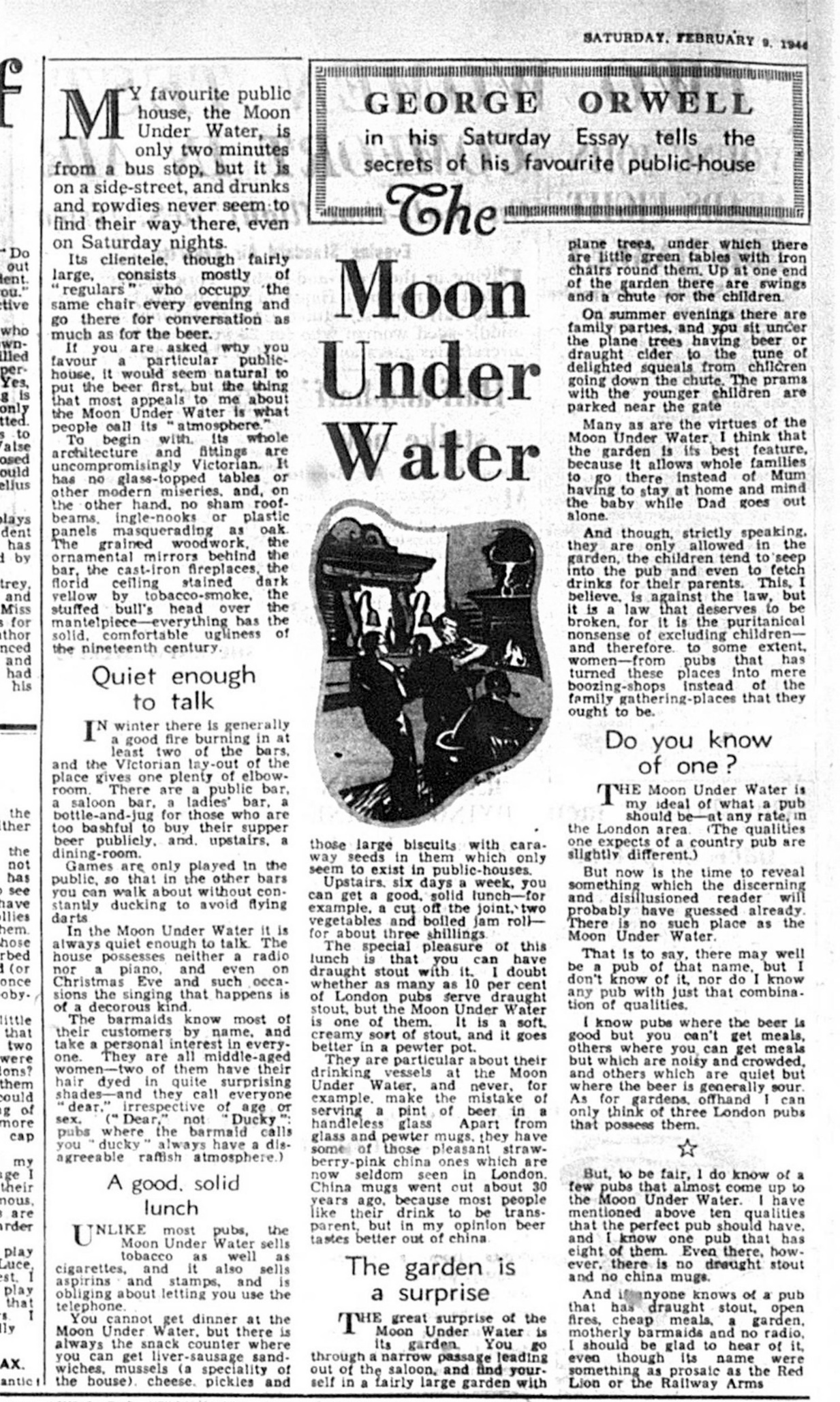
Why did Orwell’s series stop several months before he planned? It seems not to have been his choice. Peter Davison in his notes to the Complete Works writes:
On 25 February 1946, Maurice Wiggin, features editor, wrote to Orwell to say, ‘The fact that your latest article did not meet with approval’—the above or a later contribution that has not survived—‘is surely no reason why a profitable and co-operative relationship should be interrupted,’ and he hoped Orwell would resume his regular Saturday Essays,
By ‘the above’, Professor Davison means ‘The Moon Under Water’. That is, either ‘The Moon Under Water’ was disliked by the powers-that-be at the Evening Standard, or that Orwell had written another piece intended to be published on February 16th, which has since disappeared. That does leave the intriguing possibility that somewhere there is a surviving carbon-copy or newspaper proof of another fascinating Orwell examination of everyday life in Britain. On the other hand it leaves us to wonder that anyone in the newspaper’s editorial office could be so blind as to not appreciate a work that has found so great a popularity since as ‘The Moon Under Water’. And a great disappointment that a series that could have given us more of Orwell’s thought should have been cut short so thoughtlessly.
*
The Saturday Essays were not the first time that Orwell had written for the Evening Standard. Here is Andy Simons’s discussion of his earlier work, including the significant ‘Don’t let Colonel Blimp ruin the Home Guard’. Our thanks for Andy for the newspaper scan.
*
Coincidentally, I have just returned from a day spent in the Orwell archives at UCL. I read the January 1946 letter referred to in this article but, according to the archival notes, it is to Geoffrey Gorer, not Geoffrey Grigson.
Corrected. Thank you.
There is a second mention of Grigson that needs to be changed. 🙂
Corrected. Thank you.