
Spain, May 2024
The Orwell Society Trip To Catalonia And Aragon
(May 2024)
Described by
Bruce Dear and Katharine Farnham-Dear
“Most people get a fair amount of fun out of their lives, but on balance life is suffering, and only the very young or the very foolish imagine otherwise” George Orwell wrote in “Lear, Tolstoy and the Fool”. No one on our OS Aragon and Catalonia trip was either very young or very foolish – but we all had much more than a fair amount of fun. Heartfelt thanks to Quentin and Liz Kopp and Richard Blair for making it possible.
MONDAY 13 MAY
We gathered in Hostel Opera Ramblas, close to the heart of “Orwell’s” Barcelona. We were a far flung, diverse group drawn from all over the world, but we soon found lots in common. We ate at Taverna Can Magarit, an ancient cave of a Catalan restaurant that few regular tourists would ever find. There we were greeted by a cliff-face of huge rustic wine barrels and a stack of sturdy tumblers which, Quentin explained, ‘needed to be introduced to each other’. We took his advice and then dug into traditional punchy dishes such as Jumilla rabbit, Murcia salad (potato, onion and cod) and spicy snails.
TUESDAY 14 MAY
After spending the day independently exploring a rainy Barcelona, the skies cleared late afternoon as we reassembled for our first excursion.
We took a bus to the Benjamin Franklin International School in the suburban hills of Barcelona’s Zona Alta. The BFIS complex includes the former Sanatorio Maurin, a grand house seized by the POUM for hospital use in 1936 and named after their general secretary. Here Orwell famously convalesced after a sniper’s bullet sliced through his neck and missed his carotid artery by millimetres. We were kindly allowed to tour the building, comparing the modern school offices with photographs from Orwell’s time, and were taken to the roof for amazing 360-degree views of Barcelona. We were delighted that the school had decided to rename the building “The Orwell Building”. An entire wall had been redecorated with a line drawing of Orwell and a legend: “Orwell’s enduring impact is rooted in his steadfast dedication to upholding social principles, safeguarding individual rights and freedoms, and opposing abuse of power in a tumultuous and complex world. His core values of honesty, liberty, and justice are integral to the ethos and mission of our school.”
After admiring this and talking to the very impressive head and staff about their school and the appeal of dystopian fiction for today’s young people, we moved to the School Library for a special event for Foundation Andreu Nin members, students and parents.
Two Grade 10 students (age 15/16), chosen for their ambition “to make the world a better place”, presented a brief history of the Orwell Building in Catalan and Spanish and kindly answered our questions in English. They explained that they now spend 4 – 6 weeks studying The Spanish Civil War in their Spanish history lessons, trying to understand the motivations of both sides. After a long period when Spanish schools did not teach the war at all, these students agreed it was important to study it and learn from the mistakes of the past.
Richard and Quentin presented the school with Spanish copies of Orwell’s works, ranging from a 1971 first edition to a graphic novel. Even those of us with very limited Spanish could guess what La Hija del Clerigo, Sin Blanca en Paris y Londres, Rebellion en la Granja and Homage a Catalunia were.
Richard also presented prize copies of Animal Farm, signed by him, to the student winners of the BFIS Orwell Dystopian Short Story Competition. This had been open to all Middle and High School students but, notably, some of the very impressive winners were younger – and the top prize went to a student from Grade 6 (age 11/12). The story will be published in the OS Journal. Richard’s message to the winners was “keep writing and keep reading Orwell!”
Finally, there was Q&A for Richard and Quentin. The students particularly enjoyed hearing about Richard’s childhood memories of Jura, trying his father’s pipe with predictably regurgitative results and surviving an unplanned deep and chilly dunk in the Corryvreckan whirlpool.
The BFIS event had gone so well that Richard might have been a little surprised that Quentin and Liz wanted to leave so promptly, but he soon understood why. It was his 80th birthday and the Kopps had arranged a surprise dinner for him at Restaurant 7 Portes, one of Barcelona’s oldest. Carol Biederstadt had decorated the table with photos of Richard taken on previous OS trips. There were cascading toasts of cava, short speeches and a rousing rendition of “Happy Birthday” around a Catalan-style birthday cake. It was a truly splendid evening.

WEDNESDAY 15 MAY
This morning the wonderful Nick Lloyd, tour guide and author, gave us his tour of Orwell’s Barcelona. Our group contained several Orwell experts and Spanish Civil War aficionados, but everyone was impressed by Nick’s knowledge and enthusiasm (and willingness to answer questions from those of us who were less expert). His ‘walking museum’ of rare photographs and artefacts helped us to visualize the city of 90 years ago.
The highlight of the morning (apart from the excellent ‘chocolate con churros’/‘xocolata amb xurros’ at the 80-year-old Granja Dulcinea Xocoleria) was the unveiling of a plaque to honour Orwell in the foyer of Barcelona’s Royal Academy of Arts & Sciences (RACAB) and Poliorama theatre. Here Orwell had his three-day, world-view-changing stand-off with other Republicans in Café Moka. The RCAB’s president, Jordi Isern, and Miquel Berga, the Universitat Pompeu Fabra PF’s honorary English professor, both spoke. Richard and Quentin were welcomed, and their fathers hailed as “generous and idealistic [men] who had [tried] to make sense of a civil war inside a civil war”.
Richard was teased about his short trousers, so he started his speech with an apology for being overdressed! He said it was an “amazing pleasure” to be invited to this august institution, and a privilege to be allowed to go on the roof where his father “spent three idle days watching a group of Civil Guards holed up in Café Moka – and reading Raymond Chandler”. When Orwell arrived in Barcelona on Boxing Day 1936, he had been inspired by the egalitarian and communal spirit of Barcelona, but when he returned from the trenches in May, he found (much to his disillusionment) everyone fighting each other. It was this change he tried to explain in Homage to Catalonia. As Orwell’s notes were lost when NKVD agents seized his papers (Eileen, with great presence of mind, saving the passports by sitting on them in bed), Homage had to be written from memory “as honestly as [Orwell] could remember” its events. Most people now agree it was as true as it could be, given Orwell’s inevitably partial and limited understanding of a very complex situation. Richard hoped Homage would continue to contribute usefully to Spanish history. The unveiling of the plaque was an uplifting moment and a visibly moved Richard and Quentin were photographed next to it.
Then we followed the footsteps of Orwell and Kopp up the same spiral staircase (but only two at a time because it was so fragile and time-worn) and on to the roof they knew. Richard read aloud (brilliantly as always) the passage from Homage about his father on the Poliorama roof “marvelling at the folly” of the street fighting with its “nightmare of noise…echoing from thousands of [still beautiful] stone buildings”. It was astonishing to hear Orwell’s words read in the very place they described and to see with new understanding many of the buildings he was writing about
We also saw a building on Portal de l’Angel that had been the “Stalinist” jail (“really the [converted] ground floor of a shop”, says Orwell. It is now a shop again – an expensive fashion boutique. Here, in an act of “stupid malignity”, Georges Kopp was imprisoned in appalling conditions, tortured and starved. To honour his father, Quentin read the passage from Homage where the Orwells (already fingered as “rabid Trotskyites” by NKVD agents) bravely risk their own lives and liberty to visit “their personal friend”. Despite the “pigwash” food and stinking conditions, Kopp managed a black joke and “had kept his uniform neat and even contrived to shave”. Quentin was rightly proud to read this testament to his father’s resilience in those bleakest of days.
The tour finished at the railway station, from which Orwell and Eileen fled to France, with a moving reading by Richard from the end of Homage. Orwell reflects on a sleeping England with “its deep meadows, where great shining horses browse and meditate”; an England which Orwell feared would only wake up to the dark horrors gestating in Europe when it heard “the roar of bombs”.
In the evening, we headed to Café Moka to join the Barcelona Orwell Days (Dia Orwell) group. They are a mix of descendants of POUM members, academics and other Orwell enthusiasts. They aim to cross the metaphorical trench between Café Moka and the Poliorama and to “speak to everyone without taboo”, so Orwell was now “welcome here for coffee” despite the café’s 1930s’ reputation as a luxury, crypto-fascist hang out. Aurelia Aznar, a former POUM member’s daughter, said it was thanks to people like Orwell and her father the exclusory cafe had been “collectivised”, and everyone was welcome now. Aurelia’s Father Aurelio Aznar is the slim, smartly dressed soldier wearing a Sam Browne Belt in the midground of the famous Lenin Barracks photo where Orwell towers over his colleagues.
Richard read the story of the 20-odd “Assault Guards” who seized the café during the May Days “as a preliminary to attacking the POUM offices later”. Quentin then read to us about his father’s extraordinary courage and sang-froid in arranging a truce between the POUM and the “Moka’ed” Assault Guards “in several languages”. He was pleased he was not being asked to pay for the case of the café’s beer that the Assault Guards had given Georges!
Richard was asked how he felt about his father’s words becoming part of the English language, and sometimes used out of context. He said he was “not exercised”, but “proud” and added that he saw himself as “the ordinary son of an extraordinary father”.
Later that evening we took dinner at Las Caracoles (The Snails), another culinary institution, a labyrinth of dark wood panelling and tiled walls around an open kitchen. The same family have run it since 1835, so perhaps Orwell and Eileen dined here (just before they escaped to France) when they hid in plain sight by posing as wealthy tourists and “[going] to expensive restaurants and [being] very English with the waiters”. If they didn’t, they missed out.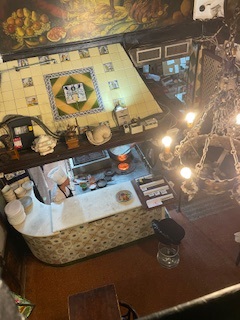
THURSDAY 16th May
Quentin and Liz dealt admirably with the challenge of an early start and guiding 18 suitcase-burdened people through a foreign city’s subway to rendezvous with our people carriers (for Liz, it was sometimes like herding particularly individualistic cats). Quentin drove one carrier and Steve Warren, an experienced driver in Spain, the other. Huge thanks to them both. We will not mention the friendly rivalry Quentin tried to engender around who could load their vehicle fastest.
We stopped at Sarinena to meet their Orwell Days group and members of the Aragonese tourist board who are promoting the area’s connection with Orwell. Their Salvador Trallero spoke of the enduring presence of Orwell’s work today. He introduced the local council’s representative for cultural affairs and tourism and then the expert driving forward their ‘Orwell Project’. He said that because Homage is one of the bestselling books in history it puts the Los Monegros area not just on the literary map, but on the universal one. Quentin agreed and stressed the Society’s commitment to attracting visitors to the area
Fernando Casalnovoa spoke about a remarkable forthcoming book. It will include a new Spanish translation of Homage, a guide to places it mentions, an essay on militia life, and annotated 1936 maps. They hoped the book would also include historic and contemporary photos of significant places, juxtaposed with the places as they look today, and Fernando showed us lots of interesting examples. They were campaigning for official Orwell signposts, but this was stuck in a bureaucratic jam. Meanwhile, they were encouraging “guerilla signposting” using stenciled images of Orwell’s distinctive, deep-furrowed face to show where he’d been. Richard said the proposed book and associated Orwell project were wonderful ideas, everything the Society could hope for, and thanked them for all their hard work.
Richard gave the Orwell Days group a Barnhill Slate. Each slate bears a piece of the tiled roof under which Orwell wrote Nineteen Eighty-Four, an engraving of Barnhill and Richard’s authenticating signature. Everyone in our group was given their own copy of Salvador Trallero’s beautiful book of Civil War photographs
We then met up with the amazing Victor Pardo Lancina, journalist, historian, battlefield archaeologist and longtime Society friend. Victor was to guide us round Aragon’s Orwell related sites, which he has done so much to research, restore and map. He took us first to a Civil War bunker at Lanaja, where Liz produced a POUM flag for a group photo and then to the trenches at “Las Tres Huegas” and “San Simón”. These had been provided with explanatory signage in Spanish but, to Victor’s frustration and sadness, the signs and trenches had not all been well maintained.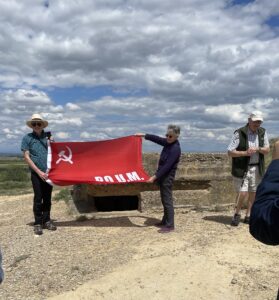
Finally, we visited the “Posicion Monte Irazo” on the Ruta Orwell where Orwell and Kopp served with a British ILP unit including the 21-year-old Bob Smillie, soon to die so tragically young. Here Orwell, an “absolutely fearless” soldier, kept standards up by shaving in wine and lowered them by choking trench mates with black shag tobacco. The restored emplacements brought Homage to life. It was easy to imagine the trench life Orwell recalled with its “animal hunger”, shivering cold, rats and mud. Photos were taken of Richard and Quentin in happier circumstances than their fathers’, with Quentin striking the same nonchalant pose his father sported nearly 90 years ago. As well as the historical and literary interest, the scenery was a spectacular combination of mountain and plain.
Dinner was taken at our hotel in Huesca, Hotel Abba (no relation to the Swedish band), and we were pleased to fall into our beds.
FRIDAY 17TH May
We started the day with a trip to Parque Miguel Servet (where the Orwell memorial would be unveiled on Sunday) and toured the public sculptures currently in it. We learnt about the republican hero, Ramon Acin, and also saw sculptures honouring Franco’s Falange. Steve, who has Spanish in-laws in a village near Huesca, said even today there is a reluctance amongst some locals to talk about the Civil War and the dictatorship that followed.
Victor took us to Sariñena airfield, and explained how it had been built, equipped and manned by the Republican forces. Sadly, the surviving airstrip was now covered in cow dung as the local farmer had built a cattle shed on it. We were privileged to be joined by Dorian (Dusty) Nicol whose mother had been a child at the airfield. He showed us the underground bunker where she had sheltered from bombing raids, prompting a lifetime of claustrophobia. Dusty tells the story in his fascinating book, Miss Spain in Exile, Isa Reyes’ Escape from the Spanish Civil War, Flamenco and Stardom in 1930s Europe. Quentin said he had read this wonderful book and recommended it to us all.
Next, we visited La Cartuja de Nuestra Señora de las Fuentes, a majestic former Carthusian monastery. It was commandeered by both sides during the Civil War and is now being restored by the local authority to at least some of its former glory. Art buffs like Katharine were thrilled to see frescoes by Manuel Bayeu, Francisco de Goya’s artist brother-in-law. Trench buffs like Chris Hall were equally thrilled to walk around the (very dusty) ammunition storage trenches discovered in the outbuildings and to see the Soviet T26 tank tracks on the monastery’s tiles. The site is not normally open on Fridays, so we were grateful to Victor for working his magic to arrange a private tour, which was given by Alberto Lasheras Taira, another old friend of the Society.
After lunch we visited the museum at Robles, Centro de Interpretación y Estudios de la Guerra Civil en Aragón. Again, this is usually only open on weekends, but Victor, whose ‘baby’ this museum is, not only arranged a special opening for us, but also arranged for Quentin and Richard to be received by the curator and the head of the local authority and their head of tourism. The museum displays a fascinating and evocative range of artefacts from the period including newspapers, military equipment and medical supplies. Introductory panels highlight some of the figures who played prominent wartime roles in the region. But the Museum’s centrepiece is undoubtedly the profoundly moving mural which lists the name of those from the region killed during the Civil War or the early years of Franco’s regime. There are nearly 8,000 names, and Victor told us he had become aware of many more since the museum was inaugurated in 2006.
One other vivid memory today. Across Aragon, storks’ nests adorn the tops of high buildings and even pylons. As we gazed at the stork’s nest wrapped round Robres church tower, and wondered if our phones could photograph it (they couldn’t) a stork flew in with a squirming rat clamped in its beak. Storks always look like they are made of entangled old umbrellas, but Orwell would have been proud of this one for eating a creature he loathed (one less for Winston’s Room 101).
SATURDAY 18th May
The sun shone brilliantly this day. We began by visiting the (now) delightful La Granja farmhouse and outbuildings just outside Huesca. In 1937, the farm was the kitchen, stores and headquarters complex where Orwell saw the “rats as big as cats” which possibly scuttled into the denouement of Nineteen Eighty-Four. We saw no alarming rodents, but Katharine did have The Quartermaster’s Stores song as an ‘ear worm’ all day. She wondered if the recurring line “In the Stores” had made Orwell homesick for his house in Wallington, especially after Eileen visited here for three brief, precious days.
We then moved to Monflorite, alive with chattering house martins, where Orwell was treated for a septic hand in late March 1937. The church still shows signs of being “badly knocked about” (in Orwell’s words) during the Civil War, and the village seemed exceptionally quiet on a Saturday morning, as if nothing much had changed since 1937. Then, one of those magical moments happened. A woman, quietly arranging flowers inside the church, told Richard that her mother had spoken of meeting his father, and another connection was made with the past.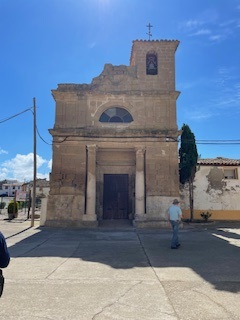
We drove on to Montearagon castle, a mass of wildflowers and history. This involved not only accessing another closed site but also crossing roadblocks set up for a mountain bike race. This really was the ultimate ‘access all areas’ trip! The castle was fought over throughout the Civil War and occupied by both sides at different times because of its spectacular 360-degree views and command of Huesca’s approaches. The brilliant young local tour guide, recruited by Victor, explained the castle had been the site of many other wars and intrigues (including long-use as a monastery) since it was first built in the 11th century.
Reflecting on all those lost in war, Professor Judith Keene read John Cornford’s love poem To Margot Heinemann (the charismatic Newnhamite and Marxist writer). Cornford was a poet and young communist. He transferred from the POUM and the Aragon Front to the International Brigade and Madrid theatre – and was tragically killed there in December 1936, aged just 21. “Heart of the heartless world, dear heart…On the last mile to Huesca…I sense you at my side”. Judith used this beautiful poem in her book, The Last Mile to Huesca: An Australian Nurse in the Spanish Civil War. Richard read The Crystal Spirit, Orwell’s Audenesque poem that encapsulates so beautifully what Spain and the inspiring idealism he saw there meant to him,
No bomb that ever burst
Shatters the crystal spirit.
One of the great delights of Orwell Society trips is that they bring together such a diverse range of people, all possessed of the most fascinating knowledge. Group member and geology Professor, Jock Keene, explained the Aragon plain’s fascinating geological history with its 10-million-year-old lake deposits now exposed as mesas and sierras. This shone a new light on Orwell’s observation that Aragon’s “hills are of a queer formation, horseshoe-shaped with flattish tops and very steep sides running down into immense ravines”. Jock also amazed us with the news that the Mediterranean had dried up about five million years’ ago when tectonic movements closed the Pillars of Hercules. Bruce is still telling people this at dinner parties.
We had a delicious lunch at Hotel Cueva Tardienta, Monegros. Jose, the owner, has officially renamed his sprawling guest complex, “The Independent Republic of Monegros”. The last sausage eaten; Jose gave us a tour.
We soon realized this was a “Republic” in “Orwellian” name only, because Jose revealed himself to be its supreme and paramount leader – a sort of cuddly Kim Jong Un. First, he took us proudly to his giant hangar of “surrealist inventions” where he showed us his “airplanes”. These Heath Robinson contraptions all appeared to be made from the salvaged parts of obsolete lawnmowers, scaffolding and 1970s’ drinks trolleys. Each bore the IRM’s insignia – a lugubrious, golden camel. Frankly, this ungulate looked more likely to fly than any of Jose’s machines. But we nodded along enthusiastically and complemented Jose on his inventions – you don’t upset the IRM’s Supreme Leader. Especially once he has walked you through his “weapons store”. It seems to contain enough mortars, shells and bazookas to flatten Mountearagon castle at least fifty times over. We hoped it was a piece of comic performance art.
Jose also took us to an “adults only” Arabian style tent. It came complete with a grand box of robes, head dresses and dancing-girl attire. Liz began enthusiastically dressing up, until Jose explained the tent was haunted by the spirits of hundreds of stag and hen parties. “But it’s OK,” he added, “the poltergeist is not a porn star”. Liz dropped the clothes back in the box.
Nearby was an open area which Jose has cleared as a landing site for “the alien spaceship” which he confidently expects will arrive imminently. When it does, the aliens will apparently first run a very successful hotel business and then take over the world. These aliens will doubtless be greatly comforted to discover that their ambitions match Jose’s almost exactly. Jose now marched us to his concluding ceremony: the raising of the IRM’s flag and a rendition of its national anthem. This hymn to the IRM’s infinite glories (which, of course, Jose had written) was blasted out through the entrance gate intercom.
We stood to bewildered attention. After all, this was Jose’s Kingdom (sorry, Republic) and we wanted to make sure he’d let us leave. Happily, going one better than The Eagles, we managed to check out and leave. Finally, an honourable mention in dispatches goes to Carol Biederstadt who bore with great patience Bruce’s somewhat childish teasing that Jose’s whole setup “would be normal in America”.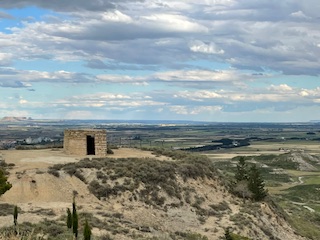
Victor then took us up to the bunkers and trenches of Posecion Santa Quiteria and we were reminded again of the glories of the Aragon countryside and how it is still marked by the memories and scars of war. Here Victor told Quentin, “Today we have been looking at history; tomorrow we will make it”.
Later, we were joined by local friends and supporters and members of the OS (who had flown out for the unveiling of the Huesca Orwell monument) for an excellent and convivial last night dinner.
SUNDAY 19th May
“If I ever go back to Spain I shall make a point of having a cup of coffee in Huesca” (Homage to Catalonia).
Sunday morning coffees rarely make History, but this Sunday in Huesca proved the exception. As Charo Ochoa (of the Citizen’s Collective) pointed out, today Richard Blair was proudly helping to fulfill his father’s 1938 promise to be sure and have coffee in Huesca if he ever came back to Spain.
The Muro Kvartet Quartet’s splendid music accompanied the ceremonies with pieces celebrating freedom and resistance by people who understood its power, including Shostakovich and Federico Garcia Lorca.
Alongside Iván Rodríguez (deputy mayor) and Juan Faci (Citizen’s Collective President), Richard unveiled Javier Sauras’ compelling bas-relief, Orwell takes Coffee in Huesca, in Parque Miguel Servet. Charo Ochoa, of the Citizen’s Collective, read a letter from the Andreu Nin Foundation’s president welcoming the unveiling of the statue and hailing Orwell as a permanent symbol of the struggle against totalitarianism.
A time capsule was ceremonially interred in front of the sculpture. It contained the donation agreement, that day’s Huescan newspaper a record of contributors to the memorial’s cost and copies of Homage in English and Spanish. The local writer, María Pilar Cavero, much moved, placed a copy of her memoir of her mother (dedicated to Orwell) in the capsule.
Poet Josete Martín Retortillo, had worked on the project and spoke on behalf of the literary association Aveletra. He reminded everyone of Orwell’s concern for ordinary people and, especially, the most disadvantaged. Retorillo hoped fervently that Orwell’s works would continue to be read, particularly by young people. He ended, “Let us be free, support one another and never lose sight of our eternal obligation to fight for freedom.”
Faci then spoke and thanked the Orwell Society for being “outstanding and constantly supportive project partners” and Richard for his extraordinary generosity alongside Eton and over 500 individual funders. He also praised Víctor, the project’s heart and soul.
Víctor (Elena Torralba translating) welcomed this “sublime” day arriving after so many difficulties. The sculpture shone with the collective financial and political power of citizens. It was a powerful gesture of historical and democratic memory, focused on an honest man who told the truth and fought for freedom. He proudly recalled Orwell’s courageous attempt to stop fascism in Spain before it could desolate Europe. Orwell was an international volunteer, so Sauras’ monument also honoured the men and women from over 50 countries who came to Spain to defend freedom and democracy.
Richard felt “honoured and very emotional” on this “wonderful occasion”. It meant so much to him that his father should be recognized for the truth of Homage to Catalonia. He highlighted Victor’s “relentless, decades-long efforts” to achieve this. He thanked the Collective for their support, the Mayor and Council for a “wonderful” site in the Parque and Suaras for his “magnificent memorial”.
Quentin said Victor’s words of the previous day had now come true: this splendid monument had made History in Huesca. To cement that History, Quentin made Victor only the Society’s second honorary life member, following the late and distinguished Professor Peter Davison. This honour recognised Victor’s many years work promoting Orwell across Spain and the world. To recognize her important contribution to Victor’s work, Quentin presented Victor’s wife, Pilar Calvete, with a beautiful bouquet.
The final speaker was deputy mayor, Iván Rodríguez, who was delighted to be taking part in such a unique occasion. He apologized for the absence of the mayor, Lorena Orduna, who was at an official event in Huesca’s twin town of Tarbes and shared a message of goodwill from her.

The Orwell Society and the Collective and City Council then exchanged gifts. Barnhill slates were presented to the Collective and Council. In return, Richard and Quentin were delighted to receive small copies of Ramon Acin’s origami “Birds”, which stands near his memorial in the Parque.
After the ceremony, the Parque buzzed with people chatting and taking photos of each other toasting Orwell with coffee. It was free courtesy of eboca (who roast small-batch South American beans in Huesca). It was also exceptional. Orwell would doubtless have enjoyed it with one of Eileen’s “heart-melting” cigars.
The celebrations then shifted gear. We met up with Victor, representatives from the Citizens Collective and other Spanish friends and took over a restaurant in nearby Sietamo for a late lunch (actually, not late by Spanish standards). We were treated to a customarily generous and delightful feast of excellent Aragonese fare. Katharine may never get over the sight of the roast half-rabbit on Desmond Avery’s plate (which she thought she recognized from a scene in Alien), but he seemed to enjoy it. There was the usual hum of excited conversation in English and Spanish and some heart-felt toasts.
But what happened next was truly memorable. The Spanish started to sing. The late Sunday afternoon was suddenly full of powerful and haunting Spanish folk song, and the hairs on the backs of our necks tingled. There was off beat clapping and impromptu dancing that reminded us of Andalusian flamenco. The OS contingent were urged to join in. Surely, we couldn’t overcome our (largely) British reserve? Or even find a song we all knew (God Save the King was quickly vetoed)? Luckily, our group included professional musician David Whaley and he gallantly conducted us in flash mob versions of Jerusalem, Waltzing Matilda, and O Danny Boy. Even with Mel Hall’s lovely voice, we weren’t exactly concert standard, but our efforts were enthusiastically appreciated, and we were very glad we had made them. We did not attempt any dancing. The final song sung by everyone was Auld Lang Syne, which will live in our memories forever.
Then, sadly, it was time to leave, and we drove back to Barcelona for farewells and homeward flights.
One last encounter summed up so much of our trip. As our group waited for the subway back to our hotel, we were approached by a young man wondering who we were. By way of explanation, David Whaley (showing his excellent teacher skills) whipped out his copy of Nineteen Eighty-Four and asked, “Do you know who wrote this?”. “Oh yes, George Orwell” replied the young man. “Well, that’s his son over there.” said David, pointing at Richard. The two were quickly introduced and a tired Richard very graciously spent his whole tube journey chatting about Nineteen Eighty-Four with a hugely excited young fan.
Like Orwell, we all saw “wonderful things” in Spain and experienced the uplifting atmosphere of fellowship. This was an absolutely superb trip. We recommend the next one in 2026 to anyone interested in glimpsing the “crystal spirit” which Orwell saw in those far-off and world-changing days.
A valuable record – thank you very much. The dramatically roasted rabbit somehow chimes in with the odd combination of suffering and having fun with which you start. Also it had never occurred to me that Orwell’s poetic inclinations would have been influenced by Auden.