
The Forgotten Memoir of the Spanish Civil War
Orwell’s eye-witness account of his time fighting alongside Republican militiamen in the Spanish civil war, Homage to Catalonia, of 1938, sold only 700 copies during his lifetime but has since become a bestseller. It is certainly one of my favourite Orwellian works. Yet two years earlier, Secker and Warburg, the publishers of Homage, had brought out John Langdon-Davies’s Behind the Spanish Barricades: Reports from the Spanish Civil War and it had been a best-seller.
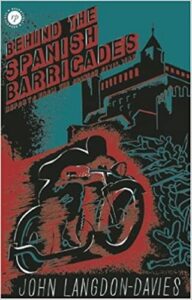
Reportage Press Edition
Langdon-Davies’s text is now largely forgotten (though it was republished in 2007 by the Reportage Press). But it is well worth re-visiting. And while both men quarrelled bitterly over their analyses of the fighting that broke out between factions of the left in Barcelona in May 1937 (and which both witnessed first-hand), it is interesting to note that amongst the 144 books Orwell listed as having read in 1949 – the year before he died – was Langdon-Davies’s Russia Puts the Clock Back: A Study of Soviet Science and Some British Scientists.
Unlike Orwell, who arrived in Spain in December 1936 largely ignorant of its language, culture and politics, Langdon-Davies, by this time, was well acquainted with the country. Born in South Africa in 1897, he came to England at the age of six and was jailed after refusing to wear a military uniform when called up in 1917. He first settled in Catalonia with his wife and two young sons in 1921 – and developed contacts with left-wing intellectuals and nationalists. In 1923, he reported for the Daily News from Barcelona on the coup by Miguel Primo de Rivera. Returning to the Catalan coast in 1926, he wrote Dancing Catalans, a study of the national dance, the sardana. In 1927, his A Short History of Women was published – and Virginia Woolf comments on it approvingly in her seminal A Room of One’s Own, of 1929.
In Behind the Spanish Barricades, he recounts the time he spends in Spain – first in May 1936 when reporting on the May Day celebrations in Madrid for the News Chronicle and then in August of the same year when he covers the civil war.
There are, in fact, some striking similarities with Homage. Orwell’s account begins, memorably, with the description (with certain homo-erotic undertones) of his meeting with an Italian militiamen at the Lenin Barracks and of the revolutionary spirit which he finds so inspiring in the streets of Barcelona. ‘It was the first time that I had ever been in a town where the working class was in the saddle. …. There was much in it that I did not understand, in some ways I did not even like it, but I recognized it immediately as a state of affairs worth fighting for. Also I believed that things were as they appeared, that this was really a workers’ State and that the entire bourgeoisie had either been killed, or voluntarily come over to the workers’ side; I did not realize that great numbers of well-to-do bourgeois were simply lying low and disguising themselves as proletarians for the time being.’
Reporting the 1 May demonstration in Madrid, Langdon-Davies writes colourfully: ‘A city given over to the proletariat. Those members of the bourgeoisie who have not driven away the night before to some country retreat, are staying in bed or peeping with distaste from behind closed shutters. … The banners are innumerable and for those willing to understand they are warnings of the storm which will break ere long. As each banner passes, the crowd salutes, clenched fist, bent left or right arm, the salute of the Popular Front or, less frequently, but too frequently for the pleasure of those who may be peeping from behind the closed shutters, a straight arm with the first stretched skywards. The trees themselves, pollarded into gaunt skeletons, are raising their boughs in the communist salute.’
Langdon-Davies is at pains throughout the book to stress that the poor in Spain are revolting quite independently against the appalling oppression they suffer – not assisted by any Moscow gold as Fleet Street was claiming. ‘No Moscow Jew had trudged those Extremaduran wastes with a pail of red paint to put up on every broken wall the sickle and hammer of angry hope. The writing on the wall has come from men and women grown tired of waiting for the redress of centuries-old wrongs.’
The extraordinary revolutionary fervour of the time is captured, in particular, by Langdon-Davies in his report of the annual conference of the CNT syndicalist trade union organisation in Zaragoza. ‘They discussed everything on the face of the earth – nudism, vegetarianism, esperanto, marriage and sex generally; the need for libertarian soviets, the possibilities of co-operating with socialists and communists, programmes of strikes, sabotage and expropriation.’
Helped by his command of the language, he paints moving pictures of the poor. In one peasant hut, he meets men who ‘had never tasted meat in their whole lives. They greeted us with the courtesy of any Spaniard. They talked and laughed with precisely the same brand of wit as Sancho Panza had. In this room, on sacking, slept night by night three married couples.’
Like Orwell, Langdon-Davies is clearly inspired by the radical, democratic politics he sees in action. Porta de la Selva, ‘a little fishing village in a fold of the Pyrenees’, is practically owned by the Fisherman’s Co-operative. ‘The fishermen own the tools of their trade, not only their nets and their boats, but the curing factory, the stores and storehouse, the refridgeration plant, the shops where daily necessities are bought, the olive oil refinery, the olive groves, the café, the hotel, the theatre and assembly room, everything that they need and use. … there is something very Spanish about Port de la Selva and its co-operation, the spontaneous local experimenting in the art of living together.’

In another village, Ansó, the local doctor and schoolmaster show off their library. ‘But where are the books?’ he asks looking at almost empty shelves. ‘They are all out being read,’ comes the answer. To which Langdon-Davies responds appropriately: ‘I had found the perfect library at last, the library without any dead or sleeping volumes.’
On his second trip in August 1936, Langdon-Davies travels on a motorbike with his 16-year-old son, Robin, leaving him finally with the ‘revolutionary committee’ in Puigcerdà for safe keeping. In the Ramblas, Barcelona, he watches the crowds. ‘Today there is not a hat, a collar, or a tie to be seen among them; the sartorial symbols of the bourgeoisie are gone, a proletarian freedom has swarmed in along the Calle del L’Hospital and the Calle del Carmen from the Parallelo. … The Solidaridad Obrera, a syndicalist paper has a splendid editorial against hats and ties. So long as there are no hats and ties seen on the Ramblas the workers may know that the victory is on their side. Hats have been a useless symbol of pride and privilege.’
Similarly, in Homage, Orwell highlights the politics of dress, writing: ‘In outward appearance it was a town in which the wealthy classes had practically ceased to exist. Except for a small number of women and foreigners there were no “well-dressed” people at all. Practically everyone wore rough working-class clothes, or blue overalls or some variant of the militia uniform.’ Significantly, at the end of the book, as Orwell and his new wife, Eileen, who has joined him at the frontline, prepare to escape from Spain as the communists ruthlessly suppress the Trotskyists and anarchists, the accompanying dampening of the revolutionary spirit is reflected in clothes. Now the safest thing is to look ‘as bourgeois as possible’.
Langdon-Davies, throughout his assignment, is all eyes. On the last Sunday of August he strolls down the Paseo de Gracià and notices manifestoes from the FAI-CNT trade union groups stuck up on trees. They are headed ‘La Organizatión de Indisiplina’ and tell how the workers of Spain have succeeded in defeating fascism thanks to the glorious life-giving power of Indiscipline. Langdon-Davies reflects: ‘I am not a theologian of the Religions of the Left, and I have no idea at all what the exact difference is between Discipline and Better Organised Indiscipline, but as I read the notice on the tree-trunk I realised once again the strange conflict between order and disorder, between reason and exuberance, that rages over the birth of new things.’
He visits Barcelona’s notorious Fifth District which ‘stinks of drains, contains sordid brothels, filthy little cafés, deformed beggars, advertisements for quack cures of venereal disease, nearly every ugly reality that most of us like to forget’. But what strikes him most of all are the residents’ dignity and comradeship. ’Because they have almost nothing in the way of possessions, because they have no hope of ever getting out of this squalor, because they live so close together that no individual can wrap himself away from his neighbours in a veil of hypocrisy and pretense, the men and women of the Fifth District understand comradeship. Because they have so little to be proud of outside themselves, they must maintain personal dignity and make of mere existence something to be proud of.’
The revolution has also promoted women’s rights. He notices a communist militia march by – with 30 to 40 women [he calls them girls] amongst them. ‘These girls were not asking for any special treatment on account of their sex; they had forgotten the he and the she; just as syndicalist, socialist, and republican had scrapped their differences, so maleness and femaleness had gone into obscurity as irrelevant to the moment.’
One chapter focuses on ‘The Burning of the Churches’ which, he says, is largely the work of the anarchists and Bakuninites. ‘…where Marxists are strong, the churches are locked up and the keys deposited in the mayor’s office, and where the Bakuninites have the power the churches have been burned.’
Langdon-Davies’s admiration for Largo Cabellero – appointed Prime Minister in September 1936, and whose administration is the first in Europe to include communists – emerges clearly when he interviews him for the News Chronicle: ‘… when you realise that every day he motors out to the Somosierra Front and does his bit of fighting, marches around encouraging his militiamen who worship him – then you see that his physical unimpressiveness is really a positive quality, a useful economy, a machine-like accuracy of mind and body that needs no romantic, theatrical or rhetorical frills.’
The book ends with a chapter titled ‘What it means to us’ in which the case for the Spanish revolution is put powerfully – together with a call for the British government to end its policy of non-intervention. ‘The simple fact is that Europe is divided into two halves, the Fascist International and the Anti-Fascist International, and our government has done all it can to give comfort to the first and to embarrass the second.’ In addition, he damns in no uncertain terms Garvin’s Observer newspaper for its attacks on what it dubs the ‘Red Regime’ in Madrid.
Langdon-Davies duly returns to the UK, bashes out Behind the Spanish Barricades in five weeks – and sees it published to acclaim late in 1936. He is back in Barcelona by the following May to witness the street fighting. As Miquel Berga points out, Langdon-Davies begins to make notes sitting in the Rugby Bar at the corner of Pau Claris and Aregó streets at 11pm on 3 May; Orwell ponders the situation from the roof of the Poliorama Theatre on the Ramblas where he has been sent to keep guard on the headquarters of the POUM militia directly opposite.
In his report for the News Chronicle, Langdon-Davies pushes the official communist line – that the street fighting is all down to a frustrated putsch by the Trotskyite POUM. Not surprisingly, Orwell devotes a number of pages in Homage to patiently refuting Langdon-Davies’s version of events. He writes: ‘I am not attacking Mr Langdon-Davies’s good faith; but admittedly he left Barcelona as soon as the fighting was over, i.e. at the moment when he could have begun serious inquiries, and throughout his report there are clear signs that he has accepted the official version of a “Trotskyist revolt” without sufficient verification.’
Langdon-Davies returns to the controversy in his article for the communist Daily Worker’s special supplement on Spain, on 21 May 1938, where he takes the opportunity to damn Homage: ‘The road to Wigan Pier leads on to Barcelona and the POUM. The value of the book is that it gives an honest picture of the sort of mentality that toys with revolutionary romanticism but shies violently at revolutionary discipline. It should be read as a warning.’
After the terrible events of May 1937, Langdon-Davies’s career is quite remarkable. Later that year he and colleagues launch a charity to help children whose lives have been overwhelmed by war, setting up a colony for 200 children in Puigcerdà on the French border. In the UK they raise funds, encouraging hundreds to ‘sponsor’ a child. Today, that organisation, known as Plan, works with 11 million children in more than 60 countries.


Moreover, after the Soviet/Nazi pact of August 1939, Langdon-Davies becomes a fervent anti-Stalinist and for his services to the British Home Guard during the war he is awarded the MBE. Orwell, one of the greatest writers of the last century, in contrast, wins no award during his lifetime – bar a 1,000 dollar literary prize from the leftist US journal, Partisan Review.
*
References
Berga, Miquel (2003) George Orwell in his centenary year: A Catalan perspective, the Anglo-Catalan Society. Available online at https://www.anglo-catalan.org/downloads/joan-gili-memorial-lectures/lecture05.pdf

Berga, Miquel (2016) May Days in Barcelona: Orwell, Langdon-Davies and the cultural memory of war, Rodden, John and Cushman, Thomas (eds) George Orwell: Into the 21st Century, London: Routledge pp 286-294
Langdon-Davies, John (2007 [1936]) Behind the Spanish Barricades: Reports from the Spanish Civil War, London: Reportage Press
Orwell, George (1962 [1938]) Homage to Catalonia, Harmondsworth, Middlesex: Penguin
Useful, interesting, and well written. Thank you.