
Orwell in the Waugh-zone
Throughout his writing career, George Orwell maintained a constant critique of Roman Catholics. There was one major exception: Evelyn Waugh. This essay explores the extraordinary Orwell-Waugh relationship, the study Orwell was planning on Waugh in the months immediately before he died, their meetings and correspondence – and the much-neglected witty, dystopian novella, Love Among the Ruins which Waugh composed in the early 1950s as a sort of tribute to the author of the recently published Nineteen Eighty-Four.
Orwell and the Catholic Question
While Orwell’s deeply unpleasant anti-Semitism was all too prevalent in his early writings, this attitude rapidly changed once he learned of the horrors of the Nazi persecution of the Jews (Angel 2020). As Michael G. Brennan comments in his excellent study of Orwell’s attitudes to religion (2017: xv): ‘Indeed, from 1945, Orwell offered a strident public voice in the denunciation of anti-Semitism even though during the same period – the last five years of his life – he showed no inclination to temper or adjust his apparently pathological hatred of the Catholic hierarchy.’
Orwell’s biographer Gordon Bowker locates the origins of this hatred of Roman Catholics – perhaps somewhat improbably – to his being sent at the age of five to be the lone boy in a convent school which his sister, Marjorie, was attending in Henley-on-Thames. The convent was run by French Ursulines exiled from France after religious education was banned there in 1903. According to Bowker (2003: 21): ‘If young Eric [Blair, as he then was] was first taught by Catholic nuns as a lone boy in a school of girls, it would explain two important and enduring aspects of his complex personality – his unremitting hostility towards Roman Catholicism and an acute sense of guilt.’ In 1931, Blair certainly told his Eton friend, Christopher Hollis, that he regularly read the Catholic press because ‘I like to see what the enemy is up to’ (ibid: 27). His anti-clerical polemics are particularly strident in the second part of The Road to Wigan Pier (1937) where he lambasts the ‘sentimental democratic Catholics of the type of Chesterton’ who naïvely argue that the dirtiness of the poor is ‘healthy’ (ibid: 54).
While fighting alongside the Republicans in the Spanish civil war in 1937, he saw the Catholic Church put its full weight behind Franco’s fascist forces – and this only served to entrench his beliefs. And he considered the hostility to the Catholics in Spain was driven largely by the economic oppression of ordinary people by landowners, industrialists and the Church. During the 1940s, in his ‘As I Please’ columns in Tribune, he accused Catholic writers such as G. K. Chesterton and Hilaire Belloc of ‘flirting with the spirit of anti-Semitism’ and linked Catholic and Hindu intellectuals in a community of reactionary thought (ibid: 96). In another column, he accused the eminent Catholics, D. B. Wyndham Lewis and J. B. Morton, of propagandising on behalf of every reactionary cause – from Mussolini, appeasement and Franco to literary censorship (ibid: 103).
Graham Greene was a Catholic who did escape his wrath. Orwell admired his idiosyncratic, sceptical, left-leaning brand of religion. And he had some good words to say about the plots and explorations of moral dilemmas in his novels Brighton Rock (1937) and The Power and the Glory (1940). Ever ready to surprise, Orwell even begins his review of The Heart of the Matter for the New Yorker, of 17 July 1948, with these words: ‘A fairly large proportion of the distinguished novels of the last few decades have been written by Catholics and have even been describable as Catholic novels’ (CWGO XIX: 404). This is because the ‘conflict not only between the world and the next world but between sanctity and goodness is a fruitful theme’. But The Heart, he suggests, gives the impression of having been mechanically constructed, ‘the familiar conflict being set out like an algebraic equation, with no attempt at psychological probability’ (ibid).
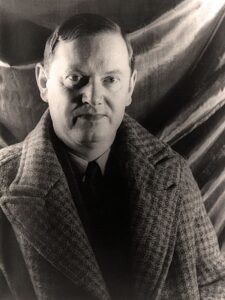
In a letter to his friend Julian Symonds, dated 21 March 1948, Orwell – writing in longhand from Ward 3, at Hairmyres Hospital, East Kilbride – tells how he had just read François Mauriac’s Thérèse Desqueyroux (1927) which had started him thinking about Catholic novelists in general (ibid: 286). He was also ‘trying to get hold of Léon Bloy’ – the French novelist, essayist, pamphleteer and poet. Significantly, in his review of The Heart, Orwell comments, approvingly, on Thérèse in which ‘the spiritual conflict does not outrage probability, because it is not pretended that Thérèse is a normal person’ (ibid: 406).
The Extraordinary Orwell-Waugh Friendship
This interest in Catholic writers continues for the rest of Orwell’s life. Still being treated for TB at Hairmyres – though still reading voraciously – on 16 May 1948 he writes to Waugh, thanking him for sending copies of Black Mischief (1932) and A Handful of Dust (1934) (ibid: 406) and for his sympathetic review of his Critical Essays in The Tablet, of 6 April 1946. Under the heading ‘A New Humanism’, Waugh describes the book as ‘a work of absorbing interest’. ‘The Art of Donald McGill’ is ‘the masterpiece’ while ‘Raffles and Miss Blandish’ – in which Orwell critiques the violence, cruelty and sexual sadism of the contemporary American crime novel – exemplifies the method in which the new school, the ‘new humanism of the common man’, is supreme. And on ‘Benefit of Clergy’ – about the artist Salvador Dali and his scurrilous memoir – he comments: ‘There is nothing in [Orwell’s] writing that is inconsistent with high moral principles’ (Davison 1996: 110).
In the 16 May letter, Orwell is keen to pick up on Waugh’s comment about the ‘pacifist strain’ in the writings of P. G. Wodehouse. He continues: ‘This started me thinking about him again, and on looking up a rare early book called “The Gold Bat” I found passages which suggested that Wodehouse had had some kind of connection with the Liberal Party, about 1908, when it was the anti-militarist party. I will add a footnote to this affect if I ever reprint the essays’ (op cit: 339).
Orwell returns to Waugh in a review of The Novelist as Thinker, edited by the Cambridge academic Balachandra Rajan, in the Times Literary Supplement, of 7 August. In an essay, ‘The innocence of Evelyn Waugh’, he suggests that the author, Derek K. Savage, is wrong to concentrate on his ‘immaturity’. ‘He does not even mention Mr Waugh’s conversion to Catholicism, which obviously cannot be left out of account in any serious study of his work. In Brideshead Revisited Mr Savage can see only nostalgia for adolescence and does not seem to have noticed that the essential theme of the book is the collision between ordinary decent behaviour and the concept of good and evil’ (ibid: 417). Here, Orwell is clearly transferring his own current and ever-developing preoccupations about ethics, religion and writing to his understanding of the novel.
For his part, Waugh was clearly fascinated by Orwell. In his diary for 31 August 1945, he says his ‘Communist cousin Claud [Cockburn] warned him against Trotskyist literature so that I read and greatly enjoyed Orwell’s Animal Farm’ which Orwell had personally sent him (CWGO XX: 74). And while Orwell was at Cranham sanatorium in 1949, Waugh – who lived just 18 miles away – visited him a number of times. They would clearly have had a lot to talk about. Waugh was not a fellow old-Etonian (he’d been to Lancing College and then Oxford University) but, like Orwell’s great friend and Observer editor, David Astor, had fought in the Royal Marines during the Second World War. Malcolm Muggeridge noted:
Waugh did go and see Orwell several times, and afterwards corresponded with him in a very delightful way. Despite all Waugh’s efforts to appear to be an irascible, deaf old curmudgeon, a sort of innate saintliness kept breaking through. I should have loved to see them together; complementary figures, his country gentleman’s outfit and Orwell’s proletarian one both straight out of back numbers of Punch (Brennan op cit: 74).
In a letter to Orwell of 17 July 1949, Waugh says he has read Nineteen Eighty-Four with great admiration. But he suggests in his treatment of Winston’s soul ‘the metaphysic are wrong’ and that the novel is spurious because it fails to acknowledge the existence of the Church. Perhaps reflecting on the scenes towards the end of the novel in which Winston is tortured in Room 101 by O’Brien, Waugh’s concludes that ‘men who love a crucified God need never think of torture as all-powerful’ (ibid: 157).
Orwell’s Uncompleted Essay on Waugh
The extraordinary Orwell/Waugh friendship culminates in two ways. In the first instance, Orwell dedicates some of his last hours alive to working on the draft of a short story, ‘A Smoking-room Story’ – and a serious essay about Waugh’s writings. Peter Davison records how he read during February and March 1949 Waugh’s Rossetti: His Life and Works (1928), Robbery Under Law (1939) and When the Going was Good (1946) and even copied out at some length three passages from his writings which were of particular interest to him (CWGO XX: 74-79). Orwell actually listed the 144 books he read – amazingly – during his last year (27 of them read for the second time while three or four of them were pamphlets) (ibid: 219-223).
Orwell begins his essay by expressing his admiration for Waugh for daring to challenge the dominant consensus – even though he may not approve of his views: ‘In our own day, the English novelist who has most conspicuously defied his contemporaries is Evelyn Waugh. Waugh’s outlook on life is, I should say, false and in some extent perverse, but at least it must be said for him that he adopted it at a time when it did not pay to do so, and his literary reputation has suffered accordingly’ (ibid: 75). His main offence – during the era in which leftists such as Auden and Spender held sway – was his ‘reactionary political tendency’. Others such as William Empson, William Plomer and V. S. Pritchett did not fit into the pattern but they were ‘lacking in political zeal’ while Graham Greene was politically left ‘in an ill-defined, unobtrusive way’. He argues that Waugh is the latest in a long line of English writers whose driving force is ‘a romantic belief in aristocracy’ ‘tinged by the kind of innocent snobbishness that causes people to wait twenty-four hours on the pavement for a good view of a royal wedding’. Orwell’s long-standing – and inadequately acknowledged – pre-occupation with humour (see Keeble 2015) emerges now in his appreciation of Waugh:
The seeming immoralism of those books [Decline and Fall and Vile Bodies] (the jokes turn not merely upon adultery but upon prostitution, homosexuality, suicide, lunacy and cannibalism) is merely a reversion to the older tradition of English humour, according to which any event can be funny provided that it either didn’t happen or happened a long time ago (op cit: 76).
Orwell next reveals his own quirky, somewhat gruesome sense of humour when he says the funniest event in Decline and Fall ‘is the sawing off of a clergyman’s head’. He suggests that in all Waugh’s books up to Brideshead Revisited (1945), ‘the idea of sanity and moral integrity is mixed up with the idea of country life – upper class country life – as it was lived a couple of generations ago’. A previous commentator in the American journal, Partisan Review, to which Orwell contributed a series of ‘London Letters’ during the Second World War, has already highlighted the way in which the action of Waugh’s books tends to take place in an old house. ‘In A Handful of Dust – this time a somewhat ridiculous house but beautiful in its owner’s eyes – it is the pivot of the story. In Brideshead Revisited it appears in more magnificent form.’
But the houses in Scoop and Vile Bodies most closely resemble Waugh’s private ideal: ‘… the middle-sized country house which required, in the days of its glory, about ten servants and which has now, if it is not merely derelict, burn turned into a hotel, a boarding school or a lunatic asylum’. Orwell carefully lists the elements that make up the ‘familiar scenery’: the ‘wet, bird-haunted lawns’, the walled garden with its crucified pear trees, the large untidy porch with its litter of raincoats, waders, landing-nets and croquet mallets, the plastery smell of the flagged passage leading to the gunroom, the estate map on the library wall, the case of stuffed birds over the staircase. He continues: ‘To Waugh, this is magic, or used to be magic, and it would be [a] waste of time to try to exorcise it from his mind merely by pointing out that…’ (ibid: 77). And reflecting on magic and in mid-sentence, Orwell’s pen ceases to flow – never to be taken up again.
In handwritten notes on Waugh that Peter Davison includes in the Collected Works, Orwell comments rather impishly on Brideshead Revisited: ‘One cannot really be a Catholic& grown up.’ And concludes: ‘Waugh is about as good a novelist as one can be while holding untenable opinions’ (ibid: 79).
Waugh’s Tribute and Critique: Love Among the Ruins
Clearly inspired by Orwell’s Nineteen Eighty-Four, which he much admired, Waugh, in 1950, composes a much-neglected dystopian novella, Love Among the Ruins. It is clearly his way of paying tribute but it also serves to encapsulate some of the critical points he made of Orwell’s work. Waugh originally calls his dystopian vision, A Pilgrim’s Progress, but it is rejected by a number of publishers. One says: ‘It seems to me sad that this man’s talent should be wasted on such a story’ while another comments: ‘The theme is almost implausibly apt for satire by Waugh and yet his handling of it is, for the most part, dull-witted and tedious’ (Manley 2017). Following this negative response, Waugh revises the text with a new version ready by November 1952 – with the hope that Ian Fleming’s Queen Anne Press will publish a deluxe edition. After that idea falls through, it is finally published by Chapman and Hall in July 1953.
Love Among the Ruins (Waugh 1972 [1953]) is rarely listed amongst the notable dystopian works that follow on from Nineteen Eighty-Four. Yet, it’s highly original, quirky, Swiftian in its bitter satire, packed with political and religious points – and certainly worth a re-evaluation. Moving away from the austere tone of his other post-war novels, it captures some of the riotous, macabre comedy of his early novels (Morère 2013). Orwell has criticised Waugh’s innate conservatism and this appears with a vengeance here: it’s full of jibes at socialism, notions of equality, modern avant-garde art, psycho-analysis, architectural innovations, trendy modern teaching methods and so on. Orwell has invented a language – Newspeak – in Nineteen Eighty-Four and here Waugh invents phrases such as ‘State help me’ in place of ‘God help me’ and so on. Just as Orwell’s choice of names is usually deeply symbolic, here ‘Plastic’ conveys the artificiality of modern man while ‘Clara’ for a while brings light to his life.
We first meet the principal protagonist, Miles Plastic, being treated leniently by the state at Mountjoy prison where he is serving time for arson. In fact, conditions in the prison are far superior to those outside. Miles has grown up in an orphanage:
Huge sums were thenceforward spent upon him; sums which, fifty years earlier, would have sent whole quiversful of boys to Winchester and New College and established them in the learned professions. In halls adorned with Picassos and Légers he yawned through long periods of Constructive Play. He never lacked the requisite cubic feet of air. His diet was balanced and on the first Friday of every month he was psycho-analysed. Every detail of his adolescence was recorded and microfilmed and filed, until at the appropriate age he was transferred to the Air Force (1972 [1953]: 183).
On release, Plastic goes to work in the ‘key’ Euthanasia Department. How Waugh revels in the joke:
Euthanasia had not been part of the original 1945 Health Service; it was a Tory measure designed to attract votes from the aged and mortally sick. Under the Bevan-Eden Coalition the Service came into general use and won instant popularity. The Union of Teachers was pressing for its application to difficult children. Foreigners came in such numbers to take advantage of the service that immigration authorities now turned back the bearers of single tickets (ibid: 194).
The department’s director is a Mr Beamish. Here, Waugh enjoys delivering a clear jibe at the Orwell/Cyril Connolly clique: ‘He had signed manifestos in his hot youth, had raised his fist in Barcelona, and had painted abstractedly for Horizon…’ But his patients ‘were kept waiting so long that often they died natural deaths before he found it convenient to poison them’ (ibid: 195). Waugh also echoes Orwell’s stress on the ever-presence of telescreens in Nineteen Eighty-Four’s Oceana by having televisions constantly supplying ‘entertainment’ to the citizens of Satellite City.
The secret, passionate love affair between Winston Smith and Julia (who may well be a police spy engaged in a honeytrap operation) features prominently in Orwell’s dystopian masterpiece. Significantly, Waugh now introduces a romantic theme – though it’s macabre and completely different. Plastic falls for Clara – but, due to a hospital operation that has gone terribly wrong, she sports, of all things, a ‘long, silken, corn-gold beard’. It only heightens Miles’s passion for her. And while Clara has come to the Euthanasia Department she doesn’t want to die. She tells Beamish: ‘I told your assistant here, I’ve simply consented to come at all because the Director of Drama cried so, and he’s rather a darling. I’ve not the smallest intention of letting you kill me’ (ibid: 199).
Waugh next echoes the theme of sexual promiscuity of Aldous Huxley’s Brave New World (1932) – rather than the sexual puritanism of Orwell’s Big Brother society against which Winston and Julia are revolting – in describing the Miles/Clara affair: ‘For Miles, child of the State, Sex had been part of the curriculum at every stage of his education; first in diagrams, then in demonstrations, then in application, he had mastered all the antics of procreation. Love was a word seldom used except by politicians and by them only in moments of pure fatuity’ (ibid: 199). When Clara announces she is pregnant Miles responds immediately: ‘It’s hard luck on the poor little beast not being an Orphan. Not much opportunity for it. If he’s a boy we must try and get him registered as a worker’ (ibid: 207).
Clara suddenly disappears – but when the distraught Miles finally discovers her in a hospital operating theatre, alas, in place of the beautiful beard there’s a ghastly piece of synthetic rubber. In despair, he returns to Mountjoy prison, sets it alight – and evades detection. In fact, he’s promoted to a new position in the Ministry of Welfare and Rest and Culture. During the first meeting with his new bosses, Miles – like Winston – betrays his former lover. To complete his rehabilitation, he needs a wife. A Miss Flower is on hand – and together they head for the registrar’s office. But the story ends ominously – with Miles fondling the cigarette lighter in his pocket intent, no doubt, on yet another act of arson (ibid: 223).
Reflections
The novella takes its title from a poem by Robert Browning (1812-1889) in which the narrator, overlooking a pasture where sheep graze, recalls that once a great ancient city, his country’s capital, stood there. After describing the beauty and grandeur of the ancient city, the speaker says that ‘a girl with eager eyes and yellow hair/Waits me there’, and that ‘she looks now, breathless, dumb/Till I come’. It ends with the beautiful line: ‘Love is best.’ It is also the title of a painting by the Pre-Raphaelite Edward Burne-Jones (1833-1898) showing two lovers in blue robes seated amidst the ruins of buildings. There is a tragic sub-text to the painting – which blends Pre-Raphaelite, Aesthetic and Symbolist techniques and themes – since it marks the ending of Burne-Jones’s four-year love affair with his model Maria Zambaco who attempted to commit suicide in 1869 after he moved to end their affair.
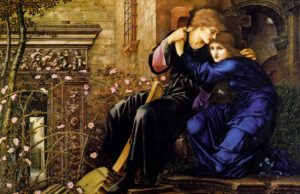 Edward Burne-Jones’ Love Among The Ruins, from Wikipedia
These aesthetic considerations are reflected in Waugh’s unusual decision to carry throughout the text sketches based on the engravings that the English artist Henry Moses had made in 1822 of sculptures by Antonio Canova, a neo-classical Italian sculptor, who had died that year. As Julie Morère comments (op cit): ‘The novella’s drawings are the perfect illustration of Waugh’s artistic stance. They appear and disappear as the pages are turned, and convey a particular cadenza to the eye movement, de-centring the message and morale of the novella. Satire … appears in the gap between the classical feature of the illustrations and the futuristic temporality of the novella.’
The novella is sub-titled A Romance of the Near Future and there is a tension between Waugh’s clear preference for looking backwards for his aesthetic models – as Orwell has critically observed – and his need here to look forward. This is Waugh’s only venture into the realm of dystopian fiction, its shortness perhaps reflecting this uncertainty. But it contains a lot of ‘laugh-out-loud’ humour and stands as a remarkable tribute to his friendship with Orwell.
Conclusion
As David Lebedoff (2008) stresses, Orwell and Waugh can appear polar opposites: Orwell the dedicated socialist and anti-Catholic who was prepared to live with tramps in order to expiate his guilt of having worked for the ‘racket’ of the British Empire as an Imperial Policeman in Burma (1922-1927) and who always hated bullying. Waugh, in contrast, the bully, the Catholic and dedicated social climber. Yet both came to see the 20th century in a similar way – imperilled by ideologues, lies, cultural decadence and assaults on tradition. Orwell, the atheist, deplored the decline of religious faith as much as Waugh the Catholic convert.
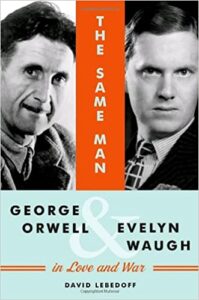
Yet, while Waugh decided that real improvement lay only in the life to come, Orwell believed in life, here and now – as a constant challenge to understand, improve and, where appropriate, celebrate.
*
References
Angel, Christopher (2020) An evolution, Orwell Society Journal, No. 16 pp 28-32
Brennan, Michael G. (2017) George Orwell and Religion, London: Bloomsbury Academic
Davison, Peter (1996) George Orwell: A Literary Life, London: Macmillan Press
Keeble, Richard Lance (2015) ‘There is always room for one more custard pie’: Orwell’s humour, Keeble, Richard Lance and Swick, David (eds) Pleasures of the Prose: Journalism and Humour, Bury St Edmunds: Abramis pp 10-25
Lebedoff, David (2008) The Same Man: George Orwell and Evelyn Waugh in Love and War, New York: Random House
Manley, Jeffrey (2017) Waugh’s dystopia, evelynwaughsociety.org, 1 July. Available online at https://evelynwaughsociety.org/2017/waughs-dystopia/
Morère, Julie (2013) Evelyn Waugh’s artistic outcry in Love Among the Ruins of a godless world, Études britanniques, Vol. 45. Available online at http://journals.openedition.org/ebc/701
Orwell, George (1998) The Collected Works of George Orwell (CWGO), Davison, Peter (ed.) London: Secker & Warburg
Waugh, Evelyn (1972 [1953]) Love Among the Ruins, in The Ordeal of Gilbert Pinfold, Harmondsworth, Middlesex: Penguin pp 177-223
Richard Lance Keeble was chair of The Orwell Society from 2013-2020. He has written and edited 42 books, the latest being Reporting Beyond Orwell (Routledge, 2020) and George Orwell, the Secret State and the Making of Nineteen Eighty-Four (Abramis, 2020)
May I question your statement regarding Orwell’s ‘deeply unpleasant anti-Semitism was all too prevalent in his early writings.’ Now, I confess to not having read Burmese Days and Coming Up For Air, I have read everything else by Orwell, some on numerous occasions. Were either of the two titles overtly anti-Semitic? I ask because as far as I can see, there’s little evidence for the accusation in what followed. He was part of Empire but to his credit, he rejected colonialism and did his best to re-educate himself. It’s hard to rid oneself of every vestige of snobbishness, and this sometimes becomes uncomfortably apparent, but usually it is class based. Orwell, in my opinion, was never particularly strong when it came to bringing characters to life, and his attempts at portraying women were pretty poor. Because of this failing, it’s hard to accept that his anti-Semitism went any further than describing a ‘Jew in the corner, guiltily eating a bacon sandwich’. Logically, there’s no way Orwell could have known HOW the Jew felt. It’s important not to ascribe comments about the Jews by ordinary (sic) Brits during the war, that somehow it was ;their own fault, with his own opinions. Yes, he took a special pleasure in skewering the Catholic faith, then those on the left who he saw as craven apologists for the horrors of Stalin’s regime. To claim he was also an anti-Semite is to perhaps pile sin upon sin. He was at heart and in spite of his best efforts a snob, but many of the British intelligentsia were also anti-Jew, It doesn’t follow that Orwell felt that way himself.
[…] work. (It’s worth noting George Orwell agreed, criticizing the novel’s lack of “pyschological probability.”) However, this could simply be a matter of preference — the novel is known as one of […]