
The Play’s the Thing: Orwell and Drama (First of Three)
Introduction
George Orwell is best known as the author of the novels Animal Farm (1945) and Nineteen Eighty-Four (1949); as an essayist, journalist, poet, letter and diary writer and broadcaster– but rarely as someone with a deep connection to drama. In fact, he wrote a play, now totally forgotten, worked for a number of months as a drama critic, composed some highly original ‘dramatic dialogues’ when at the BBC in the early 1940s, adapted Animal Farm as a drama for radio in 1947, wrote dramatic versions of Little Red Riding Hood and the Voyage of the Beagle – while William Shakespeare and Oscar Wilde were constantly referenced in his essays. Orwell really was a man of the theatre.
The first attempts at writing play
In her remarkable memoir of her times spent with Orwell while he was on holiday, first from his prep school, St. Cyprian’s, in Eastbourne, and then from Eton, which he left in December 1921, Jacintha Buddicom (2006 [1974]) tells of their shared love of voracious reading. Here, Orwell’s love of the theatre and, in particular, Shakespeare’s plays and sonnets is born.i
So it is perhaps not surprising that while serving as an Imperial Policeman in Burma, from 1922-1927, Orwell (then Eric Blair) attempts to write a play (CWGO Vol. X). Francis and Lucy Stone are desperate: their four-year-old child needs an operation – but it is costly and they have only debts. Then Stone is offered a job composing advertisements (just like Gordon Comstock in his later novel, Keep the Aspidistra Flying, of 1936 But when he ends up promoting a medicine which he knows to be a swindle he refuses. Lucy is appalled by his action – saying she may as well work as a prostitute to earn the money. The second scene is set in a prison with the cast made up of Stone, The Christian, The Poet, The Poet’s Wife and The Jailer, a particularly violent, obnoxious character. Prisoners are being executed in the next cell; off stage, the sounds of revolution can be heard. Peter Davison comments (1996: 23): ‘The plotting and characterisation are stilted and possibly influenced by Expressionist drama. It is not difficult to see why Orwell abandoned writing the play but he maintained his interest in writing drama.’
Indeed, while teaching at The Hawthorns High School for boys in Hayes, Middlesex (earning money to subsidise his writing activities), Orwell writes a play, King Charles II (CWGO Vol. X: 277-294) which is performed at Christmas 1932 in St Mary’s Church nearby – and at Hayes on 4 April 1992 by Compass Arts Theatre.ii As Peter Davison records, the play survives because one of the participants, Geoffrey W. Stevens, kept his copy. The typescript was purchased by Bill Blair (no relation) of Connecticut in 1988 (ibid).
 King Charles II is a popular children’s book in its Polish translation
It is perhaps Orwell’s attempt to re-create the excitement, violence and tensions of Shakespeare’s history plays. The first act, on the night of the Battle of Worcester, 23 August 1651, is set in an inn and features the landlord, Mr Giles, the oldest inhabitant of the village, his granddaughter Lucy (the name being carried over, then, from his Burma play) and George Burton, a labourer (intriguingly P. S. Burton was one of the pseudonyms he toyed with before settling on George Orwell for the publication of his first book, Down and Out in Paris and London, in 1933). Suddenly King Charles appears, pronouncing: ‘Alone, weaponless and on foot/My horse is dead. My sword is snapped in two./My men are scattered through the countryside./I am a penniless and landless king./True subjects must you be who would serve such.’ As Captain Chambers, of the 17th Roundheads Regiment, bangs on the inn’s door demanding to arrest the traitor king, the plot then takes a typical Shakespearean twist – involving disguise and subterfuge – with Charles putting on the clothes of Will Hodge, the ‘prentice boy’, and escaping leaving Will, dressed in Charles’s apparel, to be taken away. Act 2 moves to Bristol where Will is being guarded over by two soldiers. As he manages, somewhat incredibly, to escape, news comes in that the king has successfully fled to France. So the play ends with a celebratory song: ‘Good people all, this is a joyous time/When our good king, long in most dangerous plight,/Is safe at sea and bound for friendly France./We’ll honour it with song, and silver too.’ But, as Davison comments (ibid: 278): ‘In fact, Charles was hunted for nearly six weeks, hiding, according to a legend Orwell ignores, in an oak tree near Worcester while Cromwell’s troops searched for him in nearby fields.’
Drama and A Clergyman’s Daughter
Intriguingly, this play appears as Charles 1 which Dorothy Hare produces in Orwell’s novel, A Clergyman’s Daughter (1976 [1935]). Dorothy is the daughter of the overbearing vicar of St. Athelstan’s Church, Knype Hill, Suffolk, and constantly overwhelmed by her many responsibilities. The production and stage management are in the hands of Victor Stone (another name carried over from the Burma play), the church school headmaster. Orwell continues (ibid): ‘It was horribly hot in the conservatory and there was a powerful smell of glue and the sour sweat of children. Dorothy was kneeling on the floor, with her mouth full of pins and a pair of shears in her hand, rapidly slicing sheets of brown paper into long narrow strips.’ As the rehearsal descends into chaos, Orwell cleverly and wittily shifts the narrative into dramatic dialogue:
A GIRL: Please Miss, Mother said I was to tell you, Miss –
DOROTHY: Keep still, Percy! For goodness’ sake keep still!
CROMWELL: ‘Alt! I ‘old a pistol in my ‘and!
A SMALL GIRL ON THE BENCH: Mister! I’ve dropped my sweetie! [Snivelling] I’ve dropped by swee-e-e-etie!
And so on. The chaos continues: ‘Victor, gesticulating with his sword and shouting to overcome the din of galloping horses, was personating in turn Oliver Cromwell, Charles 1, Roundheads, Cavaliers, peasants, and court ladies. The children were now growing restive and beginning to yawn, whine and exchange furtive kicks and punches’ (ibid: 290).
In the course of the novel, Dorothy is sexually abused by the seedy Mr Warburton, has a breakdown, ends up a down-and-out in Trafalgar Square, goes hop picking in Kent, teaches for a while in a dreadful private school – only to be finally rescued by Warburton and brought back to the church. Significantly, her return to the humdrum drudgery of everyday is symbolised in her resuming her work on the costumes for the next play: ‘The glue had liquefied. Dorothy took two fresh sheets of brown paper, sliced them into narrow strips and – rather awkwardly, because of the difficulty of keeping the breastplate convex – pasted the strips horizontally across it, back and front. By degrees it stiffened under her hands. When she had reinforced it all over she set it on end to look at it. It wasn’t half bad!’ (ibid: 425).
All this is actually based on Orwell’s own experiences. Davison even picks up a term Orwell uses in a review of two works by William Hale White (‘Mark Rutherford’) to describe the novel as ‘pseudo-autobiography’ (1996: 63). As Orwell told his friend Eleanor Jaques in a letter on 18 November 1932, he was making armour for the school play and ‘I have been suffering untold agonies with glue and brown paper etc. Also painting a cigarette box for the Church Bazaar, which I very rashly undertook to gild’ (Orwell and Angus 1970, 1: 130-131). To his agent, Leonard Moore, he wrote, on 23 December 1932: ‘The miserable school play over which I had wasted so much time went off not badly’ (ibid: 134). Davison comments (1996: 31): ‘Despite himself, Orwell may have enjoyed writing and producing his little play.’
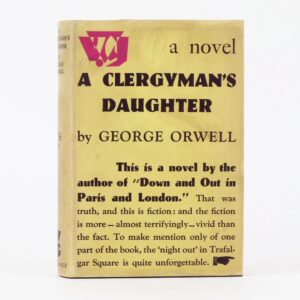
In Chapter 3 of the novel, Dorothy spends a night with the down-and-outs in Trafalgar Square (Orwell clearly milking his experiences as a tramp) and the whole episode appears in the form of a pastiche of the ‘Nighttown’ sequence of James Joyce’s Ulysses (see Myers 1991: 60). To give a flavour here is the opening (Orwell (1976 [1935]: 343):
CHARLIE [singing]: ‘Ail Mary, ‘ail Mary, ‘a-il Ma-ary – [Big Ben strikes ten.]
SNOUTER [mimicking the noise]: Ding dong, ding dong! Shut you – noise, can’t you? Seven more hours of it on this – square before we get the chance of a setdown and a bit of sleep! Cripes!
MR TALBOYS [to himself]: Non sum quails eram boni sub regno Edwardi! In the days of my innocence, before the Devil carried me up into a high place and dropped me into the Sunday newspapers – that is to say when I was Rector of Little Fawley-cum-Dewsbury …
DEAFIE [singing]: With my willy will, with my willy willy –
Critics have been generally very critical. Jeffrey Meyers (2000: 119), for instance, describes the chapter as a ‘feeble imitation’ of Joyce. Orwell, himself, came to dislike the novel as a whole damning it as ‘bollix’ and asking for it never to be reprinted in his lifetime (Taylor 2003: 139). Yet the ‘dramatic scenario’ is interesting on many counts. It reflects Orwell’s intent to be experimental in his novel writing and his life-long admiration for Joyce but, above all, it underlines his fascination with dialogue and dramatic text. As Tim Crook comments on Chapter 3: ‘This has all the hallmarks of a post-World War Two Theatre Workshop drama script developed through social immersion and observation, and the transcription of improvisation by actors. Of course, Orwell’s ear and appreciation for the language of this sub-culture as well as the realism of its social reality had been honed by direct experience’ (Crook 2015: 196).
Orwell the forgotten theatre critic
Between May 1940 and August 1941 Orwell does a stint as film and theatre reviewer for Time and Tide (the vaguely right-of-centre journal edited by Margaret, Lady Rhondda). But it has drawn little attention. It receives no mention in Robert Colls’s George Orwell: English Rebel (2013). John Sutherland (2016: 195) dismisses his output as ‘low-grade pap on literature and film’ while Gordon Bowker comments (2003: 268-269): ‘Reviewing plays and films he felt was somehow demeaning…’ Jeffrey Meyers devotes three pages to a useful, critical overview of his film reviewing but describes it as ‘a little-known aspect of his career’. There is no mention of his theatre reviewing (2000: 201-2013).
Undoubtedly the best appreciation of Orwell’s film reviews was penned by my late friend and University of Lincoln colleague John Tulloch (2012: 79-101). Tulloch concludes even-handedly: ‘He shared in many of the standard prejudices of the Thirties intellectual against film – it was a mass art, machine-made by capitalism, producing low-grade rubbish for working class consumption. … Nevertheless, the reviews contain some valuable insights and embody a developing vision of the possibilities of film, both in its degraded form as a mass-produced mechanism for propaganda and escapism and an agency through which contrary, humane perceptions can be articulated. Orwell made heroic efforts to overcome his inbuilt class prejudices, and cultivated a belief in the innate human values of ordinary people and their capacity to remake society’ (ibid: 98).
But then what of the 38 theatre reviews? While a lot of the writing is, indeed, pedestrian, it still offers unique insights into Orwell’s preoccupations and theatrical interests.
Given that his own play was titled King Charles II it is quite a coincidence that the first performance he reviews, on 18 May 1940, is of Bernard Shaw’s In Good King Charles’ Golden Days (CWGO XII: 162-163). Particularly interesting, given Orwell’s life-long fascination with dress (see Keeble 2020a), is his criticism of the costumes: ‘There is one serious fault in the present production of the play and that is the hideousness of the costumes. In a seventeenth-century play this is quite inexcusable. The women’s clothes are just bearable but the men’s seem to have been designed by someone who is colour-blind’ (ibid: 163). A week later he reviews two productions in which his determination to confront prudery and puritanism – begun in his very first article, ‘La censure en Angleterre’, in Henri Barbusse’s Monde, in 1928, where he suggests the censorship of Joyce’s Ulysses and Radclyffe Hall’s The Well of Loneliness, is a result of ‘that strange English puritanism which has no objection to dirt but which fears sexuality and detests beauty’ (see Keeble 2020b: 17). Les Parents Terribles, by Jean Cocteau, involves a convoluted plot with incest at its core (which Orwell outlines in too much tedious detail so robbing any prospective audience of any surprise) while in his review of Palladium, at the Garrison Theatre, he praises Jack Warner’s ‘gloriously vulgar badinage’ with his ‘little gel’ Joan Winters and the Three Aberdonians ‘who enliven a good acrobatic display with mild obscenities’ (CWGO XII: 166).
His reviews of Shakespeare’s The Tempest, at the Old Vic, and Portrait of Helen, by the now long-forgotten Audrey Lucas,iii are brief and witty. Shakespeare’s tragedies are the most successful with audiences, he argues, because they are ‘chock-full of murders’; but the comedies and histories are ‘hopeless, because nine-tenths of the people watching don’t know the text and can be counted on to miss the point of any joke that is not followed up by a kick on the buttocks’ (ibid: 180). Ariel, he says, ‘was horribly whimsical and indulged in exaggeratedly homosexual mannerisms, a sort of Peter Pansy’ (ibid). Of Helen, he says that ‘Under a thin veneer of sophistication it has the mental atmosphere of a fourpenny novelette’ (ibid: 181). In Noel Coward’s I’ll Leave it to You, which he reviews on 15 June 1940, it’s the humour that particularly appeals to him: ‘It may be hard to believe that such nonsense can be charming, but it is so, because of the easy dialogue which sometimes rises to the level of real funniness’ (ibid: 185).
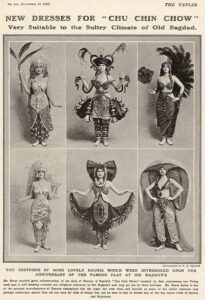
Chu Chin Chow, by Oscar Asche, which he reviews on 13 July 1940, is ‘tripe’ but he still tries to account for its original success during the First World War, highlighting, as in his film reviews, the important role of fantasy in the public imagination. ‘The charm lay in the fantastic unreality of the whole thing, and the droves of women, practically naked and painted to an agreeable walnut-juice tint. It was a never-never land, the “gorgeous East” where, as is well-known, everyone has fifty wives and spends time lying on a divan, eating pomegranates. In this vulgar spectacle [Orwell mixing here both irony and ambivalence] a doomed generation of boys got a sort of dreamlike glimpse of all the ease and pleasure that they would never have’ (ibid: 216).
His review of Vernon Sylvaine’s farce, Women Aren’t Angels, on 27 July 1940, revels in the bawdy humour. The ‘adultery-and-underwear motif is pushed to the extreme limit of decency, and sometimes a little beyond it, to the delight of the audience’ while Robertson Hare at one point wears a kilt ‘incidentally solving the famous problem of “whether they wear anything underneath”’ (ibid: 221). And his review of Shaw’s The Devil’s Disciple, on 3 August 1940, ends by highlighting the humour. Mr Milton Rosmer, as General Burgoyne, has all the best lines: ‘His remark, “The British soldier can stand up to anything except the British War Office” was much appreciated by an audience well sprinkled with uniforms’ (ibid: 224).
Orwell’s limitations as a theatre critic appear particularly in his review of Clifford Odet’s Till the Day I Die, on 17 August 1940. It would have been helpful for his English readership to outline briefly Odet’s career as a radical, American, left-wing actor and playwright – by 1940 the author already of nine plays including the acclaimed Waiting for Leftie and Awake and Sing!, of 1935. But Orwell provides no context and simply dives in – outlining the plot. While discussing Orwell’s 1944 essay, ‘Benefit of clergy’ on Salvador Dali’s scurrilous autobiography, Gordon Bowker highlights his sometimes fascination with the gruesome: ‘Orwell himself had confessed on numerous occasions to childhood cruelties – wasps cut in half, toads inflated with bicycle pumps – and some adult ones – beating his Burmese servants – and was capable of making art out of sadistic cruelty as he would demonstrate in Nineteen Eighty-Four’ (2003: 314-315). So it is interesting that in the review of Odet’s play, he writes (CWGO XII: 236): ‘There is only one piece of physical brutality in the whole play but it happens early on and the memory of it haunts all the other scenes. This is when the Brownshirt captain makes the Jew lay his fingers on the table and then suddenly smashes them to pulp with a rifle butt. A little too horrible, perhaps, but not more horrible than other things that are enacted on the stage (the gouging-out of Gloucester’s eyes in King Lear, for instance) and Heaven knows how many such things have happened in real life in the last seven years’ (Orwell perhaps thinking here of both the Spanish civil war and the current conflict).
Occasionally, Orwell provides striking insights into the somewhat stoical public reactions to the dangers of warfare in his reviews. For instance, at the end of his comments on J. B. Priestley’s Cornelius, on 7 September 1940, he records: ‘About half way through the performance … the air-raid sirens sounded. Mr Stephen Murray, acting the part of Cornelius, stepped forward and said that the lights would be turned on to allow any of the audience who wished to go out. Not more than three or four people did so, and the play proceeded normally. After only a week of bombing an air raid has ceased to be a serious interruption’ (ibid: 252).
And in his review of Applesauce, on the same day, the germ of his 1941 Horizon essay on Donald McGill’s sexy seaside postcards appears with its celebration of ‘vulgarity’. He enjoys Doris Hare’s ‘skit on a strip-tease act’, the ‘startling obscenities’ in the show and, in particular, Max Miller ‘one of a long line of English comedians who have specialized in the Sancho Panza side of life, in real lowness’ (ibid: 253, italics in the original). Max Miller is, indeed, to be celebrated in ‘The Art of Donald McGill’ (Orwell 1980 [1941a]: 576) where he also writes: ‘If you look into your own mind, which are you, Don Quixote of Sancho Panza? Almost certainly you are both. There is one part of you that wishes to be a hero or a saint, but another part of you is a little fat man who sees very clearly the advantages of staying alive with a whole skin. He is your unofficial self, the voice of the belly protesting against the soul’ (ibid: 577).
He goes on in his review to suggest that the ‘utter baseness’ of the jokes of Miller and Little Tich are distinctly English. ‘They remind one how closely-knit the civilization of England is, and how much it resembles a family, in spite of its out-of-date class distinctions. The startling obscenities which appear in Applesauce are only possible because they are expressed in double entendres which imply a common background in the audience’ (CWGO XII: 253). Orwell is to develop this idea of England being a ‘family’ in his celebrated essay ‘The Lion And The Unicorn’, of 1941, where he writes: ‘England is not the jewelled isle of Shakespeare’s much-quoted passage, not is it the inferno depicted by Dr Goebbels. More than either it resembles a family, a rather stuffy Victorian family, with not many black sheep in it but with all its cupboards bursting with skeletons. It has rich relations who have to be kow-towed to and poor relations who are horribly sat upon, and there is a deep conspiracy of silence about the source of the family income’ (Orwell 1980 [1941b]: 536)
A strikingly original – perhaps tongue-in-cheek – interpretation of Falstaff appears in his review of Shakespeare’s The Merry Wives of Windsor, on 4 January 1941. Falstaff, he says, is fat, dishonest and cowardly. ‘But he is nevertheless highly intelligent man, one of the very few among Shakespeare’s characters who can be described as “intellectuals”. It would be a wonderful if some actor would some day recognize this and act Falstaff with as much care as is usually given to Hamlet’ (CWGO XII: 361).
Much of the rest of his theatre reviewing is dreary – and clearly Orwell was not getting much fun out of it. In his diary of 17 June 1940, he confides: ‘Nowadays when I write a review, I sit down at the typewriter and type it straight out. Till recently, indeed till six months ago, I never did this and would have said that I could not do it. Virtually all that I wrote was written at least twice and my books as a whole three times – individual passages as many as five or ten times. It is not really that I have gained in facility, merely that I have ceased to care, so long as the work will pass inspection and bring in a little money. It is a deterioration directly due to the war’ (CWGO XII: 187). But he comes to life in his review of Shakespeare’s King John, on 19 July 1941, where he draws out some contemporary connections: ‘The Papal legate, inciting France to attack England, is curiously reminiscent of the League of Nations. … There is a scene which would have delighted Marx in which everyone decides to obey or disobey the Pope according to his own economic interest. Even the Quisling motif is represented by the three English aristocrats who turn traitor when the French invade England, hurriedly changing sides again at the last moment’ (ibid: 532).
*
i In addition, his friendship at these schools with Cyril Connolly – later to be the distinguished editor of Horizon and publisher of many of Orwell’s greatest essays – is largely based on their joint passion for reading
ii The Hawthorns today is the Fountain House Hotel. There is a plaque to Orwell on the front of the building, sponsored by the Hayes Literary Society
iii There is an incredibly detailed and fascinating profile of Audrey Lucas, author, playwright and one time lover of Evelyn Waugh at http://www.evelynwaugh.org.uk/styled-44/index.html
References
Avery, Desmond (2017) George Orwell at the BBC in 1942, Wellingore: The Garth Press
Bounds, Philip (2016 [2009]) Orwell & Marxism: The Political and Cultural Thinking of George Orwell, London: I. B. Tauris
Bowker, Gordon (2003) George Orwell, London: Little, Brown
Buddicom, Jacintha (2006 [1974]) Eric & Us, Chichester: Finlay Publisher, postscript edition edited by Venables, Dione
Crick, Bernard (1980) George Orwell: A Life, Harmondsworth, Middlesex: Penguin
Colls, Robert (2013) George Orwell: English Rebel, Oxford, Oxford University Press
Crook, Tim (2015) George Orwell and the radio imagination, Keeble, Richard Lance (ed.) George Orwell Now! New York: Peter Lang pp 193-208
Davison, Peter (1996) George Orwell: A Literary Life, Houndmills, Basingstoke: Macmillan
Davison, Peter (ed.) (1998) The Collected Works of George Orwell, 20 volumes, London: Secker & Warburg
Keeble, Richard Lance (2015) ‘There is always room for one more custard pie’: Orwell’s humour, Keeble, Richard Lance and Swick, David (eds) Pleasures of the Prose: Journalism and Humour, Bury St Edmunds: Abramis pp 10-25
Keeble, Richard Lance (2020a) Orwell and dress: The naked truth? George Orwell Studies, Vol. 4, No. 2 pp 78-94
Keeble, Richard Lance (2020b) The myth of freedom: Orwell and the press, in Journalism Beyond Orwell: A Collection of Essays, London: Routledge pp 15-32
Lynskey, Dorian (2019) The Ministry of Truth: A Biography of George Orwell’s 1984, London: Picador
Marshall, Peter (2008 [1992]) Demanding the Impossible: A History of Anarchism, London: Harper Perennial
Meyers, Jeffrey (2000) Orwell: Wintry Conscience of a Generation, New York/London: W. W. Norton and Company
Myers, Valerie (1991) George Orwell, London: Macmillan
Orwell, George (1976 [1935]) A Clergyman’s Daughter, in the Complete Novels, London: Secker and Warburg/Octopus pp 255-425
Orwell, George (1980 [1941a]) The art of Donald McGill, in Collected Non-Fiction, London: Secker & Warburg/Octopus pp 571-578
Orwell, George (1980 [1941b]) The Lion and the Unicorn, in Collected Non-Fiction, London: Secker & Warburg/Octopus pp 527-564
Orwell, George (1980 [1946]) Politics vs. literature: An examination of Gulliver’s Travels, in Collected Non-Fiction, London: Secker & Warburg/Octopus pp 769-781
Orwell (2000 [1949]) Nineteen Eighty-Four, London: Penguin
Orwell, Sonia and Angus, Ian (eds) (1970) The Collected Essays, Journalism and Letters Vol. 1: An Age Like This 1920-1940, Harmondsworth, Middlesex: Penguin
Sutherland, John (2016) Orwell’s Nose: A Pathological Biography, London: Reaktion Books
Taylor, D. J. (2003) Orwell: The Life, London: Chatto & Windus
Taylor, Jenny (1983) Desire is thoughtcrime, Aubrey, Crispin and Chilton, Paul (eds) Nineteen Eighty-Four in 1984: Autonomy, Control & Communication, London: Comedia Publishing Group pp 24-32
Wadhams, Stephen (1984) Remembering Orwell, Harmondsworth, Middlesex: Penguin
West, W. J. (ed.) (1985a) Orwell: The War Broadcasts, London: Gerald Duckworth & Co/BBC Productions
West, W. J. (ed.) (1985b) Orwell: The War Commentaries, London: Gerald Duckworth & Co/BBC Productions
Williams, Kristian (2017) Between the Bullet and the Lie: Essays on Orwell, Chico, CA: AK Press
-
Richard Lance Keeble was chair of The Orwell Society 2013-2020.
Leave a Reply