
The Meaning of Sabotage 80 years on
George Orwell’s ‘The Meaning of Sabotage’ was broadcast on the BBC Eastern Service on January 29th, 1942, read by Balraj Sahni. Today marks the 80th anniversary of that broadcast. The talk was not to describe how to perform sabotage in detail, but to describe how a conquered people could resist their conquerors. He said:
Sabotage is the tactic of a conquered people, just as scorched earth is the tactic of an army in retreat
and explained,
…one can hardly open a newspaper without reading that in France, or Belgium, or Yugoslavia, or wherever it may be, several more people have been shot for committing sabotage… They [acts of sabotage] are a growth of the last year, and they have increased in numbers since Hitler attacked Soviet Russia.
Orwell explained that Axis propaganda claimed Nazis and the Japanese governments were looking for lebensraum, empty land into which to expand, but events proved that not to be the case:
The German picture of Europe is of two hundred million people all working from morning to night and turning over the products of their work to Germany, and getting in return just as much as will keep them from dying of starvation. The Japanese picture of Asia is similar. To some extent the German aims have already been achieved.
The Germans, similarly, have over-run and are holding in subjection the most thickly populated and highly industrialised parts of Europe.
What, then, could a conquered people do to resist their conquerors? Some might creep out at night, destroy vehicles and petrol dumps, derail trains, and burn food trains designed for German consumption. Not everyone could do that, and some could not risk the threat to their families in retaliation. Instead the people could offer ‘passive sabotage’, because:
The whole of society rests finally on the manual worker, who always has it in his power to throw it out of gear. It is no use for the Germans to hold the European peoples in subjection unless they can trust them to work.
Orwell explained the meaning of ‘passive sabotage’:
Even if you cannot or dare not wreck the machines, you can at least slow it down and prevent it from working smoothly. This is done by working as slowly and inefficiently as possible, by deliberately wasting time, by shamming illness, and by being as wasteful as possible with material.
The consequence would be,
When Hitler finally falls, the European workers who idled, shammed sickness, wasted material and damaged machinery in the factories, will have played an important part in his destruction.
The recent short book, On Strike Against The Nazis, by Steve Cushion and Merilyn Moos, particularly Cushion’s contribution ‘Class Struggle and Resistance in Northern France and Belgium during the Second World War’, provides the detail against Orwell’s more general view of what was happening.
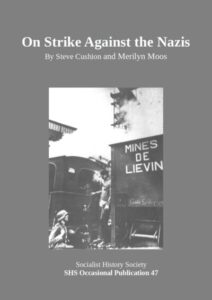
French and Belgian workers in northern France and Flanders had experience of German occupation from the First World War. They had seen their output sent to Germany, their factories dismantled, their miners kept underground to dig more coal, and their food rations reduced to feed the master-race. The Netherlands was neutral in the first conflict but quickly learned the Nazi intentions once they were invaded: early in 1941 the Germans had attempted to transfer ship-yard workers from Amsterdam to Hamburg, but were forced to abandon the plans by a strike in the yards. Not long after, the SS and their NSB (Dutch Nazis) allies had attempted a first round-up of Jews, but were met with more strikes, only to find that the Nazis were massacring protestors and sending others to concentration camps. Strikes and protests alone were not going to defeat the Nazis. Orwell would come to describe this as:
The constant executions for sabotage, which the Germans themselves announce…
South, in Belgium, according to Cushion, divisions between the Social Democrats and Communists had never been good, and each organisation had its own trade unions. Following the German invasion part of the Social Democrat government fled to London to form a government-in-exile, while what remained became collaborators. The communist leadership took their line from the Ribbentrop-Molotov Pact (as it did in Britain) and turned against the SD rather than against the Nazis. Individual communists and SDs took up the struggle. In this they were helped by the presence of Polish and Italian refugees in the workforce: the Poles could see their country being destroyed while many of the Italians had been refugees from Mussolini’s fascists.
According to Cushion “The lack of food was the main problem facing all workers during the war, but it was particularly acute in the Nord-Pas-de-Calais because the Forbidden Zone [Zone Interdite] had become separated from the organisation of supplies in the rest of France’. The French would be on short rations anyway as they were obliged to meet German impositions, but again we can see the confirmation of Orwell’s
subject populations… getting in return just as much as will keep them from dying of starvation.
The Germans charged the French for the costs of their occupation: they had an army of 300,000 in France, but charged for 18 million, a cost greater than the French pre-war budget total. Even then, the factories remained in private hands, with the owners making profits and the workers’ wages reduced, while pre-war social gains such as maximum hours legislation disappeared.
As with their earlier book, Anti-Nazi Germans, Cushion and Moos provide biographies of significant figures in the struggle, details of events, and a historical overview. ‘History is indeed little more than the register of the crimes, follies, and misfortunes of mankind’, Edward Gibbon wrote in the eighteenth century, but it continued to be true in the Second World War. As in Anti-Nazi Germans Steve Cushion is critical of the lack of opposition by the Social Democrats to the Nazis, but Merilyn Moos’ essay ‘The International Transport Workers’ Federation and Working Class Resistance to the Nazis’ is an account of the one SD organisation which had opposed the Nazis, encouraging its sea-faring and dock-worker members to boycott Nazi trade. Even that, though, ended with its leadership in exile in London.
Perhaps the most dispiriting detail of Cushion’s account of the last years of the war is the consequence of petty struggles within the Allies. Allied air-forces took to carpet bombing industrial areas in northern France to destroy production, with almost no regard for civilian casualties, even while the resistance, which was now well-organised pleaded unsuccessfully for explosives and weapons to strategically destroy the Allied targets. De Gaulle was worried that the Communist Resistance would be more successful than that lead by him, while the Allies wanted nothing to happen that could affect their war aims. Consequently, sabotage as an armed struggle remained at a low level. Though he could not have known it in January 1943, one cannot help feeling that what was left to the French, Belgians and Dutch was the one thing that Orwell identified: ‘passive sabotage’. The workers had gone through terrible suffering on the way, though.
*
On Strike Against The Nazis, by Steve Cusion and Merilyn Moos (Socialist History Society Occasional Publication 47), ISBN13: 9781916342330
We reviewed Anti-Nazi Germans here.
Leave a Reply