
Transferred Nationalists
Introduction. In his article Notes on Nationalism (Polemic, October 1945), George Orwell writes that:
One quite commonly finds that great national leaders, or the founders of nationalist movements, do not even belong to the country they have glorified. Sometimes they are outright foreigners, or more often they come from peripheral areas where nationality is doubtful. Examples are Stalin, Hitler, Napoleon, de Valera, Disraeli, Poincaré, Beaverbrook.
The first three names are instantly recognizable but many readers may not know why Orwell describes them as not belonging to the country whose nationalist movement they led. The next four names are less recognisable except to professional historians or people above a certain age. Here I explain his logic.
Joseph Vissarionvich Djugashvili ie. Stalin was a Georgian and was born near Tiflis in Georgia in 1879. Although Georgia was part of the Russian Empire and then the Soviet Union, the Georgians are a separate nationality with their own language and culture. They are still very proud of him much as the Mongolians are of Genghis Khan.
Adolf Hitler was born in Braunau in Austria on 20 April 1889. Austria was then part of the Austro-Hungarian Empire. The core of the German Empire Prussia had defeated the Austro-Hungarians in 1866. However the divide between Germany and Austria is a political not a linguistic or cultural border.
Napoleon Bonaparte was born on Corsica in 1769. It had once belonged to Genoa, an Italian city state, but was annexed by France in 1768. He was a close associate of Pasquale Paoli (1725-1807) the Corsican nationalist who led the fight for Corsican independence first from Genoa and then from France. Although French is today the official Corsican language the Corsican dialect is still closer to Italian than to French.
Eamon De Valera was born on 14 October 1882 in New York City. More Irish people live there than in Dublin and Belfast combined. His parents were a Spanish artist Juan Vivion De Valera; and an Irish servant Catherine Coll who later married a carriage driver Charles Wheelwright and lived at Rochester in New York State.
De Valera was raised by relatives in Ireland. In 1910 he married Sinead Flanagan one of his former teachers who was four years older than him. They were to have seven children.
In 1911 De Valera joined the Irish Volunteers. He opposed Irish involvement in the First World War and fought in the 1916 Dublin Easter uprising. A British court martial sentenced him to death but he was reprieved. He supported Sinn Fein and the IRA during the Irish War of Independence. He opposed the treaty that gave the twenty six counties of the Irish Free State independence in return for accepting partition. He was gaoled by the Free State during the ensuing Irish Civil War.
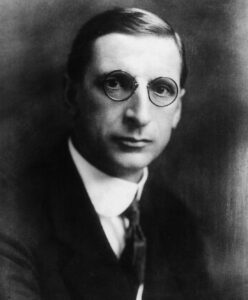 (Photograph of Éamon de Valera from Wikipedia)
In 1926 De Valera formed a new party Fianna Fail. In 1932 it came to power and he became the Taoiseach i.e. Prime Minister of Ireland, a post he held until 1957 with one gap. He was President of Ireland from 1959 to 1973. He converted the Free State into the Irish Republic; kept it neutral during the Second World War; and created a Catholic Ireland for a Catholic people. He died in 1975 aged ninety two.
Benjamin Disraeli was born in London in 1804. His parents were Isaac D’Israeli an Anglo-Jewish poet, novelist and Conservative historian; and Maria Basevi. Benjamin Disraeli’s grandparents were wealthy Italian Jewish merchants. In 1821 after a quarrel with his rabbi Isaac D’Disraeli converted to Anglicanism. Benjamin Disraeli had already had his bar mitzvah. Isaac D’isreali died in 1848 aged eighty one.
Benjamin Disraeli became a novelist. In 1837 he was elected an MP, at first as a Radical but soon joined the Conservatives. He led their die hard faction which opposed the repeal of the Corn Laws, wanting the continuing of protection for British agriculture. He was briefly Conservative Prime Minister in 1868, and then from 1874 to 1880. He was created Earl of Beaconsfield in 1876 and died in 1881 aged seventy seven.
Benjamin Disraeli’s policies were imperialism abroad and social reform at home. He believed in the ‘one nation’ Conservatism that did not long survive the fall of the British Empire. His great rival was the Liberal William Ewart Gladstone. Their oratorical battles gave rise to the saying going at it like Bill and Ben. Benjamin Disraeli’s home at Hughenden in Buckinghamshire is now a National Trust property and is open to the public.
Raymond Nicolas Landry Poincaré was born on 20 August 1864 in Bar Le Duc in Lorraine in North East France. In 1871 after Germany defeated France in the Franco-Prussian War Alsace much of Lorraine was ceded to France. Bar Le Duc remained French but Poincare became a strong French nationalist.
He became a lawyer and in 1887 was elected to the French Chamber of Deputies. He held various cabinet posts and in 1902 founded the centre right Democratic Republican Alliance. He became Prime Minister of France in 1912 and was President of France from 1913 to 1920.
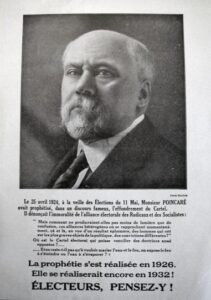 (Electoral flyer for Raymond Poincaré from Wikipedia)
President Poincaré strengthened the French alliance with Tsarist Russia and led France into war in 1914. He thought that the 1919 Treaty of Versailles was too lenient on Germany and wanted to annex the Rhineland. He was Premier of France again in 1922-1924 and 1926-1929. The French occupation of the Rhineland in 1923 and hence the German hyper- inflation was his work. He died in 1934 aged seventy four. He had never married. One of his cousins was the mathematician Jules Henri Poincare.
William Maxwell Aitken the first Lord Beaverbrook was born on 25 May 1879 at Maple, Ontario in Canada. He was one of the ten children of the Reverend William Cuthbert Aitken a Presbyterian minister who had moved from Torphichen in Scotland to Canada in 1864. The Reverend Aitken moved to Newcastle in New Brunswick in Canada in 1880.
Aitken made his money variously most notably by creating a near monopoly of the Canadian cement industry. In December 1910 he was elected the Conservative MP for Ashton under Lyne near Manchester in Lancashire. In 1911 he bought a London newspaper the Daily Express; and was knighted.
Aitken was a jingoist in the First World War. Through the Express he helped depose the British Prime Minister Asquith, who in December 1916 was replaced by David Lloyd George. In 1916 Aitken was raised to the House of Lords as the first Baron Beaverbrook. Beaverbrook is a New Brunswick rural community. From February to June 1918 he was Minister of Information.
Between the World Wars Beaverbrook built the Daily Express into Britain’s best-selling newspaper. He campaigned for protective tariffs and Imperial Preferences i.e. free trade within the empire. He supported appeasement until after the Second World War began.
On 14 May 1940 Churchill appointed Beaverbrook Minister for Aircraft Production a post he held until April 1941. With enormous energy Beaverbrook helped save Britain but he trod on many toes. He was appointed Minister of Supply in June 1941 remaining in the War Cabinet. He visited Russia in September 1941 and Stalin impressed him. Under Beaverbrook the Express campaigned for a Second Front to ease the pressure on Russia.
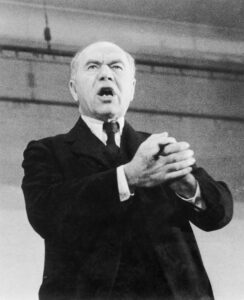 (Wartime photograph of Lord Beaverbrook from Wikipedia. This is not the photograph seen by Orwell, who described Beaverbrok as ‘looking more like a monkey on a stick than you would think possible for anyone who was not doing it on purpose.’ )
After the Second World War Beaverbrook remained a committed British Imperialist. He died of cancer on 9 June 1964 aged eighty five. He was twice married and had had many affairs. His oldest son John William Max Aitken inherited his title but disclaimed it announcing that ‘there will only be one Lord Beaverbrook’. Maxwell William Humphrey Aitken the 3rd Lord Beaverbrook is John William Max Aitken’s son and the 1st Lord Beaverbrook’s grandson.
John Saunders Lewis, known as Saunders Lewis, the father of Welsh Nationalism was born on in 1893 at Wallasey in Cheshire, the son of a Methodist minister of Welsh descent; and studied at Liverpool University. He was a Lieutenant in the South Wales Borderers in the First World War and was badly wounded in 1917. In 1922 he was appointed a lecturer in Welsh at the University of Wales, Swansea. In 1924 he married Margaret Gilchrist a Methodist convert to Catholicism. He became a Catholic.
In 1925 Saunders Lewis helped found Plaid Cymru whose ultimate aim was and is Welsh independence. During the Second World War he was a pacifist. He later helped found the Welsh Language Society. He died in 1985 in hospital in Cardiff aged ninety one. As a convert to Catholicism, a Celtic Nationalist and a pacifist he combined three of Orwell’s list of eleven types of nationalism.
*
Thanks, an interesting summary of some key personalities in UK, Irish and European history
It may seem a small point but the hyperinflation is usually ascribed to the Germans printing large amounts in paper currency, and the problems began before the Occupation of the Ruhr. To blame the French is looking in the wrong direction and really no better than echoing the nascent Nazi propaganda that blamed the foreigners and the traitors, especially Jewish ones for their losing the war. This is summed by the “stab in the back” line and the unfairness of the Treaty of Versailles. The Occupation of the Rhineland happened in part because of the refusal of the Germans to pay the reparations agreed by Versailles and equivalent to those paid by France after the war in 1870
which they had started. The level of those reparations set and agreed in the same manner as those at Versailles were intended by the Germans to be so high that France would be economically crippled for generations. The occupation of the Ruhr was meant to apply some leverage.
Another factor that applied in Germany was a massive strike and the government thought it could buy its way out with the money it printed.
Blaming and posing as victims to explain their racist politics and justify the seizure of power are classic fascist strategies.