
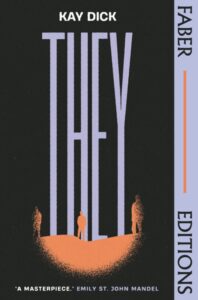
Who are “They”?
“I don’t lock my door any more,” I said. “They took another book last night.”
“Yes, they’re getting more active,” Claire said.
*
Kay Dick (1915-2001), as with several friends of George Orwell who lived into old age, ended her life in an unhappy state. For the past thirty years her name has been remembered for little more than her literary memoir Ivy and Stevie, a joint biography of Ivy Compton-Burnett and Stevie Smith published in 1971. Dick’s penultimate work of fiction, They (1977), had been almost completely forgotten, and its sales failure along with her publisher’s refusal to reprint probably added to Dick’s difficulties. Another publishing house has now reissued the book, which has an Introduction by Carmen Maria Machado: bookshops have reported a very different demand for the book compared with the original release.
They consists of nine vignettes in which the unnamed narrator moves from artist settlement to settlement among the villages of the Sussex Weald. Meanwhile, an equally unnamed movement is attempting to eradicate all individuality expressed through art or otherwise: artists are discouraged, their studios and ateliers are destroyed, books first lose individual leaves and then whole libraries are destroyed; even letter writing is discouraged, and manuscripts are torn up in the post. There are mutilations, deaths, murders (mostly off-stage), while children and young people have become philistine and cruel, even torturing and killing pets.
George Orwell’s association with Kay Dick probably began during World War II: his first surviving letter to her is dated 1945, and in her role as joint editor of The Windmill magazine she published Orwell’s “In Defence of P G Wodehouse”. Other articles he suggested for the magazine have either not survived or were never written. It is likely, though, that their association began several years before, as Orwell gave Dick a copy of Animal Farm (1945) inscribed “Kay – To make it and me acceptable” and Animal Farm seems to have been completed by Whitsun 1944 (when Andre Deutsch saw a copy) or June 1944 when Orwell showed T S Eliot his typescript. The implication of the inscription is that Dick had reworked the manuscript for Orwell.
Readers familiar with George Orwell’s life and work will recognise many themes which also appear in They. Some of these aspects (the cruelty of children, for instance) are an early feature of Nineteen Eighty-Four, but others, such as the rebuilding to remove individual dwellings, one can find in Orwell’s essays of the post-war such as “Pleasure Spots” and not in his dystopian fiction. Dick’s ability lay in her writing of these things in circumstances completely removed from Orwell’s.
One notable feature, though, and it is not clear if Dick herself was aware of it, was the concept of “They”. Orwell himself had written several times about “They” and their deleterious effects. He laid this out in detail, including their possible violence, strangely enough, in his 1945 article about limericks:-
“Aldous Huxley, in praising Lear’s fantasies as a sort of assertion of freedom, has pointed out that the ‘They’ of the Limericks represents common-sense, legality and the duller virtues generally. ‘They’ are the realists, the practical men, the sober citizens in bowler hats who are always anxious to stop you doing anything worth doing. For instance:
There was an Old Man of Whitehaven,
Who danced a quadrille with a raven:
But they said, “It’s absurd
To encourage this bird!”
So they smashed that Old Man of Whitehaven.
To smash somebody just for dancing a quadrille with a raven is exactly the kind of thing that ‘They’ would do.”
It is clear, though, that to Orwell “They” were not a subject for humour. Nearly ten years earlier in The Road To Wigan Pier, he had written about “they” and their omnipotence.
“A thousand influences constantly press a working man down into a passive role. He does not act, he is acted upon. He feels himself the slave of mysterious authority and has a firm conviction that ‘they’ will never allow him to do this, that, and the other. Once when I was hop-picking I asked the sweated pickers (they earn something under sixpence an hour) why they did not form a union. I was told immediately that ‘they’ would never allow it. Who were ‘they’? I asked. Nobody seemed to know, but evidently ‘they’ were omnipotent.”
(The Road to Wigan Pier, chapter 3)
Whether Kay Dick remembered these references in Orwell, or read them herself, or arrived at the same point with no external inspiration has yet to be decided. Anyone interested in Orwell and his world, though, should investigate They by Kay Dick. There are potential omnipotences to be feared.
*
They: A Sequence of Unease by Kay Dick (Faber, 2022, ISB13: 9780571370863)
*
Excellent, thanks Les
Most interesting, Les. Kay Dick’s Windmill is one of those obscure, little, short-lived magazines to which Orwell (despite his incredible work-load) was happy to contribute. D.J. Taylor suggests he met Dick in a London pub and was keen to encourage her editing ambitions. Orwell’s remarkable ‘In Defence of P. G. Wodehouse’ appeared in the second number in July 1945. He was paid £10 for it (CWGO XVII: 51). But, coming out three or four times a year, the magazine managed to survive only until 1948 – as Peter Marks writes in his brilliant analysis of Orwell, the essayist (Continuum 2011). In one of his letters to Dick, Orwell tells of contemplating writing a story ‘about a man who got so fed up with the weeds in his garden that he decided to have a garden just of weeds, as they seem easier to grow. Then of course as soon as he started to do this he would find the garden being overwhelmed with flowers and vegetables which came of their own accord’ (CWGO XVII: 290). What a shame it is that Orwell never got round to writing this story – but in 1945 he had other projects in mind…