
How Orwell made his (exclamation) marks!
We have examined George Orwell’s use of specific ‘cinnamon’ words, his use of crime references in his novel Coming Up For Air; and his allusion to a popular song in that same novel. Now we progress to Orwell’s punctuation.
*
George Orwell once wrote to his editor at Secker & Warburg, Roger Senhouse (a fellow old-Etonian), that in his novel Coming Up For Air (1939) he had decided to include no semi-colons. It was, he said, an ‘unnecessary stop’.i The American novelist, Kurt Vonnegut, agreed, giving this advice to writers: ‘First rule: do not use semi-colons. They are transvestite hermaphrodites representing absolutely nothing. All they do is show you’ve been to college.’ii
Orwell was, in fact, mistaken. In the end, he couldn’t avoid the lure of the semi-colon. But how many times did he actually use it in the novel? Richard Young, collector of Orwell first editions, comments:
‘When you compare the five instances of the semi-colon in the version of Coming Up For Air in the PDF version available at bookyards.com, with the Gollancz 1939 first edition, you find that only the final two (in order of reading) appear. The first three appear in the Gollancz edition simply as commas. The book was reprinted by Gollancz once in 1939, and then reset for the Uniform edition in 1948. At that point, Orwell, in correcting the new proofs, made the comment about semi-colons. Very obviously he was wrong about them not appearing in the first edition. Not only that but according to Peter Davison, three semi-colons (different ones) appeared in the 1948 edition. I have that edition as well – but could only find one of the semi-colons that Davison mentions (he took them all out of the Complete Works version). Funnily enough the semi-colon I found in the 1948 edition was just an ordinary comma in the 1939 edition. So I think across editions and proofs over the years these things have come and gone, but in the two editions in Orwell’s lifetime he failed to eliminate them entirely.’
All the same, according to my calculations, Coming Up for Air certainly marked a major fall in semi-colon usage for him: in Down and Out in Paris and London they were used 325 times, in Burmese Days 258 times, in A Clergyman’s Daughter 366 times, in Keep the Aspidistra Flying 336 times, in The Road to Wigan Pier 370 times and in Homage to Catalonia 387 times. He was to use them 55 times in Animal Farm and 171 times in Nineteen Eighty-Four.
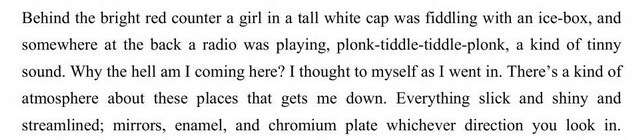
The first semi-colon now found in Coming Up For Air
All this interest in punctuation has been sparked for me by the recent publication of Florence Hazrat’s An Admirable Point: A Brief History of the Exclamation Mark! (Profile). In his review in the Times Literary Supplement, Henry Hitchings describes it as ‘enjoyably mischievous’ ‘not so much an encomium as an invitation – to shrug off the prescriptions of the language police and reawaken a sense of wonder’.
Apparently there are 2,131 exclamation marks in Salman Rushdie’s Midnight’s Children and just one in Ernest Hemingway’s The Old Man and the Sea. According to the humorist Miles Kington: ‘So far as good writing goes, the use of the exclamation mark is a sign of failure.’ But Orwell had no such scruples. He positively loved the exclamation mark! Here they are in order of prominence: Burmese Days 875, Keep the Aspidistra Flying 760, A Clergyman’s Daughter 684, Coming up for Air 352, Down and Out in Paris and London 247, Nineteen Eighty-Four 244, Homage to Catalonia 132, Animal Farm 109 and The Road to Wigan Pier 58. Frankly, I’m somewhat surprised by these findings.
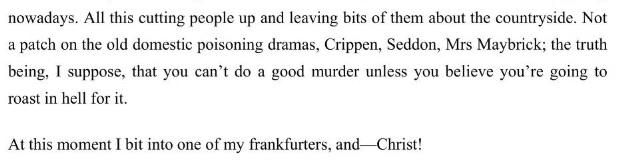
A semi-colon and an exclamation mark in Coming Up For Air
Now there’s no stopping me (forgive the pun) in my punctuation probe – and it’s fun! Let’s look at the use of parentheses (round brackets) as in ‘forgive the pun’ just now: Homage to Catalonia 154, The Road to Wigan Pier 123, Animal Farm 116, A Clergyman’s Daughter79, Coming Up For Air 64, Nineteen Eighty-Four 46, Burmese Days 43 and Keep the Aspidistra Flying 32.
But one piece of punctuation Orwell found no point in using was the square bracket. Apart the 150 largely in the Joycean Section 1 of Chapter 3 of A Clergyman’s Daughter, where they are placed around stage directions for the down-and-outs (Charlie, Snouter, Ginger and Co.) in the theatrical Trafalgar Square sequence, they rarely appear. None in Keep the Aspidistra Flying, Coming Up For Air, Nineteen Eighty-Four and Animal Farm and just one in Burmese Days, seven in The Road to Wigan Pier, 12 in Down and Out and 17 in Homage to Catalonia. So, please note academics: the use of square brackets is distinctly un-Orwellian!
Notes
i Orwell letter to Senhouse from Barnhill, Jura, 22 October 1947, Orwell, Sonia and Angus, Ian (eds) The Collected Essays, Journalism and Letters, Vol. 4, London: Penguin, 1970 p. 436
ii https://medlinguistics.com/enigmatic-semicolon.php
Richard Lance Keeble was chair of The Orwell Society 2013-2020. He would like to thank Richard Young for his help in composing this article but he remains entirely responsible for its contents.
*
Leave a Reply